


- Company
- Original text
Cleanroom testing and climatic testing compared
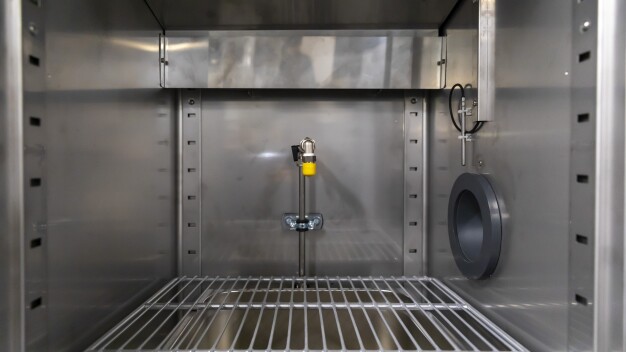
Stainless-steel test space of an environmental test chamber with a sealed lateral port for cables and sensor lines. © FDM Environment Makers
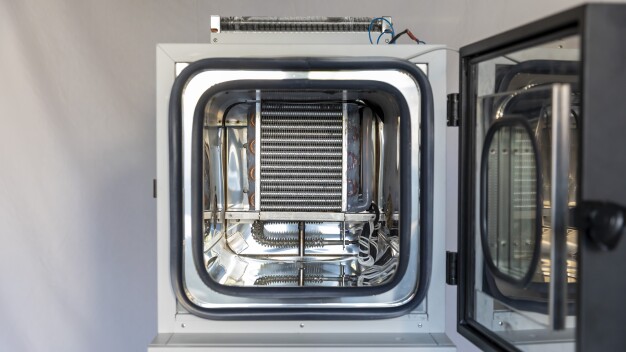
Climatic test chamber with the door open – stainless-steel test space, finned evaporator and heating elements at the back of the chamber. © FDM Environment Makers
Cleanrooms and climatic test chambers are both controlled environments, and both are found in pharmaceutical, electronics and aerospace plants. Yet they answer different questions: one keeps particles away from a product while it is being made, the other pushes a finished product through heat, cold and humidity to see how it behaves. Knowing which is which matters most where the two have to work together.
Two controlled environments, two different questions
A cleanroom and a climatic test chamber share a vocabulary: setpoints, monitoring, qualification, alarms. The overlap is real, but the purpose is not. A cleanroom protects the product from its surroundings during manufacturing. A climatic test chamber deliberately exposes the product to defined environmental stress so that its behaviour can be measured and documented.
The difference shows in the standards that govern each discipline, in the stage of the product life cycle where each is used, and in the design compromises that appear when the two are combined in one installation.
What a cleanroom controls
The reference for cleanroom classification is ISO 14644-1, which defines air cleanliness classes from ISO 1 to ISO 9 according to the maximum number of airborne particles per cubic metre for given particle sizes. As an example, an ISO 5 cleanroom allows no more than 3,520 particles of 0.5 µm or larger per cubic metre of air. ISO 14644-2 covers the monitoring that provides evidence that the room keeps its class in operation, while ISO 14698 deals with biocontamination control. In German-speaking countries the VDI 2083 series is a widely used technical reference alongside the ISO standards.
A key operating principle is the pressure cascade: rooms with a higher cleanliness level are kept at positive pressure relative to less clean areas, so that air flows from the clean side towards the less clean side. Differential pressures in the order of 5 to 15 Pa between adjacent classes are typical. Where operators must be protected from the product, for instance with highly potent or pathogenic material, the cascade is reversed and the handling area is kept at negative pressure.
Cleanroom testing is therefore about the environment itself: particle counts, pressure differentials, air change rates and contamination control. Temperature and humidity are kept stable for comfort and process reasons, but they are not the variable under study.
What a climatic test chamber controls
Climatic testing works the other way round. The chamber is a tool to generate controlled stress, and the specimen is what is being evaluated. In electronics and many industrial sectors the reference is the IEC 60068 series, "Environmental testing", adopted in Europe as EN 60068. Its Part 2 describes individual test procedures, each identified by a letter and a number.
Among the climatic tests most often requested are IEC 60068-2-1 (test A, cold), IEC 60068-2-2 (test B, dry heat), IEC 60068-2-14 (test N, change of temperature) and IEC 60068-2-30 (test Db, damp heat, cyclic). Change of temperature can be performed by moving the specimen rapidly between two zones held at different temperatures (method Na) or by ramping the temperature at a controlled rate inside a single chamber (method Nb). Cyclic damp heat alternates warm and cooler phases at high relative humidity, so that condensation forms on the specimen and is reabsorbed, cycle after cycle.
Other sectors use their own references built on the same principles. In semiconductor qualification, for example, JEDEC JESD22-A101 describes a steady-state temperature-humidity bias life test at 85 °C and 85 % relative humidity, run for hundreds or thousands of hours. In pharmaceutical stability testing, ICH Q1A(R2) defines storage conditions such as 25 °C/60 % RH (long term), 30 °C/65 % RH (intermediate) and 40 °C/75 % RH (accelerated).
In all these cases the quantities that matter are temperature and humidity accuracy, uniformity across the working volume, rate of change and long-term stability, not the particle count of the air inside the chamber.
Production stage versus qualification stage
The two disciplines also sit at different points of the product life cycle. Cleanroom conditions are required while the product is being made: sterile drug filling, microchip fabrication, assembly of optical or aerospace components. Climatic tests usually come later, when prototypes or production samples are qualified against the conditions they will meet in storage, transport and use.
In practice this means that the same company may run a cleanroom in production and a set of climatic chambers in its quality or reliability laboratory, with separate qualification documents, separate monitoring systems and separate teams.
Where the two meet
The separation breaks down in a number of applications where the product must be stressed without being contaminated.
In the pharmaceutical industry, stability chambers running ICH conditions are installed inside classified areas when sterile formulations or cell-based products are studied, and the chambers are qualified (IQ/OQ/PQ) as part of the same GMP framework as the surrounding rooms. In semiconductor reliability testing, temperature cycling and humidity tests may be carried out in a clean environment so that particles do not reach the devices when the chamber door is opened. In aerospace, components such as satellite parts are thermally cycled under vacuum in clean conditions, because contamination picked up during qualification can compromise the flight hardware.
Design challenges of combined installations
When a climatic test has to coexist with cleanroom requirements, several design points need attention:
– Materials: internal surfaces must not release particles under repeated thermal cycling. Electropolished AISI 316L stainless steel is a common choice; plastics and coatings that shed or outgas are avoided.
– Air handling: HEPA or ULPA filtration must continue to work while the chamber runs temperature ramps, and the climatic control must not disturb the airflow pattern that the cleanroom class depends on.
– Feedthroughs: cables and sensor lines that enter the chamber need sealed passages, both to protect the climatic conditions and to avoid creating a contamination path.
– Cleaning: validated cleaning procedures are needed after each test campaign, so that the installation returns to its classified state before the next use.
Each of these points adds engineering effort and cost compared with two separate installations. The decision to combine them is justified only when the product genuinely cannot leave the clean environment between manufacturing and testing.
Conclusion
Cleanroom testing asks whether the environment is clean enough for the product. Climatic testing asks whether the product is robust enough for its environment. Keeping the two questions distinct helps laboratories choose the right standards, the right equipment and the right qualification approach, and makes it easier to see when a combined solution is really needed.
Infobox: standards mentioned
– ISO 14644-1 – Cleanrooms and associated controlled environments: classification of air cleanliness by particle concentration
– ISO 14644-2 – Monitoring to provide evidence of cleanroom performance related to air cleanliness
– ISO 14698 – Cleanrooms and associated controlled environments: biocontamination control
– VDI 2083 – Cleanroom technology
– IEC 60068 series (EN 60068) – Environmental testing
– JEDEC JESD22-A101 – Steady-state temperature-humidity bias life test
– ICH Q1A(R2) – Stability testing of new drug substances and products
FDM Environment Makers
00071 Pomezia, Rome
Italy