

- Translated with AI
Cleaning – a quality-critical factor in the manufacturing process
Process safety and cost-effectiveness through optimal cleaning solutions
parts2clean provides an overview and informs about trends
On the one hand, product function and safety can be impaired by residual dirt. On the other hand, subsequent processes in the manufacturing chain, such as coating, bonding, welding, curing, measuring, testing, and assembly, require a defined clean surface. This raises the question of which procedures, media, and measures can reliably and economically achieve, demonstrate, and maintain the required cleaning quality. Solutions for this will be presented at parts2clean from June 24 to 26, 2014, in Stuttgart. "As an international leading trade fair, parts2clean offers a comprehensive range, including cleanliness control, corrosion protection, preservation, and packaging," explains Olaf Daebler, Managing Director of parts2clean.
Batch process or individual part cleaning
Whether injection nozzle, implant, cylinder crankcase, turbine, microcomponent, or electronic component – manufacturing companies today must meet significantly increased requirements for component cleanliness. There is no one-size-fits-all solution for achieving defined residual dirt specifications on component surfaces. Depending on the manufacturing stage, cleaning tasks range from coarse to intermediate to fine cleaning and require an individually tailored solution. Key factors include the material or material combination, contamination, the geometry of the component, cleanliness requirements regarding particulate and film contaminants, and production throughput. This makes it possible to select the optimal solution from the multitude of available procedures based on cleanliness technology and economic considerations.
For example, this can be a wet chemical cleaning in immersion, ultrasonic, or spray processes with an aqueous cleaner or solvent. Batch processes, in which parts are cleaned as bulk or set items, offer the advantage of high throughput in a relatively short time – and thus a low cost share of the total production costs of a workpiece. They are also often used as decentralized solutions for intermediate cleaning, for example immediately after a machining process. This prevents, among other things, mixing different processing media, which can increase cleaning effort.
Cleaning technologies such as high-pressure water jetting and dry processes, including CO2, dry ice, plasma, blasting, and vibration cleaning, are frequently used for individual part cleaning. Depending on the process, they enable targeted treatment of channels, holes, and functional surfaces and generally offer a high degree of automation, which simplifies production-integrated cleaning. In some cases, a combination of different cleaning technologies can be advantageous, especially when functional surfaces need a higher level of cleanliness for a subsequent manufacturing step than the rest of the workpiece.
Cleaning container and preparation
An often underestimated influence on the quality and costs of the cleaning process is the container used and media preparation. Effective filtration and separation systems, such as oil separators, particulate filters, membrane filters, water treatment, and in the case of solvents, distillation performance, help extend bath life and reduce disposal costs. For aqueous media, continuous monitoring of the concentration of cleaning components ensures that a bath change is not performed prematurely for safety reasons, or only when insufficient component cleanliness causes problems in subsequent processes. Consistent bath monitoring thus also contributes to optimizing process safety and cost-efficiency.
Expertise in parts and surface cleaning – bilingual technical forum
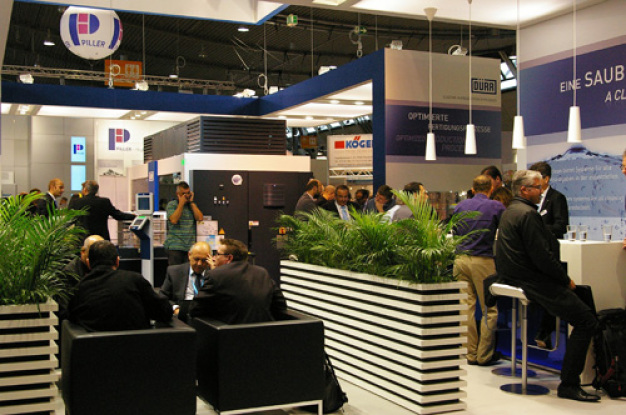
As the only trade fair worldwide with an exclusive focus on industrial parts and surface cleaning, parts2clean offers extensive know-how through its three-day technical forum. Presentations on various topics related to industrial parts and surface cleaning are translated simultaneously (German-English/English-German).
Parallel to parts2clean, from June 24 to 26, 2014, the O&S, an international trade fair for surfaces and coatings, the LASYS, an international trade fair for laser material processing, and the AUTOMOTIVE Expo will be held at the Stuttgart exhibition grounds.
Deutsche Messe AG
30521 Hannover
Germany