



- Modular rooms, Cabins
- Translated with AI
Circular construction in cleanrooms
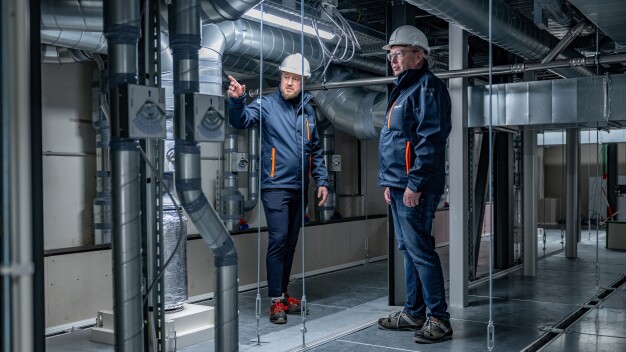
Wherever you look in the industry: circularity is on the agenda. Also in the world of cleanrooms and controlled environments. But it works a bit differently here. The requirements are stricter, the margins smaller, and the process leaves little room for experimentation. Kuijpers has specialized in finding circular solutions that work well in these demanding environments over the past few years.
In a cleanroom, every detail counts. Materials must not emit particles, surfaces must be completely smooth, and the systems must operate flawlessly. The quality of the product produced there always takes precedence. This is not a trade-off, but a strict boundary condition. Therefore, circularity must conform to this framework and is not simply a matter of replacing or reusing, but of smartly seeking solutions that fit the process requirements.
Start with the process, not the material
The greatest circular progress rarely comes from different materials, but from conversations right at the beginning. What is really needed? What does the process look like? And what requirements does this place on the space? In practice, it turns out that cleanrooms are sometimes designed more elaborately than necessary. A higher ISO class (the lower the number, the cleaner the air and the cleanroom) requires more system technology, more energy, and more material. Often, a smarter room layout or better process alignment yields the same result.
When the process is taken as the starting point and the cleanroom is adapted accordingly, a solution is created that fits exactly. Not larger or more complex than necessary, but aligned with what is truly needed. This approach directly delivers sustainable added value without compromising quality. Additionally, it contributes to a high degree of circularity because unnecessary complexity can already be avoided during the design phase.
A concrete example
Initially, a customer considered conducting part of the process in a biological safety cabinet. After several discussions, it turned out that a closed isolator was the better choice. Since the process now took place in a closed system, the space no longer had to meet the stricter requirements of a GMP-B environment – a GMP-C classification was sufficient. This immediately reduced the required number of air changes and the size of the adjacent personnel and material pass-throughs. As a result, less construction was needed, leading to lower costs and simpler installation.
What is all possible
Although circular solutions in the cleanroom are limited, fortunately, there are increasingly more options to implement circular steps. These mainly lie in system technology and design approach. For example, air ducts and piping can be easily reused with proper maintenance. Kuijpers already considers this in design – for instance, by choosing as round ducts as possible, because they are easier to dismantle and better to reuse than rectangular ducts.
Revising systems is also becoming more common. Instead of replacing an entire air treatment unit, it can be refurbished and reused. This extends the lifespan and prevents well-functioning components from being unnecessarily written off.
Another practical example is lighting. Light fixtures (the housing that contains the lamp) often last longer than the technology inside. By replacing only the internal components or the light source, a fixture can be reused without replacing the entire system. A small intervention with a clear impact.
Designing with a view to the future
In addition to reuse, the focus in controlled environments is also shifting towards how cleanrooms are constructed. Modular design is playing an increasingly important role. Think of a cleanroom with demountable walls that can be reinstalled elsewhere. Or systems that are positioned so they can be easily relocated. However, this requires a different perspective on costs. A wall that costs more initially but has residual value costs less in the long run than a cheaper wall that is dismantled after use.
Working together on a circular chain
Circularity in the cleanroom requires collaboration among all parties involved: from the client to the planner, installer, and supplier. Our strength lies especially in connecting these parties and translating ambitions into practical possibilities. By combining process knowledge, technology, and execution, space is created for responsible decisions.
It all begins with a conversation
There is no standard recipe for a circular cleanroom. However, what always works is the initial conversation: about the process, the requirements, and the possibilities. Feel free to contact us to explore which circular strategic decisions are possible for your controlled environment, via Roy Timmers, Engineer Controlled Environments: rtimmers@kuijpers.com.

Kuijpers Controlled Environments GmbH
Siemensstraße 31
47533 Kleve
Germany
Phone: +49 172 1560362
email: deutschland@kuijpers.com
Internet: https://www.kuijpers.com/de/



