




- Translated with AI
Avoid animal testing in research
Scientists at TU Berlin win the State Award
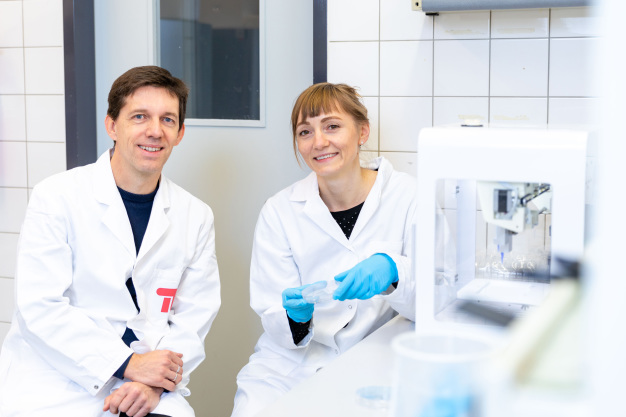
(© TU Berlin/PR/Felix Noak)
Every year, in Germany alone, 200,000 test animals are used for the research of infectious diseases. These experiments are not only highly stressful for the animals but are often only very limitedly translatable to humans. Researchers at TU Berlin have been working intensively for years to develop three-dimensional organ models that can be infected with human-pathogenic viruses. For this work, today Prof. Dr. Jens Kurreck, Professor of Biotechnology at TU Berlin, together with his colleague Dr. Johanna Berg, was awarded the Berlin State Prize for the Promotion of Research on Replacement and Supplementary Methods for Animal Testing at the Red Town Hall. This prize is jointly awarded by the Senate Department for Justice, Consumer Protection, and Anti-Discrimination, the State Office for Health and Social Affairs, and the Association of Research-Based Pharmaceutical Companies. The prize, endowed with 40,000 euros, was shared equally in 2019 between a project at TU Berlin and a project at Charité – Universitätsmedizin Berlin.
"We have created and precisely characterized three-dimensional organ models for the lungs and liver using bioprinting methods," says Johanna Berg. Subsequently, the lung model was infected, among other things, with Influenza A viruses ("flu viruses"). "We were able to demonstrate that the virus spreads in the 3D model and also triggers an immune response of the cells. According to our research, there have been no publications so far reporting that it has been possible to infect a printed model with viruses," explains Jens Kurreck.
However, for the professor, research is not the only focus but also education: "We are convinced that it is important to instill the idea of animal protection in the next generation of scientists. Therefore, replacement methods for animal testing hold great importance in our teaching. In addition to a practical course on 3D bioprinting of organ models, we discuss animal ethics in seminars; we have also practically and theoretically introduced bioprinting methods to doctoral students at graduate schools. Berlin is now a central location for the development of alternative methods to animal testing."
The scientists believe that after this "proof of principle," the model can be used to develop new antiviral substances. "Our approach has two main advantages over the traditional method (cell culture and animal testing): Human-pathogenic influenza viruses do not or only poorly multiply in animal models, so the relevance of animal models is extremely limited. We work with human cells in our 3D printing process and hope to better represent humans while also reducing animal testing," describes Jens Kurreck. With the prize money, the researchers want to further develop the lung model. So far, it consists of only one cell type, called epithelial cells. "In our current work, which can be intensified with the prize money, we will print a three-dimensional base of fibroblasts, on which a layer of epithelial cells will be cultivated and infected by the virus. Additionally, immune cells will be implemented, which will make the model significantly more informative, as immune cells are extremely important for studying the course of an infection. The closer the printed organ is to the biological organ, the more scientists will use it," explains Johanna Berg.
Technische Universität Berlin
10587 Berlin
Germany