

- Automation
- Translated with AI
Automation technology relieves hospital doctors
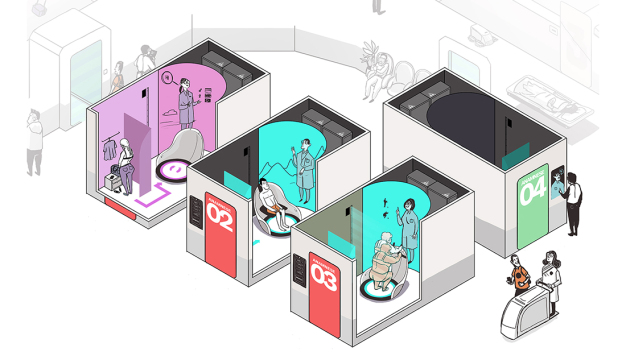
TEDIAS, the Test and Development Center for Digital Medical History Systems. © Fraunhofer IPA, Sascha May
How can medical staff in hospitals be relieved through digitalization while simultaneously placing the patient more firmly at the center of processes? Researchers at the Fraunhofer IPA are investigating how routine tasks in everyday clinical practice can be digitized and automated. In cooperation with the University Medical Center Mannheim and the Medical Faculty, they are now implementing an initial system for medical history taking and vital data collection, where the immediate presence of medical personnel will no longer be necessary.
Where can medical care in hospitals be improved through digitalization? "The medical patient admission process is the most suitable starting point among many possible entry points," reports Dr. Jens Langejürgen, Head of the Department for Clinical Health Technologies at Fraunhofer IPA and TEDIAS project leader. "Many follow-up processes rely on the information collected here, so a consistent and sustainable relief of hospital staff must begin there. We have examined the process very closely and found many routine tasks – for example, in recording basic medical data and measuring vital functions of patients – that can be made more efficient and better: For instance, we can reduce waiting times for patients, collect data completely, and at the same time relieve medical staff."
Together with the doctors at the University Medical Center Mannheim, Langejürgen's team is now developing and testing automated systems to make these processes more efficient: the Test and Development Center for Digital Patient Admission Systems, abbreviated TEDIAS. The goal of the project is to digitize patient admission as the first step to create a foundation for the digital hospital of the future.
Contactless Examination
With TEDIAS, routine processes involved in medical admission to a hospital will now be automated for the first time, potentially allowing them to be carried out without medical personnel in the future. Because the patient is more actively involved in the actual admission process, they can also be better informed. The centerpiece of the new system will be a sophisticated sensor technology combined with an avatar for patient questioning. Planned features include integrated IR cameras for measuring body temperature, sensors for determining heart and respiratory rates, microphones for recording breathing sounds or the patient's voice. All these measurements are non-intrusive for those affected, as they are contactless or require everyday actions such as sitting down on a chair. "Ideally, the patient won't notice much of it because they are simultaneously answering questions from a virtual doctor about their medical history and symptoms," explains Langejürgen.
The data analysis takes only seconds. The results of the digital initial examination can be directly displayed on the monitor for the doctor, who will see the patient shortly afterward. For this, the system must be connected to the hospital's existing systems. The time previously required for routine initial examinations is now available for longer doctor-patient conversations. If the results indicate a relevant infection, staff can also take protective measures before any infection occurs in the treatment room.
Faster Data Collection, Analysis, and Evaluation
At the University Medical Center Mannheim, the first real-world laboratory for testing the new technology is scheduled to go into operation next year. The first two rooms for digital patient admission and initial examination will be set up in the coming months: one in the neurological emergency department, where waiting times are to be shortened through preliminary examinations and questioning. The second admission room will be in internal medicine, where an initial examination is conducted for patients coming to the hospital for inpatient investigations or treatment.
"The real-world laboratory gives us the opportunity to test various existing or newer technologies under realistic conditions and to explore how patients interact with the system. Besides doctors and nursing staff, their acceptance is ultimately decisive for the use of such a system in the clinic," emphasizes Langejürgen.
The automated initial examination is only the beginning of a long-term development for the physicist who holds a doctorate in electrical engineering: "In the TEDIAS project, we are creating a foundation upon which we can build and gradually develop a digital hospital. This ensures that all relevant information is available to doctors and nursing staff from the outset. The consistency of the data and the consistently high quality also help to recognize disease progressions early and respond accordingly," predicts Langejürgen. "These data also form the basis for training algorithms with the potential to significantly improve patient care."

Fraunhofer-Institut für Produktionstechnik und Automatisierung IPA
Nobelstraße 12
70569 Stuttgart
Germany
Phone: +49 711 970 1667
email: joerg-dieter.walz@ipa.fraunhofer.de
Internet: http://www.ipa.fraunhofer.de