


- Automation
- Translated with AI
Automation against cost pressure – a user report
The mk Technology Group and Automations Robotic implement an automatic inspection system for the pharmaceutical industry
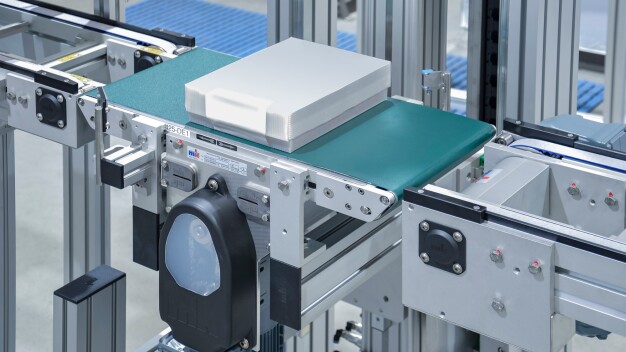
The belt guides of the lift systems are equipped with a knife edge to keep the transition to the connected conveyor line as small as possible, thereby ensuring a secure transfer of the trays. (Copyright: mk Technology Group)
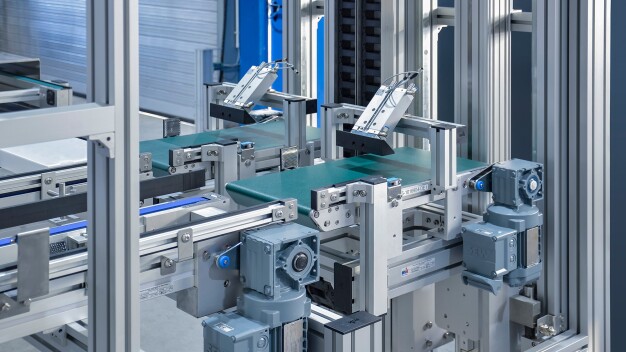
Two parallel lift systems with belt conveyors GUF-P 2000 transfer the trays to two chain conveyors ZRF-P 2045, which are mounted at a height of 2.60 m hanging from the ceiling. (Copyright: mk Technology Group)
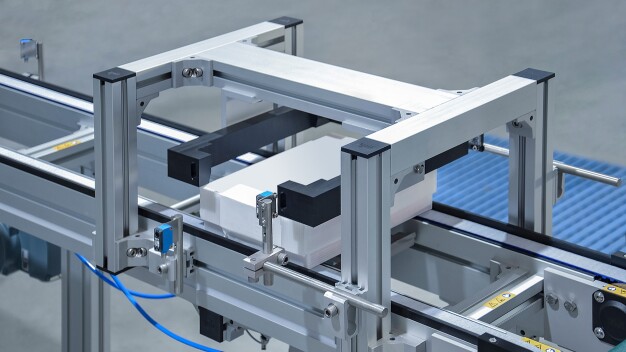
In a custom-made centering unit, the trays are pneumatically lifted into a mask and fixed in place so that the sealing labels can be applied and the barcode verified by a vision system. (Copyright: mk Technology Group)
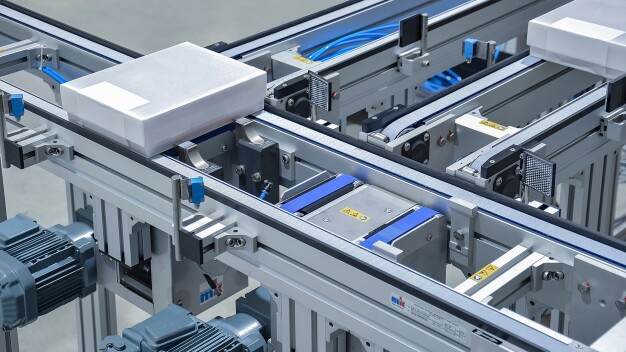
The filled and closed trays are discharged at the end of the inspection via belt conveyors ZRF-P 2045 for manual product removal from the system. Faulty trays are forwarded to a reject line. (Copyright: mk Technology Group)
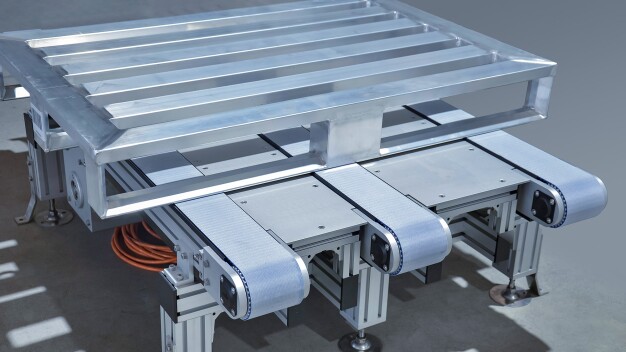
A three-strand timing belt conveyor ZRF-P 2040 with a total load of 600 kg transports the trays onto Euro pallets to the depalletizing station. (Copyright: mk Technology Group)
Rising costs and tightened regulations are increasingly burdening the pharmaceutical industry as well, leading to a significant increase in demand for automation solutions. mk and Automation Robotic respond to this with a new fully automated inspection system for cylindrical ampoules containing liquid pharmaceuticals.
Like many other industries, the pharmaceutical sector is facing rising costs for energy and raw materials, as well as stricter regulations, says Andreas Klihm, Technical Sales at mk in Troisdorf: "To manage the increased costs, more and more companies are trying to offset some of the additional expenses through increased automation in production. mk develops suitable solutions together with system integrators worldwide." One current project is an automation solution for quality control of cylindrical ampoules with liquid pharmaceuticals, implemented by mk in collaboration with Automation Robotic GmbH from Massing, Bavaria. "This system is the first of its kind to open and empty flexible plastic trays filled with cylindrical ampoules at the inlet of a downstream machine," says Andreas Schäffler, Sales at Automation Robotic. "At the outlet, the trays are then refilled and sealed again – all at an impressive speed of 600 ampoules per minute."
And here’s how the fully automated inspection line works: At the beginning of the line, aluminum Euro pallets loaded with plastic trays are positioned. Each tray contains 330 cylindrical ampoules. A forklift or optionally a driverless transport system (FTS) places the pallets onto an mk ZRF-P 2040 three-strand timing belt conveyor. This conveyor features three parallel, 110 mm wide timing belts that can be loaded stably and evenly with weights of up to 600 kg. "Although the conveyor itself does not have direct contact with the ampoules and only moves the secondary packaging, we placed great emphasis on a hygienic design of the system," explains Klihm. Therefore, the engineers used FDA-compliant timing belts and slide strips made of polyoxymethylene (POM), anodized aluminum parts and fasteners, and all steel parts are made of stainless steel. Additionally, the drives are mounted below or beside the conveyor to prevent particles from falling onto the trays.
Traditional conveyor technology works together with modern robots
The three-strand timing belt conveyor transports the Euro pallets to a depalletizing station. Klihm explains that the initial position of the trays no longer needs to be as precisely defined as before. "Modern robots, thanks to sophisticated vision systems, can now recognize and precisely pick up chaotically arranged objects in containers. This means that the conveyor system no longer needs to work with millimeter accuracy during positioning, which provides significant technical relief and cost savings." During depalletizing, a robot uses a suction gripper to remove individual trays and places them in the first processing station. Here, the tray label is automatically cut open and the lid removed. Another robot takes the opened tray with its gripper, transports it to the downstream inspection machine, and empties the tray, pushing the ampoules in a cluster onto the inspection machine's feed belt. In the testing unit, the ampoules are automatically checked for integrity, material defects, and particulate contamination.
The next task of the system is to transport the empty trays to the end of the testing line and reload them with ampoules. To save space on the floor for floor conveyors, the engineers opted for a two-strand, approximately 14-meter-long conveyor route suspended 2.6 meters from the ceiling, running parallel to the inspection machine. The operation is as follows: a robot with a double gripper transfers the lids and bases of the trays to one of two lift systems with GUF-P 2000 belt conveyors. Once at an elevated level, the tray components are moved again on ZRF-P 2045 timing belt conveyors. At the end of the route, these are transferred via two additional lifts onto a worktable, where they are again picked up by a robot and fed into the next processing steps – filling the trays with inspected ampoules and sealing them with a lid. Excess trays, for ampoules that have been rejected due to quality issues, are conveyed by the lift via a pneumatically operated end stop into a chute leading to a waste container.
The labeling of the trays takes place in the next step. The packages are moved via another approximately ten-meter-long conveyor under the ceiling to a specially manufactured centering unit by mk. This pneumatically liftable unit uses a mask to fix the sides and the lid of the package. Afterwards, the sealing labels are applied, and the barcode is verified by a vision system. At another station, it is checked whether the seal has been correctly applied and the tray properly closed. Then, the tray continues its journey via the ZRF-P 2045. Through a corner gear, it reaches manual product removal, while defective packages are directed to a reject line.
mk Technology Group
53844 Troisdorf
Germany