


- R+D & Community of Interest
- Translated with AI
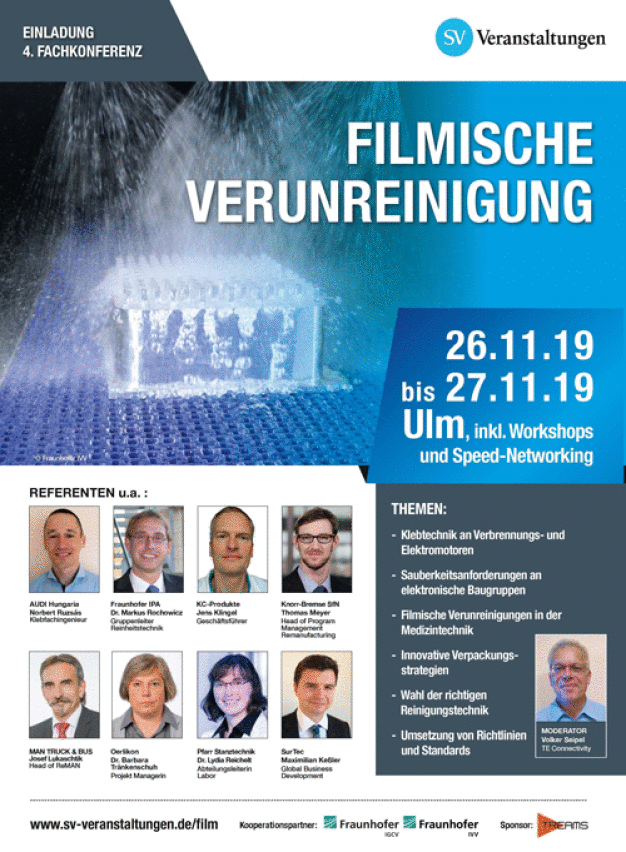
4. Specialist Conference: Cinematic Pollution
November 26th to 27th, 2019 at Maritim Hotel Ulm including workshops and speed networking
Gerhard Koblenzer, Managing Partner of LPW Reinigungssysteme GmbH

Pierre Lorenz, Technical Service Manager (flexible & rigid) Europe RESINEX Germany GmbH
Dr. Markus Rochowicz, Group Leader for Purity Technology Fraunhofer IPA
Dr. Barbara Tränkenschuh, Project Manager at Oerlikon Balzers Coating Germany GmbH
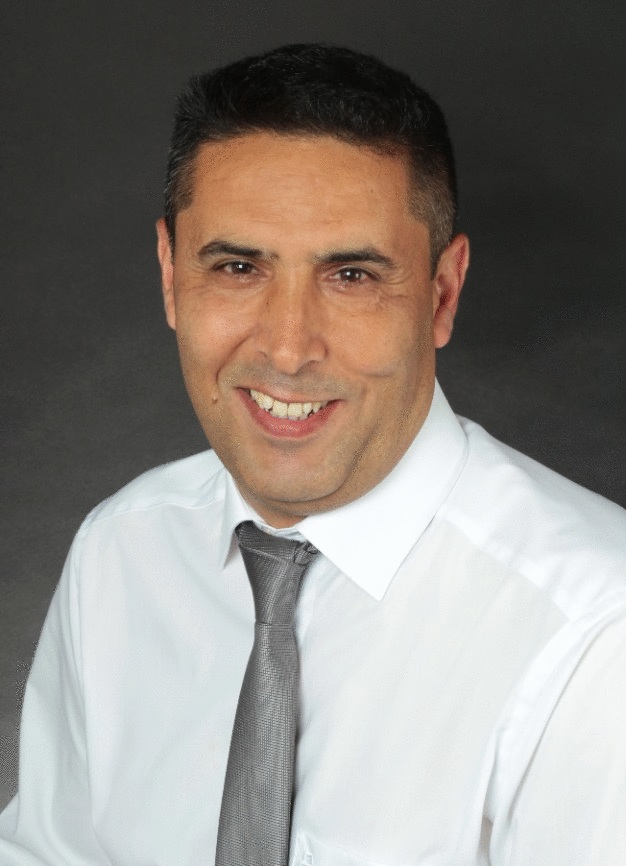
Yunus Demirtas, Head of R&D, Ecoclean GmbH
E-Mobility, Bonding, Electronics – more and more companies are dealing with technical cleanliness and filmic contamination.
At the 4th specialist conference in Ulm, experts will report among other things on:
- Bonding technology on electric motors
- Requirements for electronic assemblies
- Experiences from medical technology
- Innovative packaging strategies
- Choice of the right cleaning technology
- Implementation of guidelines and standards
Participants can gather interesting information and impulses from 15 technical presentations. Valuable contacts can also be made during the workshops. Here, you can discuss your current questions and challenges in a small group and work out answers and solutions together.
Workshop topics:
- How do I avoid filmic contamination?
- How do I analyze filmic contamination?
- How do I clean properly and effectively?
- How do I sensitize my employees?
- Which costs can be minimized and how?
Expert interviews on the specialist conference
Gerhard Koblenzer
Managing Partner
LPW Cleaning Systems GmbH
What will be your topic at this year's specialist conference?
Eliminating filmic contamination is not a new task in itself. However, the requirements for technical cleanliness have changed significantly in recent years, both for filmic and particulate, especially fine particulate, contamination. It is no longer just the classic high-purity industries (e.g., semiconductor, electronics, medical technology), but also industries like automotive, which are increasingly facing challenges in this segment. As LPW, we want to focus on the challenges in cleaning technology itself and in process management, e.g., in contract cleaning, and present our solution approaches as well as discuss our various development projects with industry experts.
Where do you currently see the biggest challenges with filmic contamination?
From our perspective, one of the biggest challenges is that the required component cleanliness can often only be achieved if process cleanliness in the entire process chain receives the same attention. This creates completely new and unfamiliar tasks for process planning, process control, and also for the design of plant technology. The 'mindset' of all involved must be adapted to this challenge. It is tough and requires a lot of convincing work.
Are there already solutions or ideas for solutions?
A variety of solution approaches are currently emerging. New cleaning and drying processes as well as the associated media preparation systems are establishing themselves on the market. Practical support is currently being developed, for example, by the technical committees of FiT, and coordinated with experts. Approaches for process traceability, combined with suitable analytical support and effective process monitoring, are close to market maturity and enable entirely new approaches in plant construction, manufacturing planning, and also in high-quality contract cleaning in this field.
Pierre Lorenz
Technical Service Manager (flexible & rigid) Europe
RESINEX Germany GmbH
What will be your topic at this year's specialist conference?
Product protection through the right choice of films, with a focus on industry applications such as shipping metals overseas. Also, protecting our food products and ideas that meet the requirements of the new packaging regulation.
Where do you currently see the biggest challenges with filmic contamination?
Finding the right dosages and settings for the multitude of applications and external conditions.
Are there already solutions or ideas for solutions?
Of course, but also dependent on the application, such as barriers in food packaging.
Dr. Markus Rochowicz
Group Leader Cleanliness Technology
Fraunhofer IPA
What will be your topic at this year's specialist conference?
We will present a new testing method, the so-called AdhäSa analysis kit, which was developed and extensively tested within an industrial consortium. It allows for quick testing of filmic/chemical residues on components within minutes, and the result is directly available as contamination mass/component surface.
Where do you currently see the biggest challenges with filmic contamination?
The topic of 'process monitoring' and 'root cause analysis' using laboratory analytical methods is already well covered today. What is missing is a simple, robust, and cost-effective method for 'testing cleanliness specifications in customer-supplier relationships.'
Are there already solutions or ideas for solutions?
The presented testing method can fill this gap and will become an important part of quality assurance regarding filmic/chemical contamination in the future.
Dr. Barbara Tränkenschuh
Project Manager
Oerlikon Balzers Coating Germany GmbH
What will be your topic at this year's specialist conference?
The main topic will be the coating ability of a component surface from a chemical perspective. It will examine which contaminants can be removed by cleaning and which must be removed. This will be illustrated with two examples dealing with filmic contamination.
Where do you currently see the biggest challenges with filmic contamination?
The biggest challenge is the detectability of filmic contamination. If only parts of the component surface are affected, the problem can be relatively easily recognized by a change in light diffraction during visual inspection. If the entire surface is affected, there is a systematic problem. This is considered at Oerlikon within the framework of project management at the beginning of a new project, examining the entire manufacturing chain from raw part production to coating.
Are there already solutions or ideas for solutions?
Depending on the chemical nature of the filmic contamination, it can be detected, for example, by measuring surface tension or fluorescence measurement.
Yunus Demirtas
Head of R&D
Ecoclean GmbH
What will be your topic at this year's specialist conference?
I will present a new approach for process-safe achievement of filmic cleanliness and demonstrate its application possibilities with examples.
Where do you currently see the biggest challenges with filmic contamination?
The topic 'filmic contamination' has only come into focus in the industry in recent years. I think that in some areas, awareness of this issue is still lacking, and the available knowledge still needs to be internalized. For many applications, the adapted cleaning techniques, evaluation criteria, and reliable, manageable measurement technology for quality control of filmic cleanliness, for example after cleaning, are still missing.
Are there already solutions or ideas for solutions?
Yes, there are many ideas and approaches. However, I believe that much will still change in the coming years. A good basis has been created by the FiT guideline 'Controlling Filmic Contamination.' Currently, equipment manufacturers are working on adapting their cleaning systems and processes or developing new solutions. Also, increasingly, measurement systems based on well-known physical measurement principles, such as various handheld devices for measuring or evaluating filmic cleanliness, are being offered.
Simone Frick
Independent Consultant
seals’n’finishing
What will be your topic at this year's specialist conference?
At the conference in Ulm, I will present the work of the VDMA working group LABS, in which I am actively involved. We, experts from industry, mostly suppliers of paint processing companies but also representatives of the automotive industry, deal with the topic of cleanliness for supplier products in paint processing. While it is not exclusively about filmic contamination, but also particles, filmic contamination is a major topic. In recent years, we have established a specification, the VDMA standard sheet 24364, which defines general tests for substances that interfere with paint adhesion, depending on the intended use of the products. These tests make it possible to practically address the large and virtually unbounded group of substances with potential for damage and demonstrate their harmful effects.
Where do you currently see the biggest challenges with filmic contamination?
One of the major challenges, in my opinion, is still the qualitative and quantitative proof of the relevant substances. There are certainly many analysis methods, but they sometimes have limitations when used with polymer components or cost-effective C-parts. For example, if contamination and component material are chemically of the same origin, exact proof becomes difficult. And for inexpensive C-parts, the use of elaborate analysis methods is often not justified economically.
Are there already solutions or ideas for solutions?
I believe that with the VDMA standard sheet 24364 and similar specifications, we already have a good approach, at least in the painting sector. Paint adhesion-disrupting substances cannot be grouped chemically. The sources of contamination with damaging potential are extremely diverse, and creating a comprehensive negative list is impossible. An exact chemical proof of all possible contaminants is therefore excluded. Detection of LABS does not occur through direct chemical identification but practically through their actual damaging effect. The tests defined in the standard sheet can be performed by smaller companies with relatively low effort.

Süddeutscher Verlag Veranstaltungen GmbH
Justus-von-Liebig-Straße 1
86899 Landsberg am Lech
Germany
Phone: +49 8191 125181
Mobile radio: +49 173 3753643
email: ingo.martin@sv-veranstaltungen.de
Internet: http://www.sv-veranstaltungen.de