



- Modulare Räume, Kabinen
- Originaltext
Universität Hamburg schickt weltweit einzigartiges Containerlabor nach Indien
Zur Untersuchung historischer Schriftartefakte
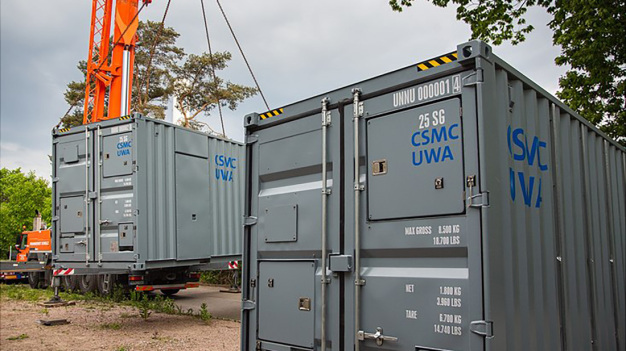
Das Containerlabor besteht aus insgesamt sieben Containern, die viele verschiedene Geräte und Labore beinhalten. Es wurde im Auftrag des Exzellenzclusters „Understanding Written Artefacts“ der Universität Hamburg maßgefertigt. (Foto: UHH/Esfandiari)
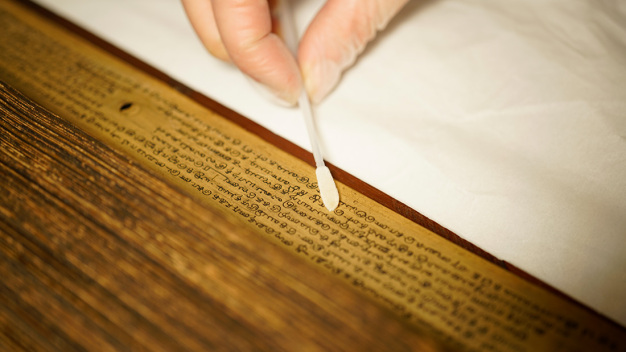
Die Palmblattmanuskripte, die im südindischen Puducherry untersucht werden sollen, gehören wie die Gutenberg-Bibel (um 1455) oder die Magna Charta von 1215 zum Weltdokumentenerbe. (Bild: UHH/K.Helmholz)
Um wertvolle Manuskripte auf der ganzen Welt zu erforschen, hat das Exzellenzcluster „Understanding Written Artefacts“ an der Universität Hamburg ein mobiles Containerlabor entwickelt. Die insgesamt sieben Container werden am 7. April 2024 erstmals ins Ausland geschickt. In Indien sollen in den kommenden anderthalb Jahren mit ihrer Hilfe Palmblattmanuskripte untersucht werden, die zum UNESCO-Weltdokumentenerbe gehören.
Im südindischen Puducherry lagern rund 12.000 unerforschte Palmblattmanuskripte. Sie stammen aus dem späten 18. und 19. Jahrhundert und gehören damit zu den ältesten erhaltenen Manuskripten dieser Art. Für Historikerinnen und Historiker gehören sie zu den wichtigsten Quellen über Religion, Geschichte, Astrologie und Medizin einer rund zweitausend Jahre alten Schriftkultur, die zu den bedeutendsten der Welt gehört.
Weil jedoch die genaue Herkunft der Manuskripte fast immer unbekannt ist, bleiben zahlreiche Fragen offen, beispielsweise zur Verbreitung bestimmter religiöser Kulte. Nun wollen Forschende des Exzellenzclusters „Understanding Written Artefacts“ (UWA) und Wissenschaftlerinnen und Wissenschaftler aus Indien einige dieser Fragen gemeinsam klären: durch materialwissenschaftliche Analysen der Manuskripte in einem weltweit einzigartigen Containerlabor. Es besteht aus insgesamt sieben Containern. Fünf enthalten Laborräume, ein weiterer Stromaggregate und Wasservorräte, ein siebter dient als Lager.
„Die benötigten Geräte stellen wir für diesen wie für jeden neuen Einsatz individuell zusammen“, sagt Prof. Dr. Markus Fischer, Chemiker und Chef des Container-Lab-Projekts an der Universität Hamburg. Fischer war maßgeblich an der Entwicklung des Labors beteiligt, das nach den Vorgaben des Hamburger Exzellenzclusters maßgefertigt wurde. Es ist beispielsweise mit einem Reinraum für molekularbiologische Arbeiten ausgestattet, um die Palmarten, deren Blätter als Schreibmaterial dienten, zu bestimmen. Geschrieben haben die unbekannten Verfasser häufig mit einer Farbe aus Ruß. Identische Rußpartikel oder wiederkehrende DNA-Strukturen bei Palmblättern könnten einen gemeinsamen Ursprung verschiedener Manuskripte belegen.
Einsatz bei Hitze und Dauerregen
Die Bedingungen während der sechswöchigen Seereise und das Klima in Südindien stellen die Forschung vor große Herausforderungen. „Im Sommer liegt die Durchschnittstemperatur dort bei mehr als 30 Grad, im Oktober beginnt der Monsun mit seiner extremen Luftfeuchtigkeit. Wir haben viele Geräte hier in Hamburg auf ihre Robustheit getestet und hoffen nun, dass sie sich vor Ort bewähren“, so Fischer.
Der Forscher wird das Containerlabor für mehrere Wochen begleiten, wie auch zwei Chemikerinnen der Universität Hamburg und der wissenschaftliche Leiter des Projekts, der Indologe Dr. Giovanni Ciotti. „Eine große Herausforderung besteht darin, dass nur nicht- oder minimalinvasive Methoden für die Untersuchung der Manuskripte infrage kommen. Sie gehören zum UNESCO-Weltdokumentenerbe. Da können Sie, salopp gesagt, nicht einfach ein Stückchen abschneiden und unters Mikroskop legen“, sagt Ciotti.
Die Dokumente befinden sich auf dem Gelände des Institut Français und der Ecole francaise d’Extrême-Orient in Puducherry. Sie gehören seit 2005 zum Weltdokumentenerbe – ebenso wie beispielsweise die Gutenberg-Bibel von 1455 oder die Magna Charta von 1215. Die Untersuchung der Palmblattmanuskripte führen die Forschenden des Exzellenzclusters UWA in Zusammenarbeit mit Wissenschaftlerinnen und Wissenschaftlern des Institut Français de Pondichéry (IFP) sowie des National Institute of Advanced Studies (NIAS) in Bangalore durch.
Universität Hamburg
20148 Hamburg
Deutschland