

- ANNEX 1
Ralf Wagner
Annex 1 and fill-and-finish processes: possible solutions and limitations
Examples of sterile manufacturing and glove interventions
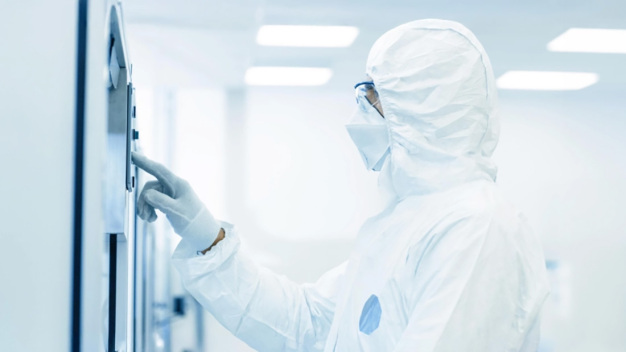
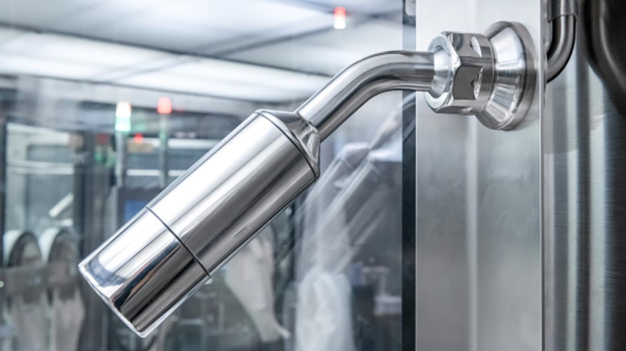
Kamerasysteme mit Ringspeicher zeichnen automatisch auf und speichern, sobald beispielsweise ein Handschuheingriff während der Batch-Verarbeitung erfolgt. Damit lässt sich nachträglich beurteilen und dokumentieren, ob dieser entsprechend den Regularien und von den Pharmazeuten definierten SOP’s (Standard Operating Procedure) durchgeführt wurde. / Camera systems with ring memory automatically record and save as soon as gloves are engaged during batch processing, for example. This makes it possible to assess and document retrospectively whether this was carried out in accordance with the regulations and SOP's (Standard Operating Procedure) defined by the pharmacists.

Strömungssimulationen des Anlagenherstellers geben Aufschluss über potenziell problematische Zonen im Isolator, die dem First-Air-Prinzip des Annex 1 zuwiderlaufen könnten. Noch in der Engineering-Phase werden diese Zonen optimiert. Pharmazeutischen Unternehmen und CDMOs können als Kunde des Anlagenbaus Strömungssimulationen in ihre Contamination Control Strategy (CCS) übernehmen, um die Optimierung einer Anlage zu dokumentieren. / Flow simulations by the system manufacturer provide information about potentially problematic zones in the insulator that could contradict the first-air principle of Annex 1. These zones are still being optimized in the engineering phase. As plant engineering customers, pharmaceutical companies and CDMOs can incorporate flow simulations into their Contamination Control Strategy (CCS) to document the optimization of a plant.
The implementation of EU GMP Annex 1, which sets strict requirements for the production of sterile medicines, presents new challenges for pharmaceutical companies. In the foreseeable future, Ralf Wagner, Sales Director for the DACH region, Portugal and Spain at Optima Pharma, believes that glove interventions – especially in high-speed systems – will most likely not be completely eliminated from the aseptic process.
Camera systems as a supplement for glove interventions in aseptic production systems
Although automation in aseptic production is progressing steadily, glove interventions will probably not be completely avoided in the foreseeable future, especially in high-speed systems. This is where camera systems provide valuable support, as the criticality of a process intervention and its potential impact on pharmaceutical quality can be assessed, evaluated and documented. High-speed cameras continuously record work processes and automatically store relevant sequences, such as when a system is stopped, or gloves are used. In this way, interventions can be analyzed retrospectively and their effects on pharmaceutical requirements and quality specifications can be assessed and documented.
Discussions about the feasibility of Annex 1 requirements
The provisions of Annex 1 continue to be intensively discussed in the industry, as individual requirements require new solutions due to technical or physical conditions or are considered to be incomplete in individual cases. This applies, for example:
– Regulations for which detailed explanations are required in practice for optimal implementation: For example, Annex 1 requires that all parts that come into indirect contact with the product are sterilized, largely pre-assembled and inserted from an aseptic point of view. For this purpose, Optima has developed new handling aids to enable implementation in practice and to take it into account as early as the mock-up phase. Further developments for the automation of the manual process are already being demonstrated and offered in specific customer projects.
– Regulations that are not clearly formulated: One example is the specification for the speed of the unidirectional air flow of 0.36 – 0.54 m/s in the "working position", i.e. at working height. Different definitions of the "working position" can lead to different air velocity results. Project-specific studies and simulations help here to represent the flows of the laminar flow across all plant zones. In this way, the specifications defined in Annex 1 are demonstrated and proven while at the same time minimizing crossflows at object level.
Conclusion: adaptations to individual requirements
Annex 1 gives pharmaceutical companies a certain amount of room for manoeuvre, which they can use as part of a risk-based approach, for example in the context of CCS studies, in order to map and prove their processes in accordance with the rules. Generally valid solutions for implementation and implementation rarely come into play in practice, as they depend on customer and pharmaceutical requirements as well as the engineering and processing process that depends on them.
Operators of new or existing plants must demonstrate compliance with Annex 1 regulations to the authority inspectorate, so that new technical designs are sometimes required. Contract Development and Manufacturing Organizations (CDMOs), which process a variety of different pharmaceuticals, rely on maximum flexibility. To this end, pharmaceutical manufacturers of selected products attach particular importance to the compatibility of new technologies.
OPTIMA packaging group GmbH
74523 Schwäbisch Hall
Germany