


- R+D & Community of Interest
- Translated with AI
When technology and biology merge
Fraunhofer capsule for biological transformation published
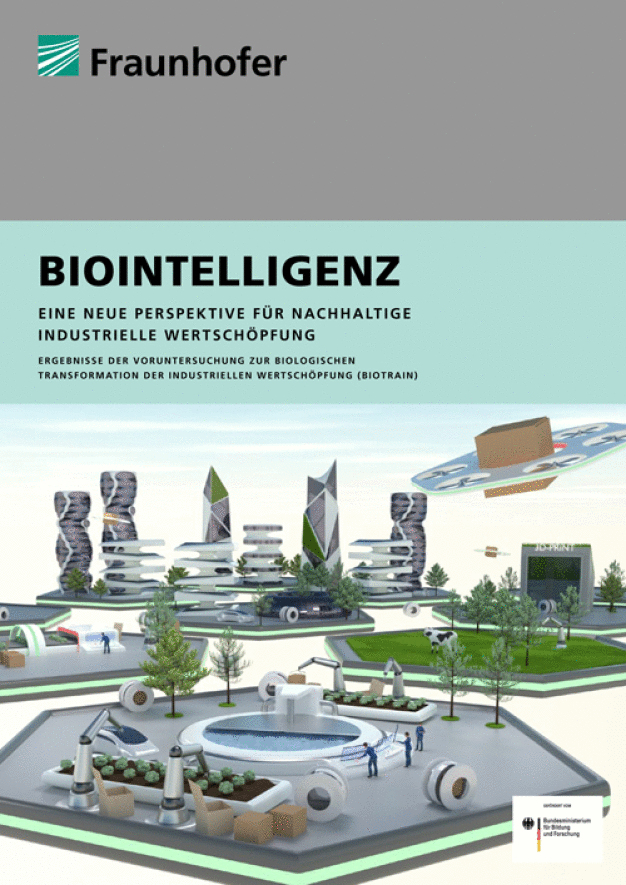
The so-called Biological Transformation of industrial value creation — convinced by many scientists at the Fraunhofer Society — could revolutionize the entire industry and society in the coming decades. What the framework conditions, opportunities, and milestones are on this path has been examined and now published by six Fraunhofer institutes in recent months.
Robots whose control modules generate their energy through photosynthesis, fermenters that produce medicines from food scraps, or kitchen cabinets in which ingredients for entire meals grow within a few days — the Biological Transformation aims to make this possible. It also conserves energy and water and avoids harmful fertilizers.
Added value of Biointelligence
This reorientation of industrial value creation means increasingly utilizing materials, structures, processes, and organisms from living nature in technology. Such systematic application of knowledge about biological processes leads to the merging of production, information, and biotechnology more and more. This can profoundly change future products, manufacturing processes, and our overall way of life — for the benefit of people and especially the environment.
Currently, the term sustainability is mostly associated with economic losses and restrictions. The Biological Transformation aims to address exactly this and make sustainability economically attractive through new concepts and innovations. It results in so-called biointelligent systems and the necessary technologies, whose potential is diverse — from disruptive innovations to modernizing German corporate and educational culture to a sustainable economic approach.
"The digital transformation of production is already well advanced under the slogan Industry 4.0. But it is increasingly clear that this alone is not enough to master society’s essential challenges. Alongside digital transformation, a new revolution is emerging with biological transformation. It is at least of equal, if not greater, importance than Industry 4.0," says Professor Thomas Bauernhansl, head of the Fraunhofer IPA and one of the authors of the preliminary study.
Recommendations for companies
BIOTRAIN is a preliminary study funded by the Federal Ministry of Education and Research (BMBF) and supervised by the project sponsor Karlsruhe PTKA. The analysis of the current status documented therein shows that German companies are not yet leading but are in a promising position in many relevant areas of Biological Transformation, such as biotechnology and information technology, if the right measures are quickly taken. But what should those measures be? The now publicly available brochure Biointelligence, jointly written by the Fraunhofer institutes IPA, IGB IML, IPT, IWM, IWU, provides insights and presents the most important results.
First, the preliminary study explores Germany’s position and analyzes strengths, weaknesses, opportunities, and risks — also in an international comparison. Subsequently, the necessary basic technologies and key action fields are presented, and possible development paths and scenarios are explored. This leads to the development and design of a positive vision for Germany. Concrete recommendations, especially for policymakers, are also a topic of the brochure. The authors recommend creating an appropriate political framework for Biological Transformation and intensifying research and transfer activities in ten identified action fields. Furthermore, educational programs should be adapted, and suitable framework conditions should be created for established companies as well as startups.
A large public congress on the topic "Biointelligent Products and Production — The Sustainable Revolution of Industry" will already take place on May 15, 2019, at the Fraunhofer IPA in Stuttgart.

Fraunhofer-Institut für Produktionstechnik und Automatisierung IPA
Nobelstraße 12
70569 Stuttgart
Germany
Phone: +49 711 970 1667
email: joerg-dieter.walz@ipa.fraunhofer.de
Internet: http://www.ipa.fraunhofer.de