


- Anniversary
- Translated with AI
Very close to the person
Ten Years of "Clinical Health Technologies"
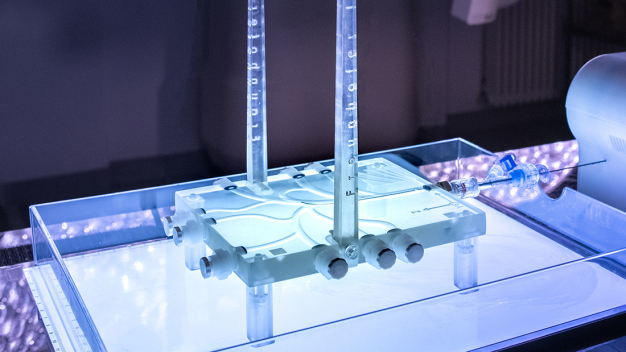
In the ANIMMED project, a guidewire of a catheter is advanced through a vascular phantom using AI. © Fraunhofer IPA / Photo: Vanessa Stachel
From the former "Project Group for Automation in Medicine and Biotechnology (PAMB)" has evolved over ten years into "Clinical Health Technologies" at Fraunhofer IPA, Mannheim. The renaming reflects how the focus of the 20-member interdisciplinary team of researchers has shifted during this time: away from pure laboratory automation towards very close collaboration with doctors directly in the clinic.
With the founding of the then IPA project group in Mannheim, this established location of medical technology was to be strengthened through the presence of Fraunhofer. Initially, it mainly involved mechanical engineering, bioprocess engineering, and robotics. "We still design devices today, but now we focus much more on the requirements of everyday clinical practice," explains physicist Dr.-Ing. Jens Langejürgen, who has been working at IPA for five years and has been leading the department since July 2021.
Test Operating Room with 5G Equipment
In hospitals, networking and digitalization are particularly important for the future. These requirements can only be partially simulated under laboratory conditions. "It's about many properties and subprocesses that can only be implemented efficiently when we are very close to the application," says Dr. Langejürgen. The department is located in the midst of the University Medical Center Mannheim. Equipment includes, among other things, a dedicated hybrid operating room with 5G technology, which is used exclusively for research and development. As part of the M²OLIE research campus, the department collaborates with medical professionals and companies on a new infrastructure for innovative, faster tumor therapies.
Various Patents
Over the past years, there have been 29 patent applications, 18 of which have already been granted. The developments are diverse. Hydraulic surgical instruments are among them, as well as 3D-printed robots for surgery and navigation aids for biopsies. A sterile milling unit extracts living single cells from tumor biopsies as a starting point for personalized therapy. A contactless sensor detects whether a person can breathe independently, which can be life-critical especially for premature infants on ventilators.
Licenses and Spin-offs
In addition to research, the IPA department always keeps an eye on potential commercialization, because ultimately, developments should benefit people. This is achieved through license agreements and spin-offs by employees. Several companies have already been founded from the department. Vibrosonic develops hearing aids that amplify sound at the eardrum like a "contact lens for the ear." Thericon visualizes different tissue types in tumor treatment using multispectral imaging. Fast Forward Discoveries dissects tissue samples into individual cells for personalized medicine. More spin-offs are in preparation.
Digitalization and Automation
In the area of "digitalization," there is still a significant gap between expectations and reality in clinics. State-of-the-art devices on one hand generate enormous amounts of data. On the other hand, doctors still have to gather information from a multitude of notes. These data remain unused for quick decisions or optimizing treatment through subsequent research because the necessary interfaces are missing. The goal here is to make all relevant information available simultaneously in an electronic system.
An ongoing project is TEDIAS, which starts at patient admission and handles routine tasks. The automated system is intended to bring structure to the data from the outset and create more time for the actual interaction between doctor and patient. The project ANIMMED also analyzes datasets using AI methods. Studies on increasing the efficiency of digital processes and the benefits of technological developments are specifically aimed at helping small and medium-sized enterprises evaluate and adapt their technologies early in development under real-world conditions.
Rapid Support in Emergencies
The Department of Clinical Health Technologies not only develops high-tech solutions. Humanitarian support and solidarity cooperation were at the forefront in projects like the Virus Fighter Handbook, a simple app for operating ventilators during the pandemic, as well as an affordable infusion set for Uganda that helps prevent dosing errors.

Fraunhofer-Institut für Produktionstechnik und Automatisierung IPA
Nobelstraße 12
70569 Stuttgart
Germany
Phone: +49 711 970 1667
email: joerg-dieter.walz@ipa.fraunhofer.de
Internet: http://www.ipa.fraunhofer.de