



- Translated with AI
Use and selection of disposable items for personal hygiene
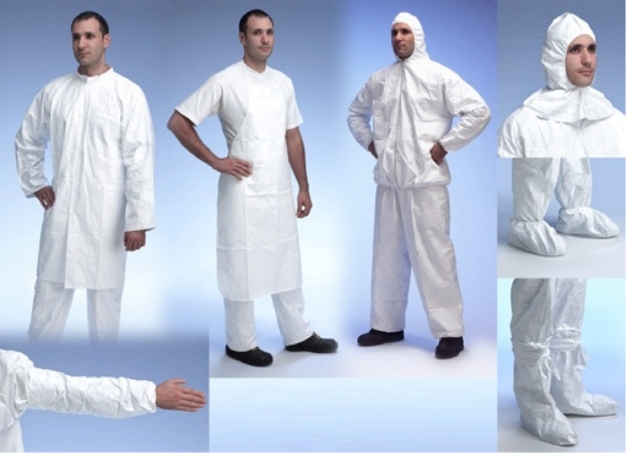
Use and selection of disposable items for personal hygiene
Author: Stephan May, basan GmbH, Kriftel
There is a wealth of disposable materials, and almost every customer request can be fulfilled. The selection of different colors, surface weights, model properties, material blends, etc., is enormous.
But how can I, as a customer, get a rough overview of this variety?
The material requirements are quickly narrowed down:
- High wearing comfort / easy to wear
- No gas or particle emissions
- Fulfillment of occupational safety requirements
- Cleanroom class suitability
- Affordable price
Which materials are used?
Polyester, cellulose, viscose, polypropylene, or blends of these materials are mostly used:
- Polyester
attracts little dirt, stretches well due to high elasticity, has high tear & abrasion resistance in wet and dry states, is crease-resistant, decomposes very slowly, absorbs little moisture, and charges easily electrostatically. However, polyester is mainly used for reusable clothing and wipe cloths in cleanrooms. Outside the cleanroom, polyester is processed into suits, costumes, dresses, shirts, weather protection clothing, bed linen, fleece, curtains, sails, and ties.
- Cellulose
mainly derived from plant fibers for various fabrics. In the apparel industry, examples include cotton and bast fibers of flax, which are processed into linen. In cleanroom products, cellulose is often mixed with polyester/polypropylene.
- Viscose
is a synthetic cellulose fiber. It is produced by processing a solution of naturally derived cellulose molecules into threads, called regenerated fibers. In the non-textile sector (English: nonwovens), viscose fibers have a larger market share than in textiles due to their versatile design options. Examples of applications include wet wipes, cotton swabs, cleaning cloths, and sponge cloths. Products made from viscose have a high water absorption capacity. It is also used for tea bags, banknote paper, and fibers and fabrics for composite materials. Viscose fibers account for about 11% of artificial fiber production.
- Polypropylene
is a byproduct of crude oil production and is obtained as filament yarn and spun fiber. Polypropylene does not absorb water (good capillary action), does not decompose, and is characterized by 100% wet strength, high tensile strength, and high electrical insulating properties. Its elongation capacity is about 30%. Polypropylene is used for higher-quality disposable clothing, mainly outside the cleanroom for functional sports underwear (good sweat transport) and outdoor clothing.
- Fleece or knitted fabric
made from the raw materials described above, opens up the possibility of combining the individual advantages of products—aiming to create new product properties. An example is polypropylene suits that offer very good protective properties and are combined with fleece. This results in significantly better moisture vapor transmission resistance and thus higher comfort for the wearer. The application area for fleece is therefore also strongly dependent on the fiber structure and bonding technique, recognizable e.g., by the surface weight. This also allows compliance with occupational safety requirements.
Which material is suitable for which cleanroom class?
Short-chain fibers like cellulose/viscose are more suitable for cleanroom classes C/D = ISO 7/8. Variants exist that bind these short fibers so they no longer easily disintegrate from the composite, enabling use in higher cleanroom classes.
Polyester > ISO 3-8 A/B = ISO 5
Polypropylene > ISO 6-7 C/D = ISO 7/8
Cellulose/Polyester-Viscose > ISO 6-7 C/D = ISO 7/8
A large part of disposable products are now manufactured in Asia. High temperatures and humidity promote the growth of microorganisms there. It is therefore not surprising that incorrect selection of disposable materials can suddenly lead to high microbial contamination in production.
About 18% of the exceeding KBE (cleanroom contamination) levels are measured on the upper body. Often, the cause is a wrongly chosen face mask. Reasons can include insufficient retention capacity, but also that the mask itself was already contaminated when entering the cleanroom. A mask from the cardboard dispenser box should therefore not be used in sterile rooms.
Wearing properties
With the right material mix and improvements in wearing comfort through cuts, elastic bands, and other characteristics, such suits are now quite comfortable.
The prevailing opinion that reusable clothing made of polyester has an advantage over disposable clothing is no longer generally valid. The market can offer attractive alternatives here.
Disposable clothing can today have the following advantages over reusable clothing:
- more comfortable to wear
- individually adjustable to the person
- more economical
- multiple uses
- cleanroom-compatible packaging
- particle-cleaned
- compliance with occupational safety standards
Face masks
The exhalation resistance of a high-quality face mask is given in mbar. The values are around 2.1 mbar. The test is usually conducted with an air volume of 95 l/min. The breathing volume of an adult jogging is about 36 l/min.
Packaging
Optimal is packaging the materials in appropriate plastic bags, which can be wiped with a cloth and cleaning solution before insertion. Packaging in dispenser boxes is less suitable due to the risk of particle release and contamination from the cardboard.

VWR International GmbH
Hilpertstraße 20a
64295 Darmstadt
Germany
Phone: + 49 6151 39720
email: info.de@vwr.com
Internet: https://de.vwr.com