




- Devices
- Translated with AI
Understanding leakage rates
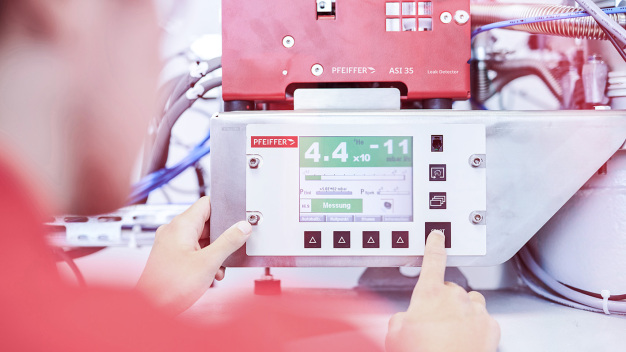
Standards such as EN ISO 20484 define the leak rate as the amount of a specific fluid that flows through a leak under specified conditions. Consequently, this leak flow can vary depending on operating conditions such as pressure, temperature, and other environmental factors. This distinction is important in practice because a leak that appears tolerable under certain conditions can lead to significant inefficiency or process instability under others. Those operating or maintaining a vacuum process should understand exactly what the leak rate describes, how it is measured, and which factors influence it. Equally important is how it affects process stability and system design.
The unit of the leak rate
The most commonly used unit for the leak rate is mbar·l/s (millibar-liter per second). To understand leak rates, we first need to consider the behavior of gases. Since gases can be compressed, the amount of gas that can flow through a leak cannot be described solely by volume or pressure. When gas enters a vacuum system from the environment at a lower pressure, it expands. For this reason, the gas amount is expressed as the product of pressure multiplied by volume (p·V) in the unit mbar·l.
Additionally, a time component is needed for the leak rate, indicating how much gas flows through a leak during a specific period. The corresponding formula is therefore p·V/t, expressed in mbar·l/s. For example, a gas cylinder illustrates p·V well: a 50-liter cylinder at 200 bar contains a gas amount of 10,000 bar·l or 10,000,000 mbar·l. This clearly shows why pressure and volume must be considered together when comparing gas quantities: neither volume nor pressure alone is sufficient to describe a gas amount.
In a pressure rise test, the system volume is therefore an essential part of the calculation. In a large chamber, the same pressure increase over the same period corresponds to a much larger gas amount than in a small chamber. Therefore, the result must always be interpreted relative to the tested volume: Leak rate = (ΔP × V) / t.
Here is the breakdown:
– mbar: the pressure component indicating how compressed the gas is
– liters: the volume component
– per second: the time period during which the escaping gas amount is measured
It should also be noted that, depending on the industry and region, other equivalent units are common. For example, Pa·m³/s, Torr·l/s, and sccm (standard cubic centimeters per minute) are also used. When comparing specifications given in different units, caution is advised. To simplify, a unit converter can be used here to quickly convert between the common units for leak rate and avoid misinterpretations when comparing values.
Factors influencing the leak rate
The rate at which gas flows through a leak is not a fixed value. It changes with operating conditions and is influenced by several factors. Operators should be aware of this to interpret measurements correctly and avoid drawing false conclusions.
The influence of pressure
The pressure difference at a leak is the difference between the pressure inside the vacuum system and the outside pressure. This also applies to pressurized systems against atmospheric pressure or reduced pressure. Generally, the higher the pressure difference, the higher the leak rate, as the pressure difference drives the gas flow. However, the relationship is not entirely straightforward. As vacuum increases, the leak rate does not continue to rise indefinitely.
Beyond a certain critical value, the pressure difference no longer determines the gas flow. After transitioning into the so-called "choked flow" region, the flow rate no longer increases with further pressure reduction. It is important to note, however, that the gas entering the system expands into a larger volume as vacuum increases, so the vacuum pump must handle a higher volumetric flow.
The influence of temperature
Temperature affects the leak rate in two ways: through the gas itself and through the material of the system components. Gas molecules move faster at higher temperatures, increasing the flow through a specific leak path. But more significantly, sealing materials expand or contract depending on temperature, e.g., O-rings, seals, and polymer hoses: at cold temperatures, they become hard and contract; at warm temperatures, they soften and can deform. Temperature also influences the permeability of materials used in vacuum systems. This is especially relevant for elastomers, whose permeability can increase significantly with rising temperature.
A system may appear airtight at ambient temperature but exhibit measurable leakage at normal operating temperature—or vice versa. Systems subjected to large temperature variations should always be tested under representative operating conditions.
The influence of leak position
While the vacuum pump is actively pumping, a pressure gradient exists in the system, with the lowest pressure at the pump inlet, gradually increasing toward the process end. In compact systems with short piping, the pressure gradient is minimal; in longer or narrower pipes, it is more pronounced.
A leak near the pump inlet shows the greatest difference between internal pressure and atmospheric pressure, resulting in the highest leak rate for the same defect size. A similar defect located closer to the process, where the pressure is higher and the pressure difference smaller, allows less gas to escape.
The influence of gas type
The type of gas also plays a role—how much depends on the system pressure. At higher pressures, when gas molecules are densely packed and move together, the viscosity of the gas determines how easily it flows through a leak. At lower pressures, when molecules move more independently and are spaced farther apart, molecular weight becomes the key factor, as lighter molecules tend to leak more easily.
This is especially relevant in processes where gases other than air are used, such as nitrogen, argon, refrigerants, hydrogen, or other inert gases, since the actual leak rate in these cases can differ from the results obtained with air.
The influence of leak rate on process stability
Since both pressure and temperature affect the leak rate and neither remains constant in most applications, the effective leak rate is not a fixed value. As operating conditions change, so does the leak rate. This leads to fluctuations in the process, often difficult to diagnose.
The effects of this variability depend on the process. In heat treatment, a fluctuating leak rate between batches can cause changes in the chamber atmosphere. This may result in uneven oxidation and inconsistent surface quality. In chemical processes, a variable leak rate can cause slightly different vacuum conditions between batches, affecting reaction rates and product consistency.
How leak rate influences system design
Not every leak causes an immediate process failure, which can create a false sense of security. If the system continues to operate, the leak is often considered acceptable and ignored.
What is overlooked is the design margin. Vacuum processes are designed with a certain reserve pumping capacity to account for real operating conditions. A leak gradually consumes this reserve. The system still functions but with reduced tolerance for other factors that can impose additional demands, such as seal degradation elsewhere, changing process conditions like increased vapor load, or the ongoing wear of other components.
By the time the leak causes a noticeable problem, the reserve has already been exhausted. What started as an acceptable leak rate becomes the reason the system no longer operates properly.
A leak does not necessarily lead to failure, but it erodes the safety margin until failure becomes unavoidable.
Conclusion
The leak rate is not a single fixed value. It is influenced by various factors, including pressure, temperature, leak location, and gas type. A leak that seems insignificant under certain conditions can become critical under others. Only those who understand the factors that determine the leak rate can effectively address and mitigate it.
Practical measures
– Conduct tests under actual operating conditions. Leak rate measurements at ambient temperature or in rough vacuum may not reflect true performance. Perform tests under representative operating conditions.
– Consider system volume. In large systems, even a critical leak may go undetected during testing. When using the pressure rise method, interpret the result in the context of the system volume: Leak rate = (ΔP × V) / t.
– Define what leak rate is acceptable for your process. There is no universally acceptable leak rate. Set your threshold based on your process requirements and available safety margins, not on general rules of thumb.
– Monitor leak rate over time. A single measurement provides limited insight. An increasing trend indicates your reserve is being depleted and action is needed before performance is affected.
– Do not wait for failure. A leak that causes a visible problem means the reserve has already been exhausted. Include leak testing in your regular maintenance schedule and respond early and proactively to deviations.
Pfeiffer Vacuum+Fab Solutions
35614 Asslar
Germany