




- Translated with AI
UDE can now produce high-quality graphene
A wonderful material
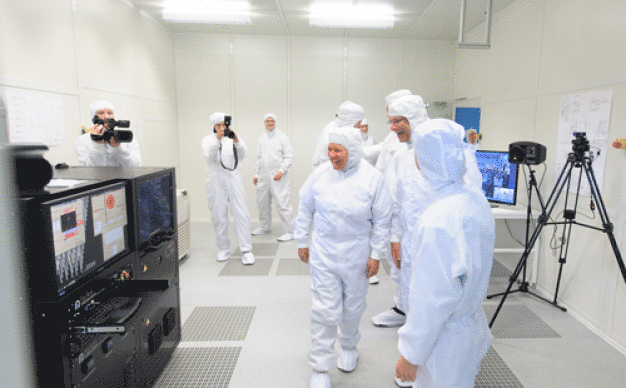
Prof. Dr. Gerd Bacher explains to Science Minister Svenja Schulze the graphene separation system.
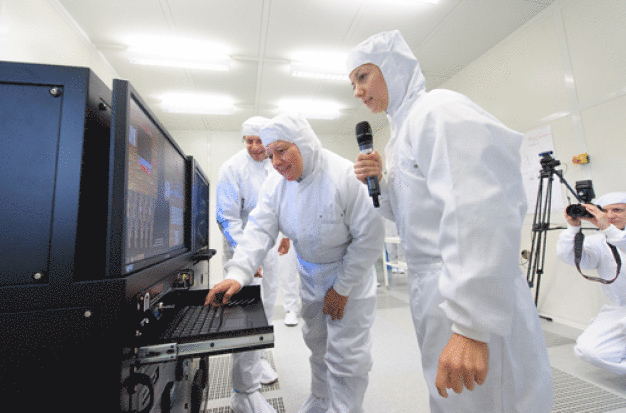
Minister of Science Svenja Schulze inaugurates the facility – supported by Prof. Gerd Bacher (l.) and scientist Bilge Bekdüz (r.).
Graphene could revolutionize the tech world. It has wonderful properties: extremely conductive, stable yet flexible, transparent, lightweight, and a million times thinner than a sheet of paper. One square meter of graphene weighs less than a milligram – and could still carry a cat. So far, the two-dimensional material, which consists of a single atomic layer, has been difficult to obtain in sufficient quality and expensive. This is because large-scale production is very complex. The research team of Prof. Dr. Gerd Bacher at the University of Duisburg-Essen (UDE) now has a facility that makes this possible. It was inaugurated on August 25, 2014, in the presence of Science Minister Svenja Schulze.
The state co-financed this highly sensitive large-scale device with 300,000 euros (total cost: 360,000 euros), which is located in a cleanroom. Using chemical vapor deposition methods, UDE nanoscientists can now produce graphene sheets up to 80 square centimeters in size – for their own work, but also for other research institutions and companies from North Rhine-Westphalia (NRW).
"I am pleased that we can make significant progress in graphene research with this production facility," said Science Minister Svenja Schulze at the inauguration. "This material opens up many new possibilities – for example, in energy storage or food packaging. It can make an important contribution to solving major societal challenges." In addition to the facility at UDE, the state is funding ten more graphene projects in NRW with up to 30,000 euros each.
"With this deposition system, we can network the graphene activities of our university, the University Alliance Ruhr, and of course all of North Rhine-Westphalia," said Prof. Dr. Jörg Schröder, UDE Vice Rector for Research, Scientific Nachwuchs, and Knowledge Transfer. "It is also important for expanding collaborations with companies. The NRW graphene specialist group already has a high number of industry partners."
The high-tech material is relevant for many industries: automotive manufacturing, communication technology, and electronics. A new generation of displays, processors, or solar cells could emerge if graphene could be produced industrially.
Gerd Bacher explores the micro- and optoelectronic possibilities. He is a professor for materials in electrical engineering and researches with his team how to produce graphene as defect-free and large-area as possible – for various applications. "We are working, among other things, on transparent electrodes for lighting elements and thin-film solar cells; other application areas include sensors or high-frequency transistors." Until now, scientists had to order graphene for this purpose – often with varying quality. "Now we can produce it ourselves and optimize it for our purposes or those of the NRW specialist group."
UDE - Universität Duisburg-Essen
47057 Duisburg
Germany



