
- Buildings & Rooms
- Translated with AI
Two brave entrepreneurs from Aachen bring fresh air into the clean industry with an airy and lightweight cleanroom
_RA_3297_21cm_web
_RA_2898_21cm_web
_RA_2952_21cm_web
_RA_2927_21cm_web
_RA_3087_21cm_web
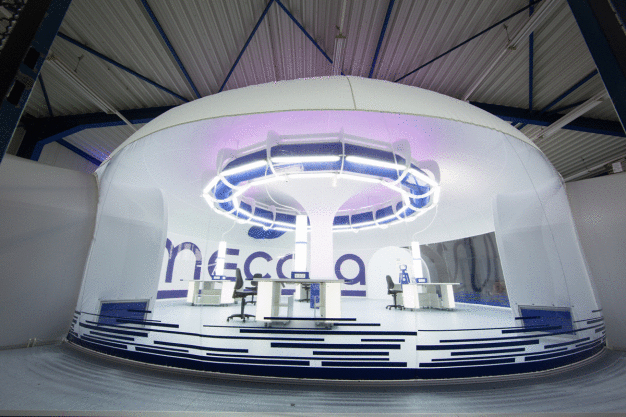
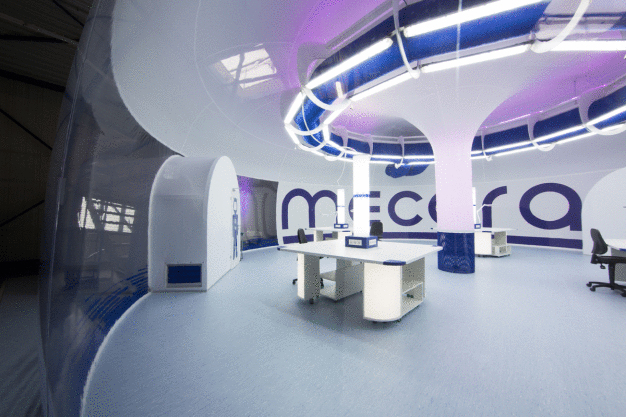
Recently, a new class of cleanrooms has emerged, and no one has noticed so far. The "sphairlab" from medical technology manufacturer Mecora looks like a giant donut, is fully pumped with purest air and state-of-the-art technology, and can be quickly assembled and disassembled if needed.
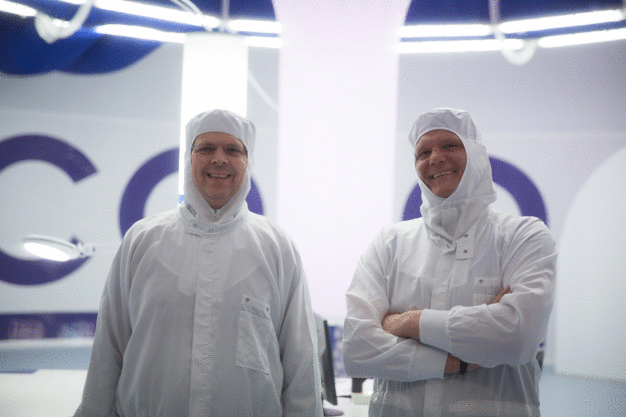
If Wolfgang Hassa had his way, he would be flying large jets over the Atlantic today. But things turned out differently, and now the Aachen pilot and aerospace engineer is building cleanrooms, more precisely, he has recently been creating cleanroom rooms for those who previously could not afford such particle-free zones. Before that, the "Tausend-Hassa" spent many years constructing hot air balloons and Zeppelins, and later, with his company Airworxx, specialized in textile architecture and "flying buildings," i.e., creating inflatable giant objects for art, trade fairs, and events.
Jens Hutzenlaub, on the other hand, has not been involved much with airy living so far. He is the owner of Mecora Medizintechnik GmbH, a company with 35 employees that earns its money developing, producing, and installing demanding components in the field of plastic medical technology. When his company rented a neighboring building last year due to rapid growth and he wanted to install a second cleanroom of an additional 150 sqm in a high hall without bearing the costs and uncertainties of permanent installation, he had an idea that seemed simple yet brilliant. What he envisioned was a cleanroom made of high-strength textile, based on the principle of a tensioned membrane structure, internally inflated with air and equipped with an intelligent ventilation system including airlocks, furnishings, and lighting — all attached at only a few points on the ceiling. "But I had no idea whether and how this crazy idea could actually be implemented," recounts the successful supplier of blood pumps, artificial hearts, and cannulas.
Is it coincidence, good luck, or fate that Jens Hutzenlaub found the perfect implementation partner for his "air project" right in Aachen, so to speak, right on his doorstep? The two engineers who ultimately realized the "sphairlab" cleanroom in a harmonious collaboration within just a few weeks seem to have achieved a great success. They are only gradually realizing this themselves, especially due to the reactions of people entering the inflated donut for the first time. "The reaction of the experts from GfPS* who came to us in December 2016 for certification was film-worthy," says Wolfgang Hassa, amused. Such reactions had even the specialists not seen before, despite their international experience in certifying cleanrooms. After an intensive exchange of experience and thorough testing, the "sphairlab" passed its certification with flying colors.
High Tech and High Touch
Elsewhere, the air-filled cleanroom also causes great surprise, sometimes mixed with disbelief. "This can't be real, can it?" ask those who only see the "sphairlab" on paper and consider the impressive images to be Photoshop creations. But hot air looks different: from the crazy idea, a transportable cleanroom with a diameter of 13 meters and a height of 5 meters has been developed, with its outer shell made of flame-retardant polyester fabric, kept in shape by an external continuous-running blower with minimal internal pressure.
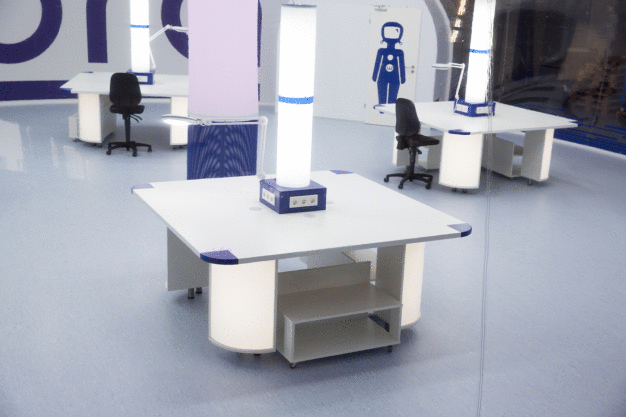
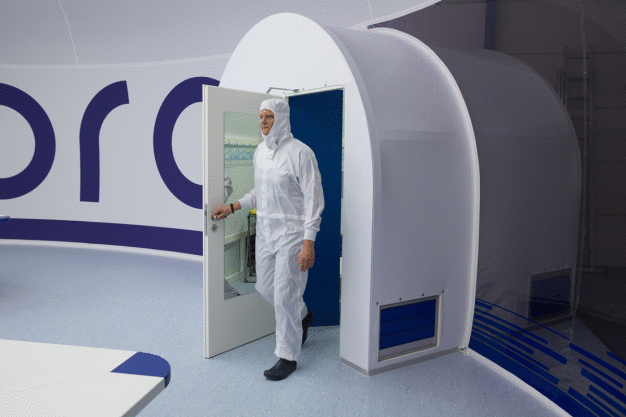
The transparent PVC walls are also B1-certified and make the "sphairlab" appear like a floating cheese dome. From a airflow perspective, the clean air cushion is optimized and leaves no dead angles. Access is via two double-door airlocks with a dismantlable metal frame covered with opaque fabric. Even the seams that hold the air cushion together can be easily disinfected and cleaned thanks to their coating. And with mounted rails, zipper closures, and removable rubber lips, the entire space can be quickly dismantled when needed. Everything in the "sphairlab" follows the motto: lots of fabric, little metal. Except for the furnishings: the tables are designed as island solutions, illuminated from above and supplied with power and compressed air. Ergonomics and functionality have formed a solid combination here.
Donut, Tunnel, or Sphere
That the "sphairlab" is also a real eye-catcher, which in a way also serves as a showroom, probably does not hurt its market chances, especially since the shape can be variably adjusted according to customer requirements. While the Aacheners have designed their own air space as a donut, they also offer tunnels or spheres as standard, as well as various combinations thereof. Mecora also supplies a construction documentation and the acceptance certificate up to ISO Class 7 for each "sphairlab" cleanroom. Building certificates, test reports, and material certificates also ensure comprehensive documentation.
In terms of material and energy consumption, and thus sustainability, the transparent air body achieves remarkable results: it makes a big impression in operation but consumes little, and when not needed or when moving, the shell can be packed into a bag. Waste at the end of use is therefore minimal. In this way, the innovative concept could excite many startups and attract companies that want to install a clean or sterile room but shy away from the costs of permanent installation. Especially the increasing requirements for cleanliness in many production environments make the mobile "sphairlab" increasingly interesting — especially since the costs are surprisingly low.
Anything Goes — As Long As It's Inside
The application possibilities for the "sphairlab" are only limited by a few constraints. Companies in medical technology can quickly and cost-effectively expand their production, and pharmaceutical companies can install multiple modules in a hall and connect them via airlocks to prevent cross-contamination. Even use as an operating room, whether in crisis areas or as an interim solution during moves, renovations, or building damage, can be realized in a short time. Young companies that are growing dynamically but have limited capital can minimize costs and effort while maintaining flexibility.
Especially for companies with rented spaces, the "sphairlab" offers an affordable cleanroom solution without permanent installation. And for manufacturers who need to meet "clean" production requirements during ongoing operations, it offers the possibility to quickly convert existing machinery into a "cleanroom tunnel." Ultimately, countless companies in sectors like food, packaging, or automotive can benefit from an inexpensive cleanroom, even without ISO certification. And in strawberry or flood-prone areas, the "sphairlab" is ideal as an operating room or ambulance station. A simple corrugated iron hall or an outdated aircraft hangar is sufficient as protection against wind and weather.
*Society for Production Hygiene and Sterility Assurance mbH

sphairlab GmbH
Abteilung sphairlab
Merzbrück 212
52146 Würselen
Germany
Phone: +49 163 2518059
email: info@sphairlab.com
Internet: http://www.sphairlab.com