
- Transport
- Translated with AI
Transport medications safely and efficiently
Project of TH Cologne: Real-time Monitoring System for Multi-Chamber Insulation Containers
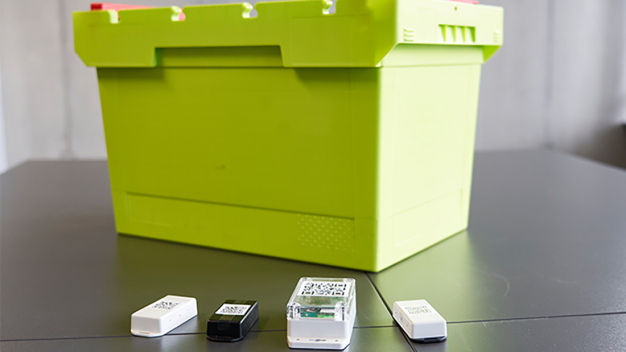
In the "sensoKo" project, TH Cologne, together with m2m Germany GmbH, developed a real-time monitoring system for multi-chamber insulated containers. This is intended to simplify logistics processes in the pharmaceutical industry. (Image: Monika Probst/TH Cologne)
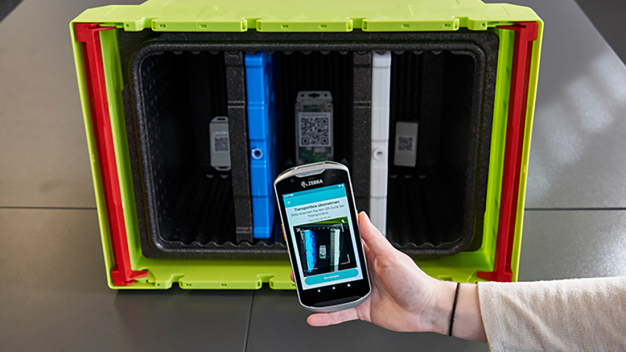
With the help of a smartphone app, information about the respective temperature ranges of the chambers can be monitored in real time. (Image: Monika Probst/TH Cologne)
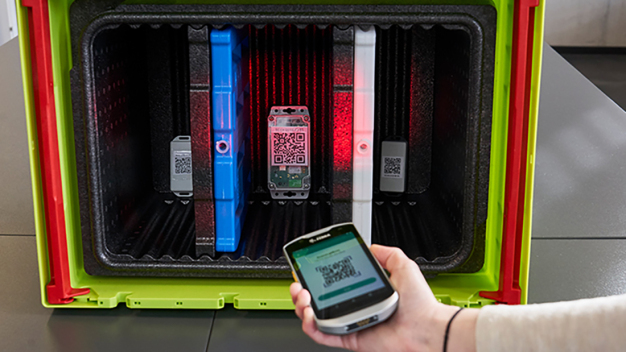
The transfer of the boxes between wholesale, transport, and pharmacies is carried out via scans. (Image: Monika Probst/TH Cologne)
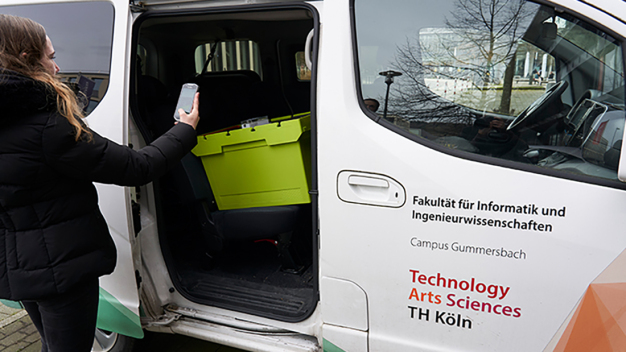
In several function tests, in which the process flow of a pharmaceutical delivery was simulated, the entire system was already successfully tested. (Image: Monika Probst/TH Cologne)
From cooling to documentation: When delivering medicines, numerous requirements must be met. To address this, mostly isolated solutions have been used so far, which sometimes incur additional costs and are time-consuming to handle. The Cologne Institute for Digital Ecosystems (CIDE) at TH Cologne has therefore developed a comprehensive system in the project "sensoKo" together with m2m Germany GmbH. This system aims to simplify logistics processes in the pharmaceutical industry.
"Every day, around 57,000 medications are delivered to pharmacies in Germany. In doing so, certain requirements must be met according to the 'Good Distribution Practice of medicinal products for human use' (GDP), such as continuous monitoring and complete documentation of temperature," says Prof. Dr. Matthias Böhmer from CIDE. To implement this guideline, multiple containers with specific temperature ranges are currently used. To control the temperature inside, so-called data loggers are employed – compact, battery-powered devices with microprocessors, data storage, and multiple sensors – which are placed inside the containers.
However, these solutions are not optimal, Böhmer explains: "On the one hand, a lot of space is lost in the transport vehicles. On the other hand, the data loggers must be individually and sometimes manually read out – which takes time and can be imprecise. Therefore, the cold chain cannot always be maintained, leading to medicines being disposed of and replaced," Böhmer states. To ensure the safety of medicines and reduce ongoing operational costs for pharmaceutical companies, the "sensoKo" project developed a novel transport container system with multiple insulation chambers and integrated sensors.
Monitor temperature via web and app
In an initial step, the project team conducted a preliminary market analysis and examined the processes in the current supply chain to derive requirements for the overall system. As a result, three main temperature ranges for transporting medicines were identified: deep-frozen, below 20 degrees Celsius; fresh, between two and eight degrees Celsius; and room temperature, between 15 and 25 degrees Celsius. The respective temperatures are measured in the newly developed system using sensors. Unlike data loggers, these sensors are permanently installed, highly recyclable, have optimized energy efficiency, and measure temperature more reliably.
Furthermore, the team identified the tasks, needs, and interfaces of wholesalers, transporters, and pharmacies to ensure GDP-compliant and secure transport of medicines. "The handover between these actors occurs with our system via scans of the transport boxes and a traceable process, in which the sensors are continuously monitored and each process step is interactively logged. We have implemented a smartphone app for this purpose. The sensors communicate directly over the Internet of Things (IoT), so the temperature ranges can be monitored in real-time. This allows constant control over whether boxes are opened at the wrong moments or if certain temperature thresholds are exceeded within the chambers," Böhmer explains.
Pharmaceutical logistics can be significantly improved
In several functional tests, where the process flow of a medicine delivery was simulated, the entire system was successfully tested. "The software architecture we developed, along with the associated hardware components, enables much more precise monitoring of temperatures in multi-chamber insulation containers. This can improve the quality of pharmaceutical logistics, and the previously sometimes time-consuming documentation is automated," Böhmer states. The project’s results are directly applicable in the field of pharmaceutical logistics. Components of the development, such as the mobile app for process chain verification or the IoT platform for real-time data analysis, can also be used in other areas – for example, in value chains within Industry 4.0.
Moreover, there are various ways to optimize and expand the existing system. "To detect deviations from the specified temperature ranges more efficiently and, above all, earlier, further studies could explore models based on artificial intelligence," Böhmer suggests. Additionally, it makes sense to implement location-based tracking in follow-up work to make the supply chains of medicines more transparent for the involved actors and to facilitate documentation.
About the project
The research and development project "Development of a sensor- and cloud-based communication system for specific integration into multi-chamber insulation containers for more efficient GDP-compliant process handling in the pharmaceutical industry" (sensoKo) was led at TH Cologne by Prof. Dr. Matthias Böhmer from the Cologne Institute for Digital Ecosystems. The project partner was m2m Germany GmbH. The project was funded by the Federal Ministry for Economic Affairs and Climate Action over a period of two years with 156,000 euros.
TH Köln
50678 Köln
Germany