




- Translated with AI
Study on yeast cells: Protein discovered that initiates cell death – similar process also in human cells?
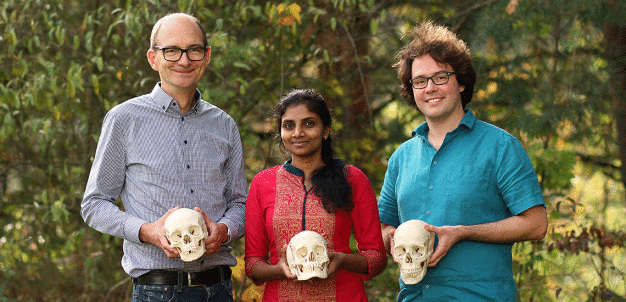
Professor Dr. Johannes Herrmann (left), SreeDivya Saladi, and Felix Boos. (Photo: Koziel/TUK)
When cells die, they initiate cell death. In higher organisms, it is ensured that the entire organism remains unharmed. But even in single-celled organisms, there is a mechanism. Why this was previously unclear. Researchers from Kaiserslautern have now found a solution. They discovered a protein in yeast cells that exists in two forms. In healthy cells, it functions as an enzyme; in defective cells, it triggers cell death. The process could work similarly in human cells. From an evolutionary perspective, this makes sense because it allows for the sorting out of cells that are not "fit," i.e., not adapted. The study was published in the journal "Molecular Cell".
Every organism consists of cells. Whether in humans, animals, or plants – their structure and function are very similar. However, for example, the cells of the oral mucosa only live a few days and are constantly replaced, whereas most nerve cells accompany us throughout our entire lives and thus can be 80 or 90 years old. "When cells die, they usually initiate a specific program called apoptosis," says Professor Dr. Johannes Herrmann, who heads the Department of Cell Biology at the Technical University of Kaiserslautern (TUK).
This "suicide" program ensures that dying cells do not have harmful effects on the entire organism. "It has long been known that cells that need to give way to other structures during embryonic development are removed through apoptosis," he continues. However, little is understood about why single-celled organisms like yeast also have such a program, which largely resembles that of humans and animals. Unicellular organisms do not have embryonic development, nor is there a restructuring of tissues here.
SreeDivya Saladi and Felix Boos, who are researching in Herrmann's team, have now found an explanation for the fundamental importance of cell death. Boos, who studied mathematics and biology in Kaiserslautern before his doctorate, focused as a doctoral student on the lifespan of proteins in baker's yeast cells. "We use this unicellular organism as a test model," says the doctoral student, "because it is similar to human cells in many properties."
Boos used a new method that makes it possible to measure the lifespan of hundreds of proteins simultaneously. Mass spectrometry is used, which allows for precise identification of proteins – similar to a fingerprint that can only be assigned to one person. Boos's main focus is on proteins of the mitochondria, the power plants of our cells. "Scientists know quite a lot about their production, but very little about their breakdown," says Boos. In his analysis, he saw that the proteins were broken down quite slowly and very uniformly. However, there were a few exceptions. One protein, in particular, caught his interest. "The protein Nde1 is broken down especially quickly," he continues. "Apparently, a fairly large part of it is removed shortly after its formation. We wanted to find out what is behind this unusually short lifespan."
His colleague SreeDivya Saladi continued the work. The doctoral student discovered that the protein has another function besides a known one. "It is an enzyme important for respiration," she says. "But it can also initiate cell death." The scientist then investigated why it is toxic to the cell. It turned out that it exists in two forms. "In healthy cells, it mainly serves as an enzyme," says the researcher. However, in cells where the mitochondria do not function properly, it looks different. "Here, there is a second variant. These proteins are not located inside the mitochondria like the healthy version, but on the surface of the mitochondria," she explains. In healthy cells, this surface variant is quickly broken down. "This also explains the high degradation rate of the protein," adds Boos. "In defective cells, however, this is not the case. They accumulate, leading to cell death," Saladi continues.
"Evolution has thus produced an elaborate selection mechanism that ensures cells with defects are deliberately eliminated," summarizes Herrmann. This is important in unicellular organisms, for example, when cells grow through fermentation. "Many functions of the mitochondria are not needed in this process," the professor continues. "Cells that are less fit, i.e., less well adapted to the conditions, are thus sorted out. This also explains why unicellular organisms use apoptosis."
There is also a similar protein in animals and humans. "It has long been known that it can trigger cell death in humans," says the Kaiserslautern professor. However, it was previously unclear under what conditions and for what purpose this happens. Whether the mechanism described above works the same way in humans needs further studies to clarify. The parallels between the cell types are very large, "so we suspect that we have discovered a new general function of apoptosis that involves the selection of cells based on their function," Herrmann concludes.
Doctoral student SreeDivya Saladi researched in Professor Herrmann's group for three years. She is now back in India to further investigate the role of mitochondria.
The study was published in the renowned journal "Molecular Cell": "The NADH dehydrogenase Nde1 executes cell death after integrating signals from metabolism and proteostasis on the mitochondrial surface"
DOI: https://doi.org/10.1016/j.molcel.2019.09.027
Answer questions:
Felix Boos
Department of Cell Biology
Email: fboos[at]rhrk.uni-kl.de
Phone: 0631 205-2409
Prof. Dr. Johannes Herrmann
Department of Cell Biology
Email: hannes.herrmann[at]biologie.uni-kl.de
Phone: 0631 205-2406
Technische Universität Kaiserslautern
67663 Kaiserslautern
Germany