




- Science
- Translated with AI
Barbara Halstenberg
Smallest satellite with TU Berlin system technology tests quantum communication in space
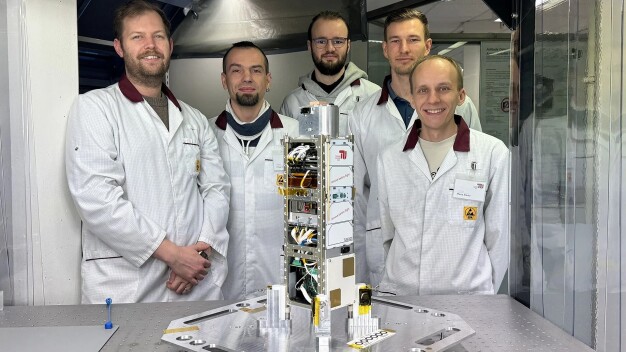
The QUICK³ flight pattern in the integration laboratory at the Department of Aerospace Engineering with the development team of the Technical University of Berlin.
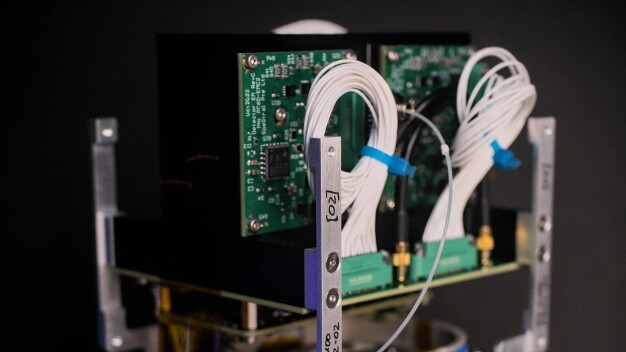
The small satellite QUICK³ serves as a technology demonstrator for components of a future quantum satellite system.
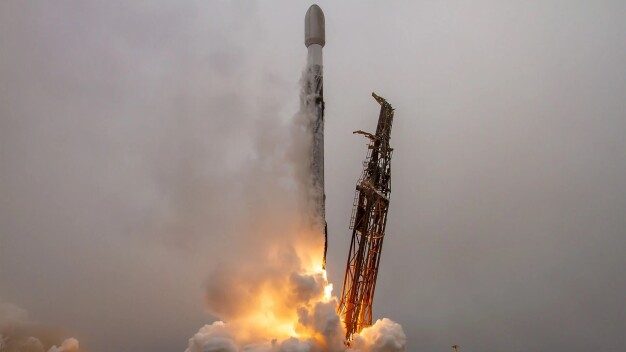
Successful launch of the rocket from the Vandenberg Space Center (California, USA)
On Monday, June 23, 2025, the microsatellite QUICK³ from the Vandenberg Space Center (California, USA; GMT-7) was successfully launched into Earth's orbit. The mission aims to test new technologies for secure quantum communication and conduct a quantum physics experiment under space conditions. The Technical University of Berlin plays a central role in the research consortium and provides key contributions to the implementation.
QUICK³ is a small satellite of the 3U-CubeSat type – about the size of a shoebox and weighing around four kilograms. It serves as a technology demonstrator for components of a future quantum satellite system. On board is a quantum light source that generates individual particles of light (photons) based on a two-dimensional material. These photons are intended to help securely transmit information in the future. Unlike classical communication systems, quantum transmission physically prevents any unnoticed access to the data.
Connecting the scientific components
The TU Berlin ensured that the various scientific instruments on the satellite work together and are reliably integrated into the satellite's overall system. For this, the team developed a special electronic module that controls the experiments in space, stores the measurement data, and later transmits it to Earth. The mechanical structure that secures the sensitive components inside the satellite also comes from TU Berlin. The engineers designed it to withstand the stresses of rocket launch.
"One of the biggest tasks in this project was coordinating the interfaces between the scientific partners and the satellite bus provider. The Space Engineering Department at TU Berlin played a bridging role. We ensured that the overall system functions reliably," says system engineer Philipp Werner from TU Berlin.
Julian Bartholomäus, project manager at TU Berlin, explains: "Our many years of experience in space technology – we are the only university worldwide to have launched over 30 satellites into orbit – helped us implement the experiments in orbit as automatically as possible. We utilized many existing developments from our TUBIN mission and were thus able to respond flexibly to changes during the project."
Technology testing and fundamental research in space
The transmission of individual photons over large distances is only limitedly possible via optical fibers. In space, however, the atmosphere barely dampens the light – an advantage for transmitting individual photons. QUICK³ tests whether the components intended for this purpose also operate reliably under orbital conditions. The mission thus provides important insights for building a future global quantum communication network with many satellites.
Another goal of the mission is a fundamental physics test: the team wants to verify whether the so-called Born's probability interpretation of quantum mechanics is also confirmed in weightlessness. This question has not yet been investigated under space conditions. The project participants expect to have initial scientific results by the end of 2025.
The project is funded by the Federal Ministry for Economic Affairs and Energy. The leadership is provided by Prof. Dr. Tobias Vogl from the Technical University of Munich, who, together with the team from Friedrich Schiller University Jena, built the quantum light source and integrated it with an optical chip from CNR-IFN in Italy. The Ferdinand-Braun-Institut for High-Frequency Technology in Berlin built a laser system to excite the quantum light source, which is controlled by electronics from the "National University of Singapore".
Technische Universität Berlin
10587 Berlin
Germany



