



- Science
- Translated with AI
Significant boost for application research: FMD gives the green light for the "Chiplet Application Hub"
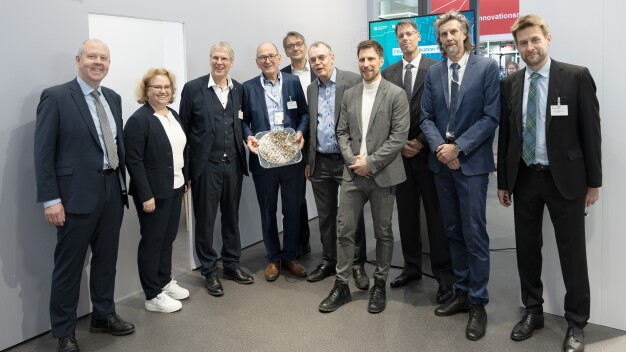
At the Hannover Messe, the launch of the new "Chiplet Application Hub" of the Research Factory Microelectronics Germany (FMD) took place on March 31, 2025. (Markus Jürgens © Fraunhofer-Gesellschaft)
At the Hannover Messe on March 31, 2025, the launch of the new "Chiplet Application Hub" of the FMD took place. As a node for the development and application of chiplet technologies, it bridges research and industrial use. Together with industry, it advances the development of "made in Germany" chiplets and elevates industrial research to a new level. The hub complements the work of the FMD in the "Chips for Europe Initiative" at the national level, thereby strengthening Germany's technological resilience. Research, development, and prototype manufacturing are carried out utilizing the technological capabilities of the APECS pilot line.
The Microelectronics Germany Research Factory (FMD) is actively working in the field of heterointegration and is driving chiplet innovations forward in the APECS pilot line, launched at the end of 2024, on a European level. A significant portion of the total funding of 730 million euros for APECS is invested in technological capabilities for chiplets.
These open groundbreaking opportunities especially for the automotive industry and high-performance computing, but also for other sectors such as industrial electronics and medical technology. They enable advances in advanced packaging, the integration of high-performance subsystems (e.g., powerful computing modules, sensor/edge modules, controllers), and a more flexible supply chain through the use of semiconductor components from various manufacturers.
To specifically promote the industrial application of chiplets in Germany and Europe, the FMD is now building the "Chiplet Application Hub." This provides the application framework for the APECS pilot line and will ensure that companies benefit from the latest chiplet developments and that Europe's strengths in the semiconductor sector are further expanded. FMD and industry partners from all areas of the semiconductor ecosystem are pooling their expertise in the hub to jointly develop new chiplet solutions for applications in automotive and automation environments. Concrete development roadmaps and pilot projects will be created, tailored specifically to industry requirements. Industry partners contribute significant in-house efforts to advance chiplet innovations together with the FMD. In combination with the technological capabilities of the APECS pilot line, new manufacturing technologies, design methods, and standards can be developed and prototypes tested. The "Chiplet Application Hub" acts as a driver of pre-competitive industrial research and elevates it to a new level. As a result, innovations reach industrial application faster.
Chiplet technology as a catalyst for value creation, technology transfer, and competitiveness
The importance of chiplet technology lies in its modularity and scalability. It enables targeted combination of various semiconductor technologies and tailoring to specific applications. This allows for the realization of new system architectures with improved energy efficiency, performance, and reusability of highly expensive design components.
Prof. Holger Hanselka, President of the Fraunhofer-Gesellschaft: "The establishment of the 'Chiplet Application Hub' marks another milestone for microelectronics research in Germany, from which the European site will also benefit greatly through an independent, high-performance semiconductor industry. Through close collaboration between science and industry, we can purposefully and optimally harness the innovative power of chiplet technology." He emphasizes that this is an excellent example of how strong partnerships between leading European research institutions and companies are key to technological resilience and form the basis for groundbreaking innovations. "Furthermore, the establishment of imec in Baden-Württemberg vividly demonstrates how strategic collaborations across borders can sustainably strengthen Europe's competitiveness."
Prof. Albert Heuberger, Chairman of the FMD Steering Committee and Spokesperson of the Fraunhofer Microelectronics Network, as well as founding director of the "Chiplet Application Hub," adds: "The 'Chiplet Application Hub' is an important building block for implementing the EU Chips Act in Germany and will be closely linked with competence centers that are gradually being established across European countries in this context. The decision of imec to establish itself in Heilbronn underscores the close integration of various actors in the European chip ecosystem and shows how the EU Chips Act brings together research institutes, companies, and competence centers to jointly secure Europe's technological competitiveness."
Voices from industry: benefits of a strategic partnership with the "Chiplet Application Hub"
The foundation of the "Chiplet Application Hub" is close cooperation with strong industry partners to develop practical and industry-oriented solutions. By combining design, system integration, and testing procedures, the hub aims to establish itself as a long-term platform for the application of chiplet technologies in Germany and Europe. Modular semiconductor architectures offer great potential, especially in high-performance computing and artificial intelligence.
"Chiplet technology is a key component for the future of the semiconductor industry," says Dr. Heike Riel, IBM Fellow, who leads the science of quantum and information technology at IBM, adding: "Through modular integration of semiconductor components, we can create innovative computing solutions that are not only more powerful but also more energy-efficient. The 'Chiplet Application Hub' provides an ideal platform to further develop this technology and advance its industrial implementation."
The chiplet technology also opens up new possibilities for high-performance and adaptable electronic systems in the automotive sector.
Jürgen Heckelmann, Head of Strategic Semiconductor Management Procurement at Audi AG, welcomes the establishment of the hub and says: "Chiplets offer enormous advantages for the automotive sector. The transformation towards centralized control units requires flexible and scalable solutions. Especially in automated driving and infotainment, chiplets will enable more targeted adaptation to different vehicle classes and functionalities, and also offer more energy-efficient, loss-reducing solutions. An important benefit is also the modularization of sensor and actuator systems, making them more flexible to integrate into various systems. The hub will be an essential partner for the further development of future electronic architectures."
Andreas Aal, Volkswagen Commercial Vehicles, Senior Member IEEE, CRP, Chair SEMI GAAC, adds: "Chiplets enable us to create tailored hardware platforms for the software-based business model of Mobility & Transport-as-a-Service in the long term, offering the necessary flexibility, adaptability, and cost efficiency. The 'Chiplet Application Hub' provides a crucial bridge to enable digital innovations from the non-automotive sector for use in vehicles, considering aspects like lifecycle management, cybersecurity, and robustness. We need to move away from the traditional automotive ecosystem and instead become a robust system-of-systems compatible with the global digital ecosystem."
Siemens Digital Industries also believes that the heterogeneous integration of chiplets is the way forward for next-generation electronic products, such as autonomous vehicles. Heiko Dudek, 3D IC & Advanced Heterogeneous Packaging EMEA, Siemens Digital Industries, explains: "For this reason, investments are currently being made in developing design technologies and solutions to better serve this area. We welcome the establishment of the 'Chiplet Application Hub' and look forward to collaborating on this initiative to ensure its success."
Through its leverage on industrial research and technology transfer, the "Chiplet Innovation Hub" will accelerate innovations and serve as a catalyst for the market introduction of new chiplet technologies. In the coming years, the hub will be further expanded through targeted collaborations, research projects, and the development of a strong innovation network to sustainably strengthen Germany's competitiveness.
Partnerships with strong partners for a robust chip ecosystem
With the founding of the "Chiplet Innovation Hub," the FMD sends a clear signal regarding the central role of chiplets in microelectronics research and strengthens its position within the European chip ecosystem. The planned establishment of renowned research centers, such as the Belgian "imec," underscores the relevance of this technology. Imec plans to establish a research group for chiplet architectures in high-performance computing for the automotive sector in Heilbronn (Baden-Württemberg). To maximize this potential, both partners are pooling their efforts and have signed a Memorandum of Understanding (MoU) to define a joint strategic orientation. This affirms their commitment to advancing chiplet innovations and setting new standards for their development and industrial application.
About the Microelectronics Germany Research Factory (FMD)
The Microelectronics Germany Research Factory (FMD), a cooperation of the Fraunhofer Microelectronics Network with the Leibniz Institutes FBH and IHP, is the central contact for all questions related to micro- and nanoelectronics research and development in Germany and Europe. As a one-stop shop, the FMD combines technologically excellent solutions and system offerings from its 15 cooperating institutes of the Fraunhofer Society and Leibniz Association into a customized overall package. Under the virtual umbrella of the FMD, the largest consortium of its kind in Europe has been formed, now with more than 5,400 employees and a unique diversity of expertise and infrastructure. More information can be found at www.forschungsfabrik-mikroelektronik.de. Also visit our virtual 3D showroom at https://fmd-insight.de/showroom
About the Fraunhofer-Gesellschaft
The Fraunhofer-Gesellschaft, headquartered in Germany, is one of the leading organizations for applied research. It plays a central role in the innovation process – focusing on key future-relevant technologies and transferring research results to industry to strengthen our economic location and benefit society. Founded in 1949, the organization currently operates 76 institutes and research institutions in Germany. With nearly 32,000 employees, mostly with natural science or engineering backgrounds, it manages an annual budget of 3.4 billion euros. Of this, 3.0 billion euros come from contract research. https://www.fraunhofer.de/
About the APECS Pilot Line
Within the framework of the EU Chips Act, the Microelectronics Germany Research Factory (FMD) will build a comprehensive pilot line for resilient and trustworthy heterogeneous systems with APECS in the coming years. This will promote the innovation capacity of the European industry across its full spectrum and serve as a key component for Europe's technological resilience. Through the activation of new functionalities within the "System Technology Co-Optimization" (STCO), an end-to-end design, and pilot production capacities, the pilot line enables the further development of innovations from research to practical, scalable manufacturing solutions. Additionally, APECS offers a one-stop shop for customers across nearly all traditional vertical industry sectors, including large corporations, SMEs, and startups.
In a strong European consortium, APECS pools the technological expertise, infrastructure, and know-how of ten partners from eight European countries: Germany (Fraunhofer Microelectronics Network, FBH, IHP), Austria (TU Graz), Finland (VTT), Belgium (imec), France (CEA-Leti), Greece (FORTH), Spain (IMB-CNM, CSIC), and Portugal (INL). The APECS pilot line is coordinated by the Fraunhofer-Gesellschaft and implemented by the FMD.
APECS is co-financed by Chips Joint Undertaking and national grants from Belgium, Germany, Finland, France, Greece, Austria, Portugal, and Spain within the "Chips for Europe" initiative. The total funding for the APECS pilot line amounts to 730 million euros over 4.5 years.
More information can be found at: https://www.apecs.eu/
Forschungsfabrik Mikroelektronik Deutschland (FMD)
10178 Berlin
Germany