




- Science
- Translated with AI
Satellite ATHENE-1: National Space Control Center operates experimental laboratory in orbit
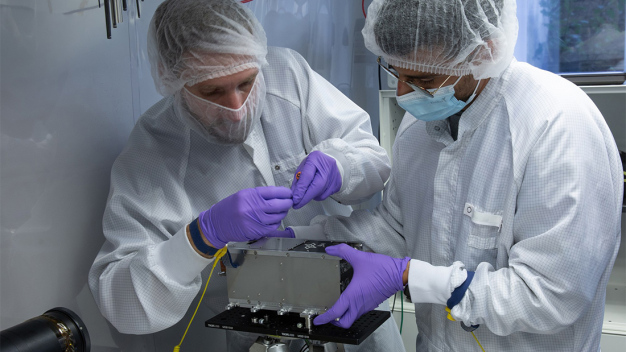
Cube1G Terminal – Work in the cleanroom: The optical terminal is being prepared for deployment in the cleanroom of the DLR Institute of Communication and Navigation. In the SeRANIS mission (Seamless Radio Access Networks for Internet of Space), experiments are demonstrated on the small satellite ATHENE-1, whose data are transmitted to the ground via Cube1G. (Credit: © DLR. All rights reserved)
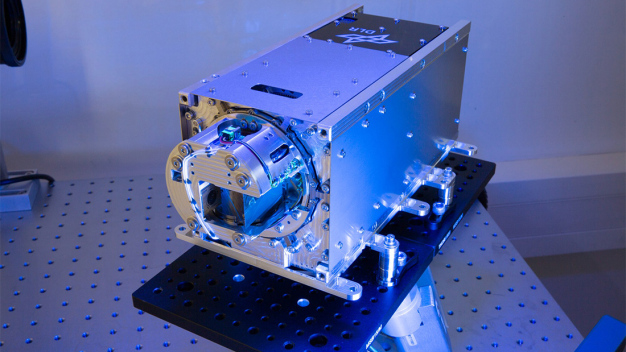
Cube1G Terminal in the cleanroom: The optical Cube1G terminal features a coarse alignment unit that can move the laser beam in any direction independently of the carrier system. This flexibility enables data transmission regardless of the satellite's position. (Credit: DLR (CC BY-NC-ND 3.0))
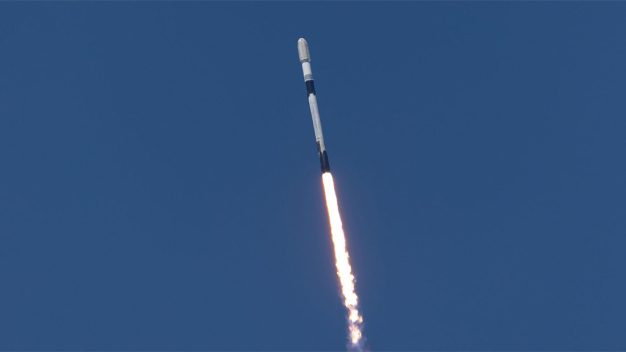
Start of the Transporter-18 Mission by SpaceX: On Thursday, October 1st, at 8:32 p.m. CEST, Falcon 9 launched as part of the "Transporter-18" mission from Space Launch Complex 4E (SLC-4E) at Vandenberg Space Force Base in California into low Earth orbit. "Transporter-18" was a special rideshare mission for small satellites. This flight included 130 payloads, including CubeSats, microsatellites, hosted payloads, as well as two spacecraft with re-entry modules and four orbital transfer vehicles, which transported 41 of these payloads that were to be deployed at a later time. (Credit: SpaceX)
– The GSOC National Space Operations Center of the DLR is responsible for transmitting telemetry data, sending commands, and monitoring and controlling the satellite.
– The DLR also provides two instruments onboard the satellite.
– The technology demonstrator ATHENE-1 is a central element of the SeRANIS research project, led by the University of the Bundeswehr Munich.
– Focus areas: Spaceflight, security, small satellites
The technology demonstrator ATHENE-1 was successfully launched from the US Vandenberg Space Force Base in California. The small satellite, developed and built by the OHB subsidiary LuxSpace in collaboration with the University of the Bundeswehr Munich, was launched aboard a SpaceX Falcon-9 rocket as part of the Transporter-18 mission and was planned to be placed into a low Earth orbit. The satellite is controlled by the GSOC (German Space Operations Center) of the DLR (German Aerospace Center) in Oberpfaffenhofen. Research at GSOC aims to test new operational concepts for further automation. Additionally, the DLR provides two instruments onboard the satellite.
ATHENE-1 is the central element of the SeRANIS (Seamless Radio Access Networks for Internet of Space) research project, led by the University of the Bundeswehr Munich and supported by the Bundeswehr's Center for Digitalization and Technology Research (dtec.bw). The project's goal is to accelerate the transfer of innovative technologies from research into practical application and to demonstrate their benefits for future space capabilities.
GSOC as the central interface between satellite and ground segment
With the successful launch, the operational phase of the mission begins. GSOC provides the necessary ground infrastructure for transmitting telemetry data, sending commands, and monitoring and controlling the satellite.
"The GSOC in Oberpfaffenhofen serves as the satellite control center and the central interface between the satellite and the ground segment," says Dr. Anke Pagels-Kerp, DLR Executive Board Member for Spaceflight. "At the same time, we are researching the processes and methods for satellite control of tomorrow, which will be highly automated and characterized by a much larger number of satellites in mega-constellations down to low Earth orbits. ATHENE-1 is an ideal test platform to practically trial this increasing automation of control procedures in space."
The nearly 300-kilogram satellite ATHENE-1 will serve as a technology and testing platform for a total of 15 scientific experiments. The DLR is involved with the laser communication terminal Cube1G and the instrument LITE (Laser Interferometer for Thermal Expansion measurements) for measuring thermally induced deformations of new materials.
Testing key technologies under real conditions
The focus of the mission is on new technologies for satellite-based communication and networking, reconnaissance and sensing, navigation, and AI-supported data processing directly in orbit. These technologies include sixth-generation mobile systems (6G), laser communication, and the Internet of Things (IoT). Procedures for detecting, localizing, and countering interference are also being tested to enhance the resilience of satellite navigation and communication systems. Furthermore, the mission enables testing of new approaches to intelligent signal and data processing, as well as future applications in security.
"When we launched SeRANIS six years ago, our goal was to test new key technologies as early as possible under real space conditions. With the successful launch of ATHENE-1, this vision is becoming reality. We could not have foreseen the security policy developments of recent years — but the flexible mission design has allowed us to incorporate new questions," says Prof. Andreas Knopp, initiator and program director of SeRANIS at the University of the Bundeswehr Munich.
Responding more flexibly to new scenarios
Technologically, ATHENE-1 also represents the shift toward software-defined and reconfigurable satellite systems. The technologies tested during the mission are intended to enable functions and applications to be adapted after launch to new requirements. This allows satellites to respond more flexibly to new standards, operational scenarios, or disturbances.
"The successful launch of ATHENE-1 is a significant milestone for the entire project team and a strong example of the capabilities of collaboration between science and industry," says Marco Fuchs, CEO of OHB. "With this mission, we are laying the groundwork to gain crucial insights for future communication, navigation, and security applications. The developments of recent years have shown how important technological sovereignty and resilient space systems have become."
The ATHENE-1 mission is based on LuxSpace's modular small satellite platform Triton-X Heavy, combined with a multifunctional experimental payload developed by the University of the Bundeswehr Munich, which was integrated at OHB's Oberpfaffenhofen site. OHB Orbital Access was responsible for executing the launch campaign. In addition to spaceflight operations and astronaut training, the DLR is involved through the Institute of Communication and Navigation in Oberpfaffenhofen and the Institute of Satellite Geodesy and Inertial Sensors in Hannover.
DLR e.V.
51147 Köln
Germany