- Buildings & Rooms
- Translated with AI
Room pressure regulation offers high savings potential
STZ EURO optimizes room pressure in cleanrooms and increases energy efficiency
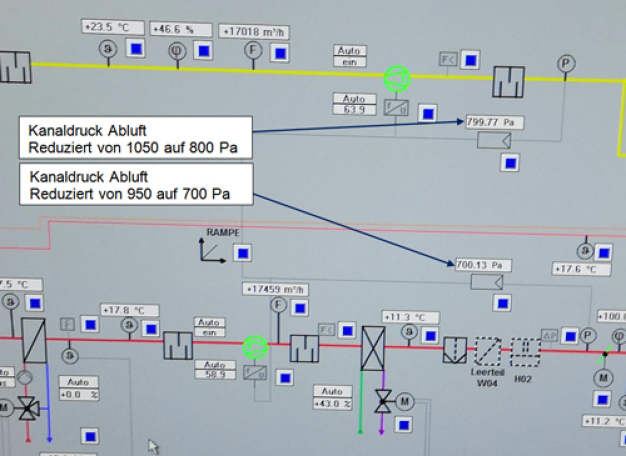
Through appropriate optimization by STZ EURO, the duct pressure in the exhaust air was reduced from 1,050 Pa to 800 Pa, and in the supply air from 950 Pa to 700 Pa.
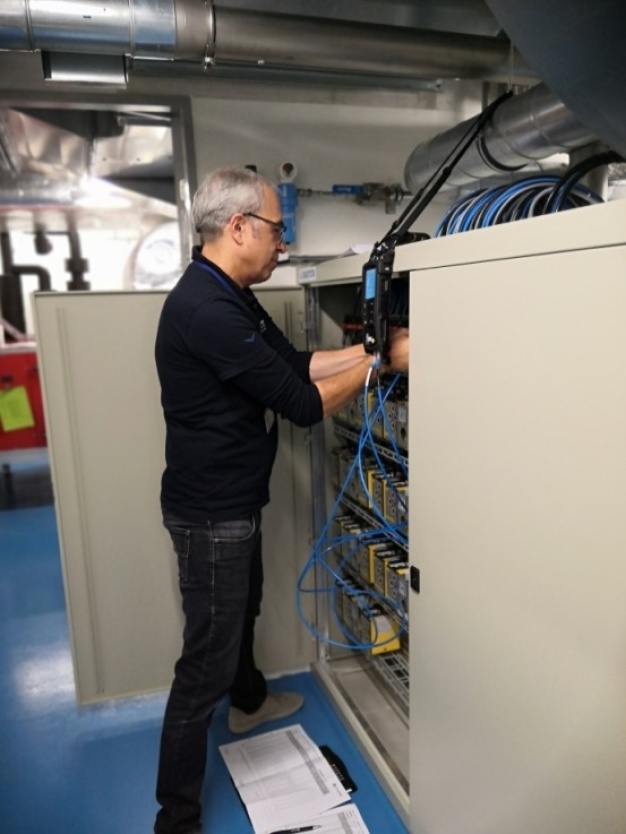
STZ EURO-Engineers adjusting the volume flow and room pressure control circuits.
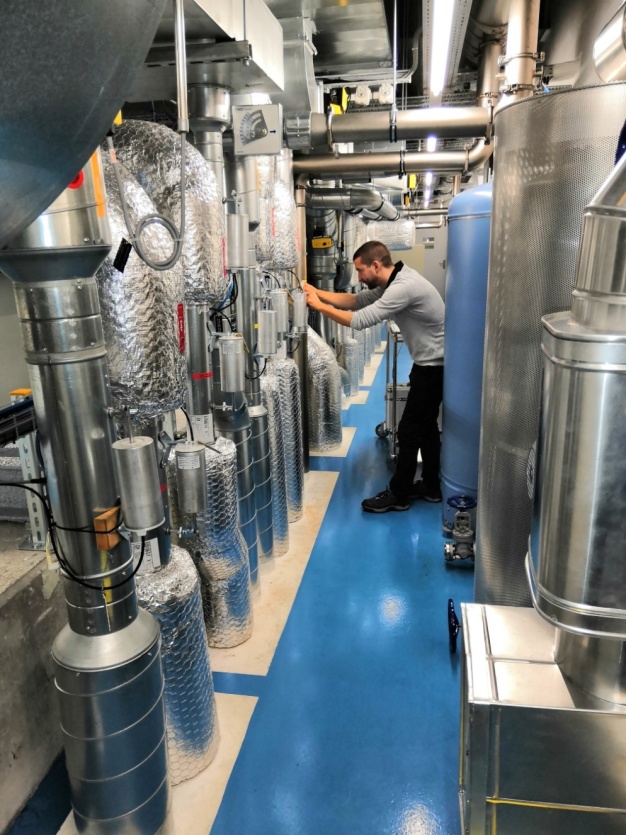
STZ EURO engineers during the adjustment of the volume flow and room pressure control circuits.

Dipl.-Ing. (FH) Michael Kuhn, Head of the Steinbeis Transfer Center for Energy, Environmental, and Cleanroom Technology and Lecturer in Cleanroom Technology.
According to the Federal Environment Agency, the use of efficient ventilation systems in industrial and commercial enterprises alone can save around 7 billion kWh. STZ EURO was able to achieve significant energy savings through appropriate optimization of filter systems and control loops in a cleanroom area, as well as eliminate disruptive room pressure fluctuations. This was a great relief for a packaging company in the pharmaceutical sector.
Room pressure fluctuations can jeopardize the production safety of pharmaceutical manufacturers. In the case of a primary pharmaceutical packaging facility, it was found that the air filters used in the control loop offered very high flow resistance. The higher the resistance, the more energy the fans need to maintain pressure. When the filters are dirty, a strong negative pressure occurs in the control loop, which then becomes unstable. Therefore, not only was a solution for the room pressure fluctuations close at hand, but additional savings opportunities as well.
STZ EURO accompanied the installation of the new HEPA filter systems. These have a much lower initial pressure loss than the previously installed filters. Filter integrity tests were conducted both before and after the installation to ensure proper function.
However, the work was by no means finished here. Although it is common practice in the industry to simply adopt the previous setpoints of the control loops.
"Due to the lower resistance throughout the control circuit, the setpoints for volume flow and room pressure control can now be further optimized," says Michael Kuhn, head of STZ EURO. The pressure setpoints for the supply and exhaust air ducts were gradually reduced and readjusted while maintaining an appropriate control reserve. Accordingly, the entire volume flow and room pressure control circuits were adjusted by STZ EURO.
"Considering that a large part of the energy in HVAC systems is needed to overcome the airflow resistance of air filters and compensate for pressure loss, optimized settings can lead to significant savings. This is an often overlooked but highly profitable factor for a company's energy balance," adds Michael Kuhn.
For example, the exhaust duct pressure at the pharmaceutical packaging company was reduced from 1,050 Pa to 800 Pa in the first control loop. The supply air duct pressure of the second control loop was reduced from 950 Pa to 700 Pa. A savings of 500 Pa.
Generating and maintaining 500 Pa caused the operator an annual additional energy cost equivalent to about eight single-family homes. A cost that—regardless of trouble-free operation—is now being consistently saved.
"After the professional optimization of our ventilation system by the STZ engineers, it is now running smoothly. Everything was completed within the planned timeframe. Especially gratifying is that the room pressure fluctuations have stopped, and we are also saving energy through the reduction of duct pressure," says Roberto Gheza, Technics & Validation of the customer.

STZ EURO Steinbeis-Transferzentrum
Energie-, Umwelt- und Reinraumtechnik Offenburg
Badstraße 24a
77652 Offenburg
Germany
Phone: +49 781 20354711
email: mkuhn@stz-euro.de
Internet: http://www.stz-euro.de