


- Robot
- Translated with AI
Robot-assisted automation under sterile conditions
Loading and unloading of freeze dryers at Vetter in Ravensburg
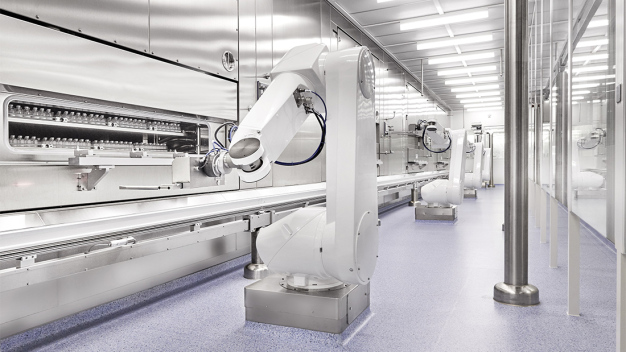
A total of ten Stäubli Stericlean robots handle the automated loading and unloading of the freeze-drying systems under sterile conditions. (Image rights: @ Vetter Pharma International GmbH)
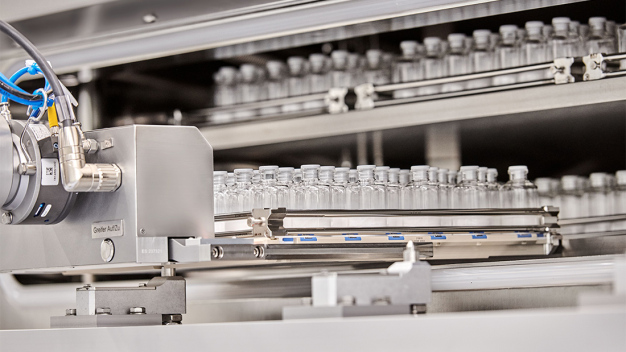
The Stäubli robots operate with the utmost precision when handling the vials. (Image rights: @ Vetter Pharma International GmbH)
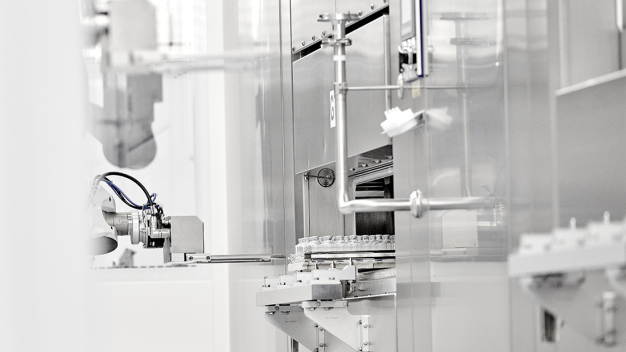
The systems are loaded on one side and unloaded on the other. This task is performed by a robot that grips the frames with vials. (Image rights: @ Vetter Pharma International GmbH)
The latest lyophilization filling line from pharmaceutical service provider Vetter sets standards in hygiene. Ten Stäubli Stericlean robots, developed for use in pharmaceutical production, handle the automated loading and unloading of freeze dryers under sterile conditions.
With freeze drying or lyophilization, pharmaceutical manufacturers have a process available that extends the shelf life of medications. The principle: a liquid active ingredient, already filled into injection systems, is dehydrated under vacuum. This usually occurs slowly to prevent damage to the molecular structure of the active ingredient, using defined temperature profiles and under vacuum. At the end of the freeze-drying process, a solid active ingredient in powder form with longer shelf life and excellent transportability is produced, which can be re-liquefied as needed before use.
For the pharmaceutical service provider Vetter, headquartered in Ravensburg, lyophilization is a proven process. The company operates production facilities with subsequent freeze drying in several plants. When planning such systems, Vetter relies heavily on its own expertise. The freeze dryer itself is purchased, as is the robotics, but the system integration is handled by Vetter's own automation technology.
Urgently recommended: Automatic loading and unloading
The high degree of automation in this and other production areas is not only driven by the pursuit of high process efficiency and productivity. Equally important is the need for sterile working conditions, which is much safer when processes are carried out without human intervention.
This is also mandated by relevant regulatory guidelines for pharmaceutical production. Dr. Arne Schröder, Head of Production Systems at Vetter: “Annex 1 of the EU-GMP guidelines, effective since 2023, clearly states: Automatic vial sealing under aseptic sterile conditions – which is part of the lyophilization process – is 'highly recommended'.” The industry follows this urgent recommendation, and rightly so: a single contaminant introduced into the process can have far-reaching consequences – up to the complete loss of valuable batches.
At the center: Four flexibly controllable freezing systems
The latest Vetter filling line integrates four freeze dryers into the layout of the cleanroom. They are located between the two cleanrooms for vial filling and vial sealing. Since different active ingredients are lyophilized in these systems, the central operating parameters can be adjusted across a wide range. The freezing temperature varies from -10 to -50 degrees Celsius, and the time to reach the target temperature ranges from 36 to 140 hours. Dr. Arne Schröder: “Particularly complex active ingredients like monoclonal antibodies must be freeze-dried very slowly; otherwise, damage can occur.”
Depending on vial size, a freeze dryer in this production system can lyophilize up to 96,000 units per batch. Up to 500 vials are placed on a transport plate, which is part of a transport system developed by Vetter with a “Specific loading pattern”: Similar to puzzle pieces, the stainless steel frames of the transport plates interlock with others, allowing the Stäubli robots to handle them individually or in groups. This mainly simplifies unloading.
Ten robots for hygiene-sensitive applications
For loading and unloading the freeze dryers, Vetter’s planners developed an automated solution – as recommended in Annex 1 of the EU-GMP guidelines. The systems are loaded from one side and unloaded on the other. Each task is performed by a robot that grips the frames with vials. In addition to these eight robots positioned directly at the systems, two more handle the transport of the frames before loading and after unloading.
The selection of robots focused on one key factor: operability in a sterile, hygiene-sensitive environment. Due to decades of collaboration, the decision was straightforward. Vetter uses Stäubli Stericlean robots from the TX2-160 series, specifically developed for these conditions. “Vetter is known for its high standards of quality and process safety. We are very pleased that the company has trusted our robotic systems for many years,” says Tobias Resch, Key Account Manager Pharma at Stäubli Robotics.
The Stericlean six-axis robots enable operation under aseptic conditions. The hermetically sealed robots work reliably in GMP Class A cleanrooms and are suitable for regular thorough cleaning, e.g., with vaporized hydrogen peroxide (H2O2).
Hygienic plant design
What stands out about the eight Stericlean robots of the TX2-160 type for loading and unloading the freeze dryers is their off-center arrangement. Normally, smaller robots from the TX2-90 series would suffice for this task – if not for the pharmaceutical-grade sterility requirements. Dr. Arne Schröder: “For this application, the requirements of GMP Class A cleanroom are in effect. That means we need a unidirectional airflow, and the robots must not interfere with or cause turbulence in this airflow. Therefore, the Stericlean robots are positioned next to the systems, which requires investing in six-axis robots with greater reach.”
From a hygiene perspective, the factors of serviceability and robot lifespan are also important for Vetter: “If a robot were to fail unexpectedly, it could lead to the loss of the entire batch. In our plants, Stäubli robots are known for their long service life and high system availability. That’s another reason we chose Stericlean robots.”
Best results in hygiene monitoring
Vetter sets very high standards for germ-free conditions and their verification. Dr. Arne Schröder: “For each batch, we place agar plates at critical points and evaluate them microbiologically afterward. Only when these results are approved do we release the batch for the customer.”
Since commissioning the system in 2020, around 21,000 such tests have been conducted without a single anomaly. “This is a significant success, largely because very little personnel are present in the sterile area.” Thus, the Stericlean robots make a crucial contribution to sterile medication manufacturing according to the highest hygiene standards.
Stäubli Tec-Systems GmbH Robotics
95448 Bayreuth
Germany