




- Systems
- Translated with AI
Retrieve machine data via the connection cable
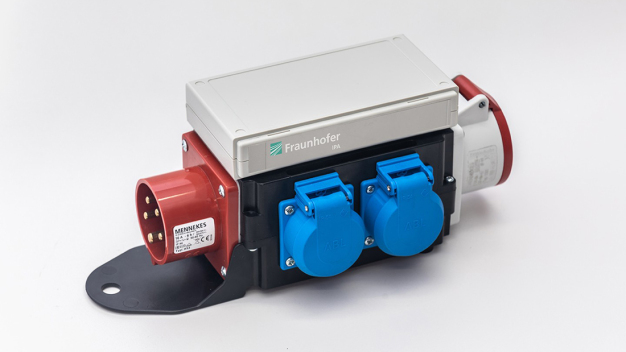
This AC current transformer uses the power supply to retrieve basic machine data. © Fraunhofer IPA/Photo: Rainer Bez
Low-threshold entry into digital production: A research team from the Fraunhofer Institute for Production Technology and Automation IPA has developed an affordable and easy-to-use monitoring system that extracts data from old existing machines. IT expertise and process knowledge are not required for this.
Especially small and medium-sized enterprises (SMEs) are still at the beginning of digitalization. This conclusion is drawn by a study conducted by students of the ESB Business School at Reutlingen University in collaboration with Fraunhofer IPA. They surveyed a total of 23 companies from various industries of the industrial mid-sized sector in Baden-Württemberg between October 2018 and January 2019. Since then, there has been no fundamental change in this finding.
In fact, many of the machines in mechanical workshops or production are decades old. They still reliably serve their purpose today, but lack modern controls and cannot be networked with each other. "However, there is interest in Industry 4.0," notes Christoph Birenbaum, Group Leader for Lightweight Manufacturing Systems at Fraunhofer IPA. What is missing is the budget for extensive digitalization measures and the necessary expertise. "Therefore, there is a need for an affordable and easy-to-operate solution that quickly extracts data from existing machines, significantly lowering the barriers to entry for digitalization."
Basic functions already enable new business models
This is exactly what a research team led by Birenbaum has now developed. A contactless alternating current measurement transducer uses the power supply to retrieve basic machine data, stores it in a cloud, and displays it in the form of simple, minimal-function graphics in an app. From this, it can initially be seen whether a machine is running without faults. Curve progressions also indicate which forces are acting while the machine processes a workpiece.
Furthermore, the system offers the possibility, after a short learning phase, to perform simple process monitoring and to detect whether, for example, cutting tools are new, somewhat worn, or worn out. Until now, many machine operators relied on their hearing or other experiential knowledge for this question. Now, the app shows them when it is time to replace wear parts such as drills, milling cutters, or saw blades. "Such basic functions are enough to develop new business models and allow SMEs an initial simple entry into digitalization," says Birenbaum. Machine tool manufacturers could thus become service providers and offer their customers predictive maintenance services.
No technical expertise required
Unlike existing retrofit solutions, Birenbaum and his team’s approach does not require IT expertise or process knowledge. And the monitoring system along with software and a simply designed user interface will also be affordable. The researcher estimates that it could eventually be available for around 150 euros.
However, the retrofit monitoring system currently exists only as a prototype. It is being further developed in a project in collaboration with a partner. Among other things, the software is being supplemented with elements of artificial intelligence.

Fraunhofer-Institut für Produktionstechnik und Automatisierung IPA
Nobelstraße 12
70569 Stuttgart
Germany
Phone: +49 711 970 1667
email: joerg-dieter.walz@ipa.fraunhofer.de
Internet: http://www.ipa.fraunhofer.de



