
- Filter
- Translated with AI
Proactively plan process exhaust in cleanrooms
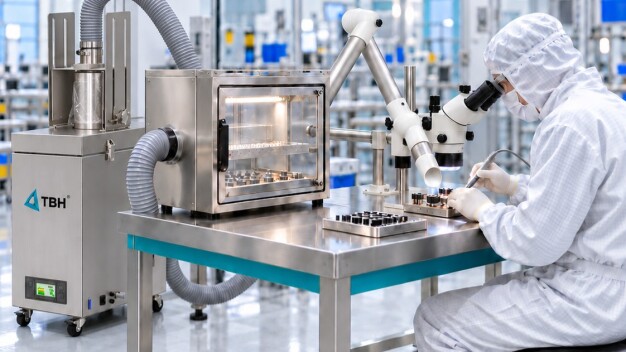
Local extraction while blowing off small components under the microscope, as well as extraction of vapors from a drying chamber. AI-generated example illustration, as an original image of the customer’s process cannot be used for data protection reasons.
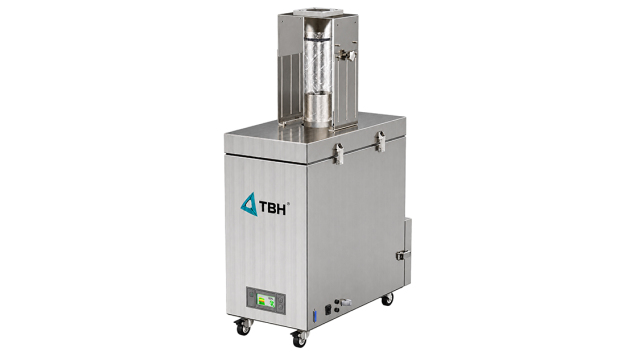
The TBH CR series with the filter console extended. © TBH GmbH
During the post-processing of medical technology components, particles and gaseous emissions must be reliably captured. A customer project shows how different extraction tasks can be solved with TBH’s CR series. In addition to process extraction, the subsequent filter change also plays an important role.
A medical technology customer approached TBH GmbH with a specific challenge: After small components are coated with epoxy resin, further processing steps take place in a cleanroom. Under a microscope, the components are blown off with a cannula, which can stir up particles. In addition, outgassing occurs in a drying chamber, including volatile organic compounds (VOCs) from the epoxy resin process. The customer was looking for an extraction solution that would take both emission sources into account and could be integrated into the cleanroom environment.
With the CR-GL265, TBH was able to offer a suitable solution for these requirements. The system enables targeted capture of emissions at their respective points of origin and combines multistage filtration with a special filter change concept. Especially in a cleanroom, the challenge does not end with the separation of particles: The release of the captured substances should also be avoided when saturated filters are subsequently replaced.
Low-contamination or contamination-free filter change
The CR-GL265 offers two filter change procedures. With the low-contamination option, the intake area is shielded during replacement by a retractable protective hose. The patented SafeChange system enables a contamination-free filter change. Before removal, a retractable transfer liner is sealed with a special closure, keeping the separated particles enclosed.
A special feature of the CR-GL265 is the downstream H14 safety filter. It serves as an additional safety stage in the event of a possible leak in the upstream HEPA filter. As no SafeChange option is provided for this filter, it is replaced annually outside the cleanroom. The maintenance location and accessibility of the system should therefore also be taken into account during the planning stage.
Tailoring filtration to the process
The CR-GL265 combines an F7 pre-filter, an H13 particle filter and the additional H14 safety filter. An activated carbon unit is optionally available for suitable gaseous substances. The required filter configuration depends on the substances actually released, their concentrations and the respective process conditions.
Activated carbon saturation is not detected via the regular filter monitoring system. Its service life and the required replacement must therefore be considered separately. The extraction system can also be integrated into the machine control system via a 25-pin Sub-D interface.
Cleanroom suitability tested
The cleanroom suitability of the CR-GL265 was tested by CCI – von Kahlden GmbH. With regard to particulate emissions, the system tested was confirmed as suitable for use in cleanrooms up to ISO Class 5 in accordance with DIN EN ISO 14644-1. Other test criteria included filter tightness, the electrostatic discharge capability of the housing and cleanability.
The exhaust air is directed toward the floor in order to affect the cleanroom airflow as little as possible. This airflow direction was also examined as part of the testing.
The customer project illustrates that several factors interact when planning cleanroom extraction: capture directly at the process, the appropriate filter configuration, airflow direction and the subsequent filter change. If these requirements are taken into account at an early stage, extraction technology can be specifically integrated into sensitive manufacturing processes.
TBH at COMPAMED
Those who would like to learn more about the CR series and suitable extraction solutions for medical technology can speak directly with TBH experts at COMPAMED in Düsseldorf. The company will be represented in Hall 8B at the Baden-Württemberg joint stand THE LÄND.
TBH GmbH
75334 Straubenhardt
Germany