



- Translated with AI
New Construction Wildau: Benefits for Research, Industry, and the Region
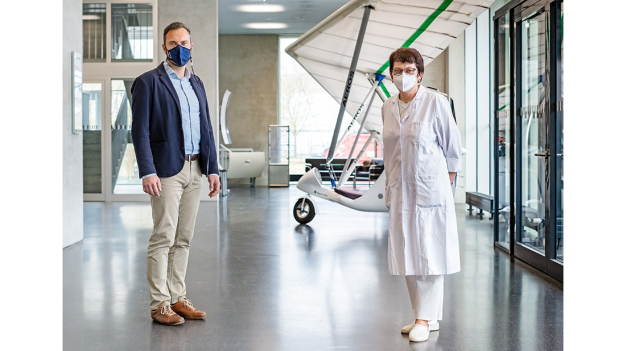
Professor Holger Seidlitz and Katarina Padaszus in the foyer of the new building in Wildau. © Fraunhofer IAP, Photo: Till Budde
The PYCO research division of the Fraunhofer IAP has consolidated its lightweight construction expertise, previously spread across multiple locations, under one roof in Wildau – recently marking the handover for the new building. This offers many advantages for industrial customers: The spacious facilities include laboratories for material development as well as space for manufacturing technologies for larger components. Fraunhofer IAP thus provides complete lightweight construction solutions from a single source.
Whether for aerospace or automotive sectors, wind turbines or rail vehicles: The Polymer Materials and Composites PYCO research division of the Fraunhofer Institute for Applied Polymer Research IAP develops corresponding lightweight construction technologies – focusing on fiber-reinforced composites based on thermosetting reactive resins as well as thermoplastics, which must meet the highest standards. Previously, the technologies for synthesis, resin formulation, and component manufacturing were split between two locations in Teltow and Wildau; they are now united under one roof – in a recently acquired new building at the Wildau site, where around 30 researchers are already working. The new office and laboratory buildings cover approximately 2,700 square meters and are equipped with state-of-the-art technology. The centerpiece of the Wildau technical campus is, among other things, an impregnation system, which is modular and can be used for coatings, impregnation, and prepreg production. The new building was financed 80 percent by the European Regional Development Fund and ten percent each by the federal government and the state of Brandenburg.
Advantages for Researchers, Industrial Customers, and the Region
“We are now bringing all disciplines under one roof,” says Prof. Holger Seidlitz, who heads the PYCO research division. “And we also have the space capacity for engineering disciplines. Our credo is: From monomer to component – everything from a single source.” While the research division was previously strongly focused on materials science, the engineering perspective of lightweight construction is now also incorporated: pure material development has been expanded to include the manufacturing chain. Industrial customers particularly benefit from this new focus on components.
This expansion is also reflected in the organizational chart: Prof. Christian Dreyer oversees materials development in the “Customized Materials” group, while Mr. Seidlitz focuses on the engineering perspective in the “Design and Manufacturing” group – dealing with lightweight construction designs, calculations, manufacturing technologies, and testing scenarios for components at a large scale. In short: The engineers are capable of jointly developing components and parts with partners and customers for practical applications. “With our solutions from a single source, we offer development for practical use – which is especially valued by industry,” confirms Seidlitz.
In addition to leading the PYCO research division at Fraunhofer IAP, Seidlitz holds a professorship at Brandenburg University of Technology Cottbus-Senftenberg, located in the “capital” of structural change in Lusatia. “With the new site, we will be able to serve the Wildau-Cottbus axis even more closely in the future and offer a wide range of expertise,” says Seidlitz. “In this way, we can better support the activities related to structural change than before.” The new location thus offers numerous advantages – not only for research but also for industry partners and the region.
Location Teltow: An Era Comes to an End
The Teltow site, which has now been closed in favor of the new building in Wildau, can well be described as a traditional location: During the GDR era, it belonged as the Institute for Fiber Research to the Academy of Sciences; in 1976, it was completely restructured into the Institute for Polymer Chemistry. After reunification, the Fraunhofer Society took over part of the institute. The PYCO division was initially affiliated with Fraunhofer IFAM, later transferred to Fraunhofer IZM, then became an independent Fraunhofer facility, until it was finally integrated into Fraunhofer IAP as a research division in 2016.
This entire development is well known to Katarina Padaszus from her own experience; she worked in Teltow for 45 years and was thus the “longest-serving employee” at the location. She was also the one who symbolically turned off the lights and closed the door in the old institute building. “The research priorities have remained similar – even in the GDR, we were already dedicated to resin development, mainly for use as adhesives and coupling agents. The current focus, however, is more on their modification and processing for numerous technical applications,” summarizes Padaszus. “However, the research conditions and technologies have changed significantly: while in the GDR we thought it was great just to have a calculator, I am now amazed at the complex and highly efficient devices we can access today.”
Fraunhofer-Institut für Angewandte Polymerforschung IAP
14476 Potsdam-Golm
Germany



