
- Electronics (wafers, semiconductors, microchips,...)
- Translated with AI
Maybe the smallest university logo in the world?
Electrical engineering student at Hochschule Karlsruhe creates a three-dimensional HKA logo with line thickness of one-tenth of a hair's width
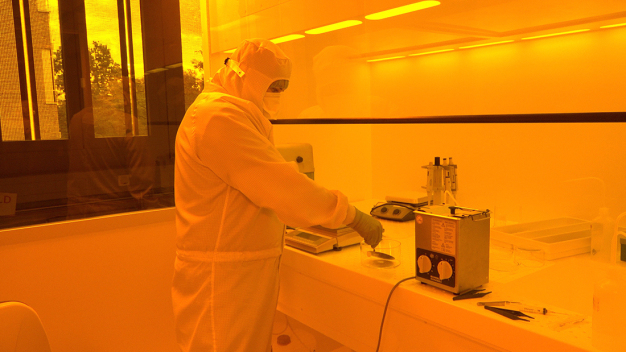
Electrical engineering student Matthias Wagner immerses the silicon wafer into a development bath in the cleanroom.
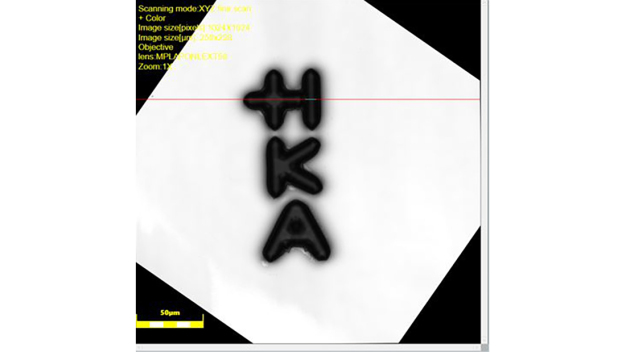
Microscopic image of perhaps the smallest university logo in the world: The line width is 8 µm, the logo is approximately 50 µm wide ...
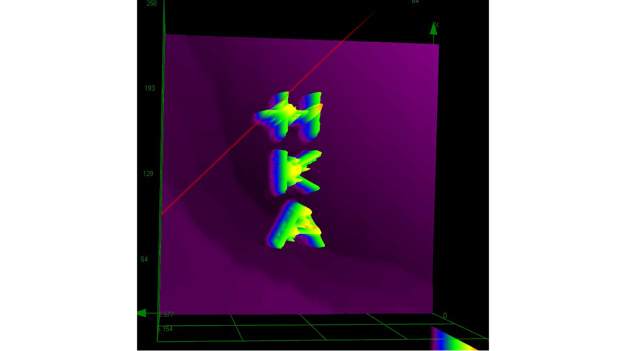
... , so this is at least the smallest HKA logo in the world.
A very special semester project was chosen by Matthias Wagner: he created the smallest HKA logo in the world as a three-dimensional microstructure. The structure consists of a plastic-like polymer and is applied to a silicon substrate. The letters of the logo have a line thickness of only about 8 µm. The human hair of a Central European is approximately 60 to 80 µm wide, which means: the entire logo, with a width of around 50 µm, easily fits into a hair, and the logo cannot be seen with the naked eye.
Matthias Wagner, who studies electrical and information engineering with a specialization in sensor technology at Karlsruhe University of Applied Sciences (HKA), produced the miniaturized HKA logo using a lithography process. This process is also used in the semiconductor industry to manufacture computer chips. First, a so-called photomask with the miniaturized logo is created. The photomask is comparable to a stencil or a slide. It is illuminated with UV radiation during the process, which projects the logos onto an extremely smooth silicon wafer, known as a wafer. The silicon wafer is coated with a light-sensitive lacquer. The exposed areas harden, and the unexposed areas are removed during development – leaving behind the microstructures of the HKA logo.
One challenge was scaling the logo down to the micrometer level. In this range, even tiny dust particles act like large boulders. Therefore, all activities had to be carried out in the nearly dust-free cleanroom of the Faculty of Electrical and Information Engineering.
"For me, it was important to learn about all the equipment and processes and to acquire the skills needed in the semiconductor industry," summarizes Matthias Wagner of his project work. After completing his studies, the 30-year-old, who previously completed training as a medical-technical laboratory assistant, plans to move further into medical technology. "A clear trend towards miniaturization of sensors in analytical devices can also be seen in the medical field," says Prof. Dr. Christian Karnutsch, who supervised the project and also leads the IONAS working group, which researches microfluidic and nanophotonic systems. Therefore, it is important, according to Karnutsch, to give aspiring electrical engineers access to the tools of micro- and nanotechnology during their studies, to let them experiment with current technologies, and to allow them to make mistakes. "Nothing progresses as quickly as one would like," smiles Matthias Wagner, and this was one of the most important lessons learned: "You have to try some process steps multiple times under different conditions with varying parameters until they finally work. But when you then look into the laser confocal microscope with a magnification of 50x and see the result of the work, it’s a fantastic feeling."
Hochschule Karlsruhe - Technik und Wirtschaft
76133 Karlsruhe
Germany