



- Translated with AI
Manufacturing-integrated cleaning of bulk material
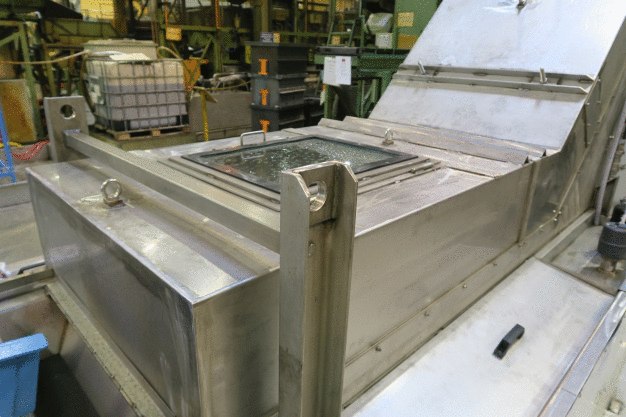
Three immersion transducers integrated into the working chamber filled with 3,800 liters of medium, with a frequency of 25 kHz, enable fast and process-safe cleaning of the parts. (Image source: Weber Ultrasonics AG)
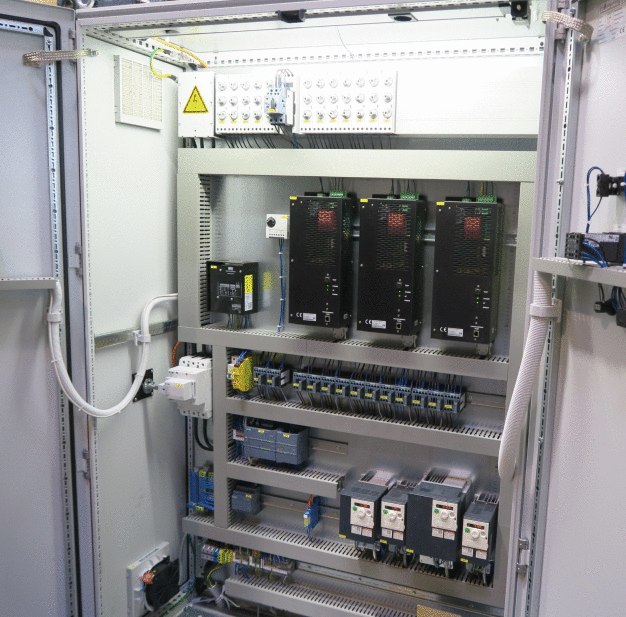
The performance of the ultrasonic railhead generators can be adjusted in 1% steps within the range of 10 to 100 percent, allowing optimal adaptation to part-specific cleaning programs. (Image source: Weber Ultrasonics AG)
Mass-produced items such as screws are typically cleaned as bulk material in batch processes. This part cleaning often becomes a bottleneck in production. To circumvent this, Weber Ultrasonics, together with a machinery manufacturer, developed an ultrasonic cleaning system concept for integrated individual part cleaning of bulk material. It increases productivity, quality, and cost-effectiveness.
The batch cleaning of bulk parts requires elaborate and costly handling of parts for repacking into cleaning containers and subsequent removal for the next manufacturing step. Additionally, part cleaning in batch processes itself takes a lot of time. This often leads to production standstills. Furthermore, batch cleaning carries the risk of part mixing. Due to these disadvantages, a manufacturer of bulk parts was looking for a solution that enables fast and continuous inline cleaning of parts in sync with the production cycle. The time limit was 50 seconds.
Inline Ultrasonic Cleaning System for Bulk Material
This challenge was addressed by Weber Ultrasonics AG, a technology leader in ultrasonic components and solutions for welding, cutting, and cleaning, and by Dr. Ing. Gössling Maschinenfabrik GmbH, which specializes in custom conveyor and process engineering as well as automation systems. Based on the results of process development carried out at Weber Ultrasonics' technical center, the companies designed an innovative conveyor and system concept for individual part cleaning of bulk material.
After production, the parts are transported to a bunker hopper, from which they are conveyed onto a conveyor belt. Here, the parts are separated so that they form a "part carpet" on the 800 mm wide conveyor. This passes through a work chamber filled with approximately 3,800 liters of cleaning medium at a predetermined speed. Inside, three immersion oscillators with a frequency of 25 kHz are arranged at the top. They transmit sound waves generated by three hoist rail generators HS 1, each with 1,000 watts of power, into the cleaning liquid. To ensure optimal sound transmission, the oscillators can be adjusted in height and spacing. The cleaning effect is based on the physical phenomenon of cavitation. It ensures that contaminants such as machining oil, coolant, chips, and abrasives are quickly and reliably removed.
Following the cleaning belt is an ascending, enclosed conveyor with integrated spray nozzles for rinsing the parts. They then reach an equally enclosed, horizontal section of the conveyor where residual water droplets are blown off from the parts. Subsequently, the bulk material is directed onto a so-called "polter belt," equipped with three hot air blowers. These provide sufficient part drying over a length of about 1.5 meters. After cleaning and drying, the parts are automatically transported to the next manufacturing step.
Optimally Coordinated Ultrasonic Technology
The immersion oscillators are designed as durable versions to accommodate continuous operation of the system. They feature, among other things, a laser-welded capsule. This achieves exemplary warpage resistance and dimensional stability, as well as significantly higher quality and strength of the very smooth weld seam.
The ultrasonic generators, which are designed to be integrated and compatible with standard DIN rails, now feature a 32-bit microcontroller for digital frequency generation and control. The power can be regulated from 10 to 100 percent in 1% steps, allowing optimal adaptation to specific parts cleaning programs.
Weber Ultrasonics AG
76307 Karlsbad-Ittersbach
Germany