

- Building technology
- Translated with AI
Make ventilation systems with efficient filters suitable for Ökodesign
More efficient doesn't go: Camfil offers Germany's first F7 pocket filter of energy class A+ and thus ensures bonuses in the energy balance.
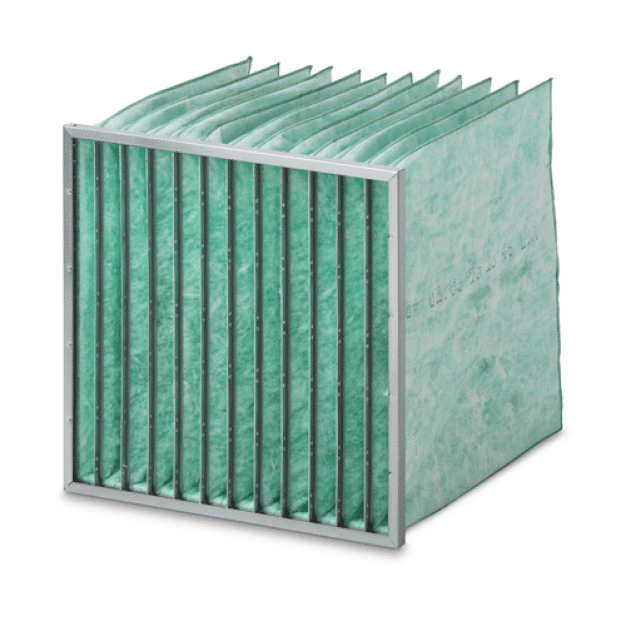
Image: Camfil
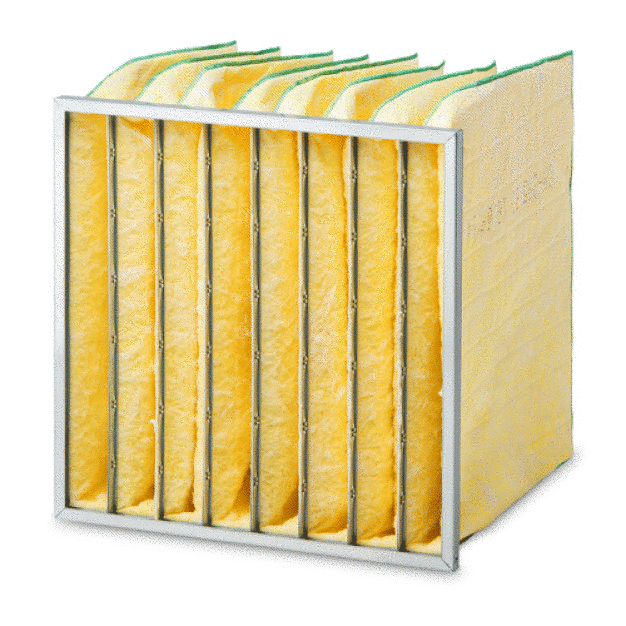
Image: Camfil
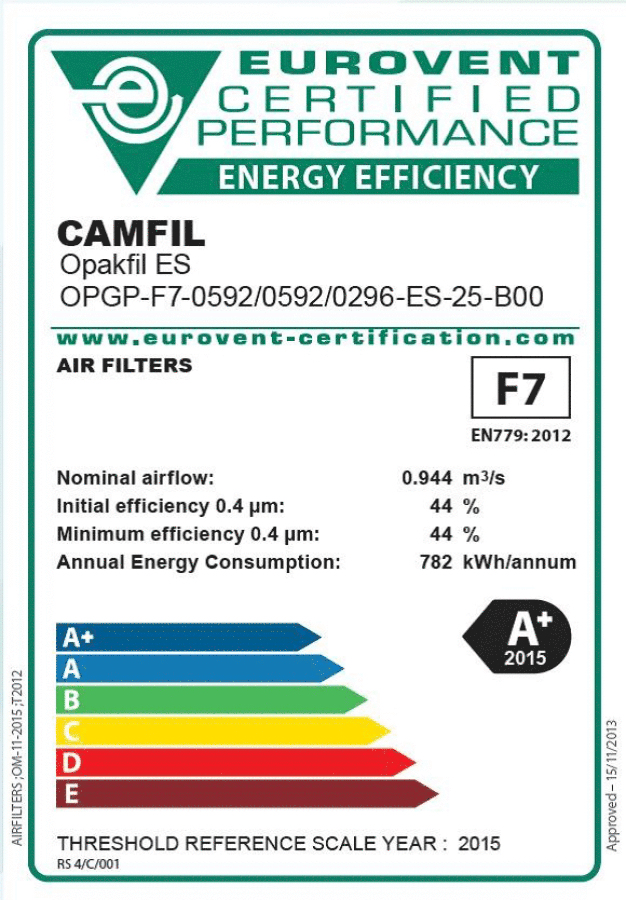
Image: Camfil

Minimum efficiencies required by the EcoDesign Directive 1253/2014 for heat recovery.
The EcoDesign Directive 1253/2014, published at the end of last year, for environmentally friendly design of ventilation systems, although to be implemented gradually over two or four years, still has an ambitious goal: The European Union estimates the annual potential savings in primary energy in 2025 at 15% in residential buildings and even 85% in non-residential buildings.[1] As with all EcoDesign initiatives of the EU, the focus is primarily on parameters that serve to increase efficiency and provide clear labeling of energy-consuming products.
The EU regulation differentiates between purely supply or exhaust air systems and combined supply/exhaust systems, which are the focus of the following explanations due to their wider prevalence.
Central ventilation systems in non-residential buildings with air volumes over 1,000 m3/h must in the future meet additional requirements beyond a clearly defined level of energy efficiency, which must be confirmed with a CE mark after appropriate testing: For example, the fan speed of the fans should be either multi-stage or continuously adjustable from 2016. Additionally, a minimum efficiency of heat recovery of 63% for recirculating systems and 68% for all other systems (such as plate, duct, or rotary heat exchangers) is mandatory. From 2018, an integrated warning system is also required, which signals via measurement of pressure loss when a filter needs to be replaced. Also, from 2018, the minimum efficiency requirements for heat recovery in recirculating systems increase to 67%, and for alternative concepts to 73% (see Fig. 1: Minimum efficiencies for heat recovery required by the EcoDesign Directive 1253/2014).
Furthermore, a maximum value for the electrical power consumption of the fan has been set, which is also influenced by the pressure losses of air filters and heat recovery systems in the HVAC unit. If one of the two filters necessary for supply and exhaust air cleaning is missing during measurement, this deficiency results in a penalty. Conversely, every percentage point by which the integrated heat recovery technology exceeds the permitted minimum value is rewarded with a bonus of 30 W/(m3/s).
According to the EcoDesign Directive 1253/2014, the following components make up the overall configuration of a central supply/exhaust air system for non-residential buildings:
- a housing
- at least two fans with speed control or multi-stage drive
- a heat recovery system (WRS)
- a clean, fine filter on the intake side
(~ a fine dust filter at least class F7 for cleaning the intake air)
complies with the requirements of VDI Guideline 6022 )
- a clean medium-fine filter on the exhaust side
(~ a medium filter at least class M5 for cleaning the exhaust air)
The number of optimization approaches to increase energy efficiency is therefore limited on one hand. On the other hand, the further development of fan efficiencies and resistance reductions in heat recovery systems often leads to significant cost increases for the system. Manufacturers and operators of HVAC systems are therefore well advised to focus primarily on selecting efficient air filters. Because this not only enables environmentally friendly but also comparatively inexpensive optimization of the energy consumption of their ventilation equipment.
The component air filter also seems to be important to the initiators of the EcoDesign Directive 1253/2014, as they already require from January 2016 the indication of the energy properties and preferably the energy classification of the filters used, along with information on annual energy consumption.[2]
When it comes to achieving the best possible filter performance over long service life with minimal energy expenditure, Camfil currently offers the best Eurovent Energy Rating bag filter solution for the required cleaning of intake air: Hi-Flo M7 50+ is the new product, where the "7" stands for filter class F7 and "50+" describes the minimum efficiency with more than 50% (for filter class F7, 35% would be sufficient). However, the manufacturer's real pioneering achievement lies in achieving extraordinary energy efficiency and thus a classification with A+ according to the new Eurovent Energy Rating. This is partly due to an optimized filter medium combined with a particularly aerodynamic bag design. According to Eurovent Guideline 4/21, using a Hi-Flo M7 50+ should not consume more than 764 kWh annually. This corresponds to energy savings of up to 36% compared to an F7 filter of energy class B.
The newly developed conical filter bag design by Camfil is also responsible for the energy-efficient performance of the Hi-Flo UF5. In the M5 filter class, it consumes 585 kWh/year (energy class A), making it well suited for energy-efficient exhaust air filtration in accordance with the EcoDesign Directive.
[1] Kaup, C; Kampeis, P.: Study on the contribution and share of heat recovery from central ventilation systems (RLT systems) in non-residential buildings, 2013.
[2] Regulation (EU) No. 1253/2014, Annex V, p. 1).

Camfil GmbH
Feldstr. 26 - 32
23858 Reinfeld
Germany
Phone: +49 4533 2020
Fax: +49 4533 202202
email: info.de@camfil.com
Internet: http://www.camfil.com