



- Science
- Translated with AI
Ion implantation: A process that has revolutionized semiconductor manufacturing
An interview with Dr. Andreas Thies from the FMD Institute Leibniz FBH
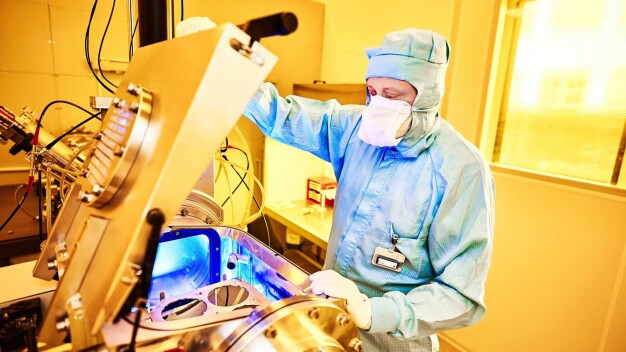
Ion implantation is of central importance for the doping of semiconductors, i.e., the process of introducing foreign atoms into the semiconductor. (Copyright: FBH | Matthias Baumbach)
The development of ion implantation in the 1960s was one of the fundamental prerequisites for the production of highly integrated circuits as we know them today. The process is used to introduce foreign atoms into a semiconductor and thus, for example, change its conductivity (doping). At the Ferdinand-Braun-Institut, Leibniz Institute for High-Frequency Technology (Leibniz FBH), Dr. Andreas Thies, head of the "Backend" working group, is involved in questions such as how ion implantation can be further improved. We spoke with him about his daily work, challenges, and innovations in the semiconductor process.
Mr. Thies, you work at Leibniz FBH in the Process Technology Department and lead the "Backend" working group. What processes are you specifically involved with?
The task of our working group is to produce individual elements, called chips, from components that are still on a complete wafer. After the chips are separated from the wafer, for example by sawing or laser cutting, they all need to be processed individually. This step marks the transition from the frontend to the backend. While all processes in the frontend occur on a wafer, individual chips are processed in the backend. There are also two traditional areas that belong to the backend: implantation – not a particularly clean technology – and electroplating.
What does "not particularly clean" mean in this context?
We work in a cleanroom, which is absolutely particle-free. Well: "absolutely" as a generalization isn't entirely accurate. There are different particle classes, and depending on which cleanroom is used and how small the structures being manufactured are, different particle classes must be maintained. When something is cut or divided in the backend, debris or small particles are generated. When defining how clean the room is, it ultimately comes down to the number and size of particles. Compared to a medical or biological cleanroom, the backend is still very clean. However, the quality criteria of the frontend are even higher.
Let's now take a look at implantation and your daily work. What tasks are you currently working on, and what challenges do you face?
Currently, we are working on advancing our ion implantation further. Classically, an ion implanter is a quite complex device. With our implanter, we introduce many different ions. There are many parameters that can be adjusted to control the implantation process. However, there are also limitations, for example, in the acceleration voltage. This acceleration voltage determines the depth of the implanted ions in the material. It influences not only the penetration depth but also their speed and energy, which in turn affects interactions with the material. Our maximum voltage is 500,000 volts. We cannot set higher voltages, partly because it is prohibited for radiation protection reasons and partly because space constraints in our implanter room make it impossible.
For example, to specifically set the desired electrical properties, we can implant many different ions. This is a significant difference from industrial implantation. Usually, dozens of ion implanters are available, each acquired for a specific task. One is used for phosphorus implantation, another for arsenic or antimony implantation. Unlike in the silicon industry, at FBH we have an implanter that can implant everything we need.
Partners can bring us metals, gases, or liquids – and we convert everything into the gas phase. First, we ionize the substances, accelerate the ions, and then shoot them into our workpiece. Many material properties adjusted via implantation in silicon technology are achieved in III/V semiconductor technology through epitaxy. For this, FBH has its own department, Material Technology, which produces the special layers. We then modify these layers only with ion implantation, for example, by locally destroying them to reduce conductivity.
Furthermore, we are currently developing techniques to further evolve our implanter so that implantation is possible even with very small doses. The dose is always the product of time and current (the number of ions shot per second onto the target material). When currents become very small, they are difficult to measure. Once the current reaches the limit of measurability, we cannot reduce it further, even if only a small dose is to be implanted. But the time cannot be arbitrarily short either. We need a solution for that. Experimenting with new ideas and approaches is very enjoyable for me and makes my work varied.
How long does it typically take to improve or further develop such processes?
With the last example, I have been working on it for about six months. It is indeed a quite complex process. First, ideas need to be developed and planned. Then, components are ordered, which often take three to four months for delivery. Afterwards, the parts may need to be adjusted by our workshop before assembly. Once the functionality has been tested in normal operation, the components are finally installed into the implanter to see if everything works even in ultra-high vacuum. Ion implantation always takes place in a very high vacuum, meaning very low pressure.
Ion implantation is of central importance for doping semiconductors, i.e., the process of introducing foreign atoms into the semiconductor to regulate its conductivity. In the past, this was done through a thermal process or diffusion. However, this method is very sensitive to surface contamination. Why has ion implantation become the standard method, and what advantages does it offer?
Implantation is a standard technique that made silicon technology possible because the introduction of ions no longer depends on the surface condition. Whether the surface has minimal contamination or not doesn't matter. The particles are accelerated and shot onto the surface with relatively high energy so that the layers can be penetrated evenly. Therefore, the yield in ion implantation is very high. Ion implantation also enabled the famous explosive increase in production volume and integration density. It was one of the prerequisites for manufacturing the highly integrated circuits available today.
So, the choice of ions depends on the material used?
Exactly, it always depends on the material and what our customers or colleagues at the institute bring to us in terms of tasks. The way of implantation – the ion type, energy, or dose – must be adapted to the material. That means colleagues tell me what layer structure they want and would like to change, and I simulate it. There are established software tools for this. For a complex epitaxy, programming takes two to three hours. Afterwards, different energies and depths are simulated. I would say that processing a normal order takes about half a day. Sometimes it might take a full day. Overall, it's not rocket science.
Outlook: In addition to ion implantation, we also discussed electroplating and its importance for semiconductor manufacturing with Dr. Andreas Thies. You can read more about this in part two of the interview on FMD.insight.
Forschungsfabrik Mikroelektronik Deutschland (FMD)
10178 Berlin
Germany



