
- Translated with AI
In the clear
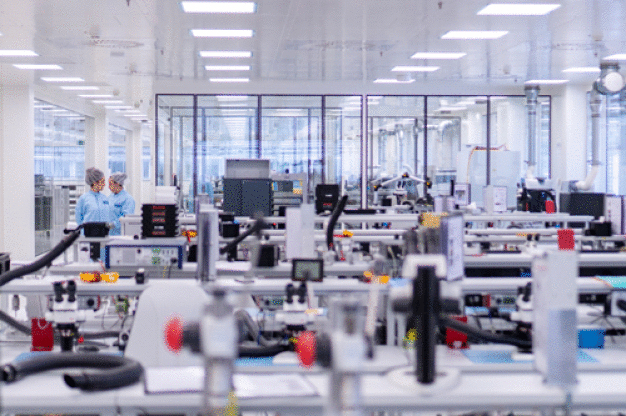
The new certified cleanrooms of Maxon at the headquarters in Switzerland – before and after the move of the first assembly stations. (Image: Maxon Motor)
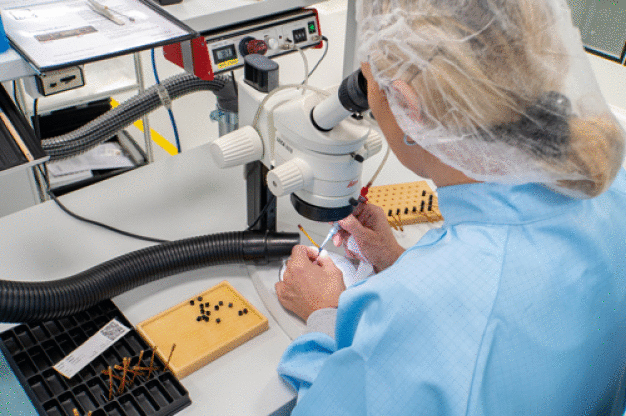
Medical technology does not tolerate mistakes. That is why maxon produces micromotors in certified cleanrooms. The effort required to build such specialized rooms is not to be underestimated.
Cleanrooms are needed in various industries – for example, in medicine, food technology, and the semiconductor industry. Producing electric motors in cleanrooms may seem unusual. However, this is exactly what maxon has been doing since early 2019 in the newly built Innovation Center in Switzerland. Over 1,200 square meters of cleanrooms have been created here, where, among other things, drive systems are manufactured under strict hygiene regulations. But why?
Clearly: To build a powerful motor that, for example, is used in industrial automation, engineering skill, precise work, and a clean environment are required – but not necessarily a cleanroom. Instead, the new cleanrooms are used to produce tiny components from maxon: motors with a diameter of just a few millimeters. Such drives are primarily used in medical technology. While maxon is already a strong partner when it comes to drives in medicine, such as insulin pumps or surgical hand tools, the Swiss drive specialist is equipping itself with the new cleanrooms for even more delicate and intricate applications – including implantable drive systems like heart pumps.
Months of Planning
"Planning a certified cleanroom was a new and exciting challenge for us," says Christian Kunde, project manager at maxon medical. The effort was enormous. "We spent about 15 months planning together with external experts." Indeed: At first glance, they are simply clean rooms separated by glass, with many assembly stations and microscopes. The entire technology takes place behind the scenes: in the partition walls and ceiling, pipes are lined up, and kilometers of cables run. All this technology is necessary, among other things, to generate a higher air pressure in the cleanrooms. The principle behind this: When the door to a cleanroom is opened, clean air always flows out – preventing the entry of dirty air. It would be a "dead end" to leave all doors open. To prevent this from happening, cleanrooms have airlocks where the air pressure is slightly lower than inside but still higher than normal. Modern technology prevents the two entrances and exits of an airlock from being open at the same time. "Communication between door and seal is therefore not possible in cleanrooms," says Christian Kunde with a laugh.
The particle concentration in the air is measured every minute. In addition to the cleanrooms, maxon has recently also established a so-called GMP area (good manufacturing practice). Here, not only is the particle concentration measured, but also the microbiological contamination of surfaces and the air with germs, bacteria, or fungi – again with an eye toward future applications in high-tech medicine with implantable miniature drives.
Air is constantly "purified"
Cleanrooms are certified in various classes. maxon’s cleanrooms belong to the "comfortable" category. That means: Employees must take various measures before and during work – for example, wearing a hairnet and special clothing – but they are not in a completely different world. In nanotechnology, pharmaceuticals, or semiconductor manufacturing, it’s different. Here, employees sometimes look as if they are on another planet. The technology used to keep particle concentration as low as possible also differs. In maxon’s cleanrooms, constantly filtered air flows in. This "circulates" the existing air, which is then extracted and filtered again. Through this continuous exchange, the air is essentially "diluted" in terms of particle concentration. Another, somewhat more elaborate technique used, for example, in operating rooms, is called displacement ventilation or "laminar flow" in English. Here, filtered air flows from top to bottom, and the goal is not to stir up the air but to prevent particles from "floating" in the room in the first place.
maxon motor gmbh
81825 München
Germany