




- Pressure
- Translated with AI
Ralph Jeschabek, Head of Marketing bei ALMiG
In matters of purity unmatched
Röchling Medical Solutions SE in Neuhaus relies on oil-free screw compressors with heat recovery from ALMiG
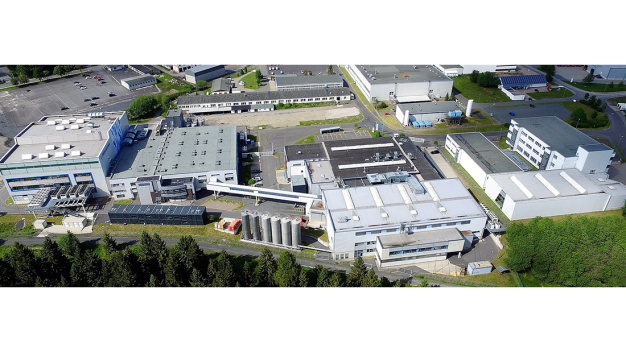
Röchling Medical in Neuhaus am Rennweg: The building for the cleanrooms was inaugurated in 2017. The company had to expand its manufacturing capacities to be prepared for future growth. (Image credit: Röchling Medical Solutions SE)
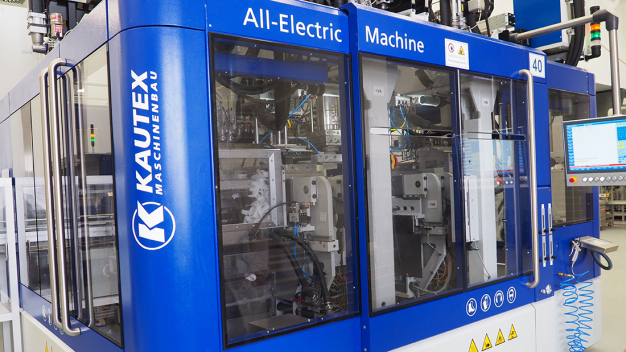
Processes such as blow molding are used for this purpose. (Image: ALMiG Compressors GmbH)
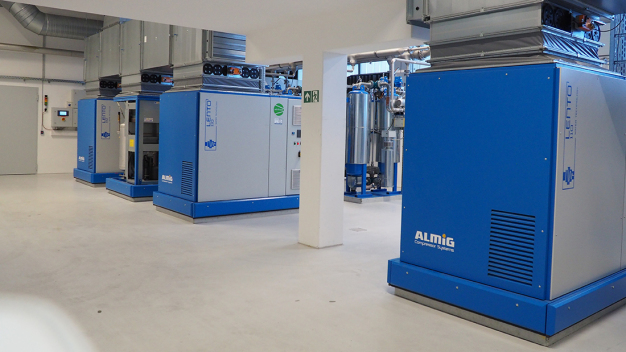
Not guaranteed off the shelf: The compressed air station from ALMiG meets very special requirements for clean compressed air. (Image: ALMiG Compressors GmbH)
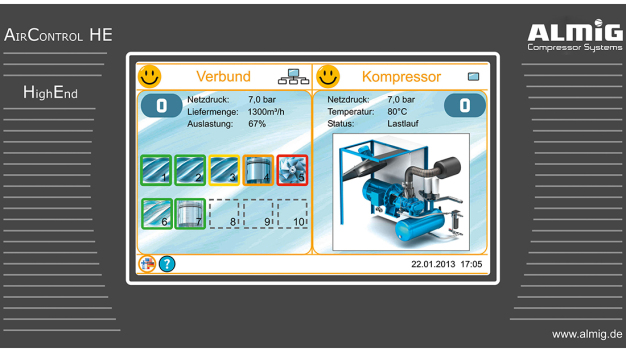
The ALMIG Air Control HE controls the compressors in a load-dependent manner within the network. This allows full utilization of the energy advantages of speed control. (Image: ALMiG Compressors GmbH)
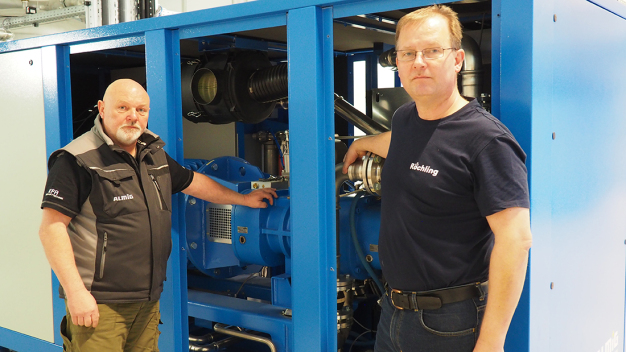
Uwe Herrmann (left) and Jürgen Neubauer at a screw compressor LENTO 110: "Cleaner than the air we breathe." (Image: ALMiG Compressors GmbH)
The Röchling Medical Solution SE in Neuhaus develops and manufactures customized packaging solutions for every medical filling material. For the production of hollow bodies made of plastic, Röchling relies, among other things, on extrusion blow molding. In this process, oil- and germ-free compressed air plays a crucial role in achieving the required quality. A compressed air station with currently seven water-injected screw compressors of the LENTO 110 series from ALMiG is used, which are claimed to be unique in terms of safety. An expansion of the station is planned.
"We produce primary packaging for pharmaceutical products under the most modern cleanroom conditions in GMP classes C and D," describes Jürgen Neubauer. He is Manager of Technical Building Equipment at Röchling Medical in Neuhaus am Rennweg, a small town in the Thuringian Forest. "We inaugurated the cleanroom building in 2017. We had to expand our manufacturing capacities at this site to be prepared for future growth," he says. In 2016, the Röchling Group added the Medical division to its existing Industrial and Automotive sectors. Several large projects quickly arose. The company responded.
About half of Röchling Medical's goods are exported abroad. These include closures, measuring cups, dropper tips, and dispensers with various dosing options, as well as different containers: "We can produce bottles with a capacity of two milliliters and all sizes up to canisters of ten liters or larger," explains Neubauer, pointing to the machines that produce products in the GMP cleanroom class "C". To manufacture the hollow bodies, we rely, among other things, on multilayer extrusion blow molding." In this process, plastic is melted and pressed through a nozzle. A tubular preform is created, which is transferred into the ready blow mold. By increasing pressure, it adapts to the internal contours of the mold. The forming process is additionally assisted by blow air in the tool. "This way, we can also produce hollow bodies with multilayer wall structures," says Neubauer. Critical for product quality: no germs may enter the material via the blow air. Therefore, the purity of the compressed air is subject to particularly high requirements.
Oil- and germ-free compressed air
Until the new building in 2017, Röchling Medical relied on oil-injected compressors. To free the compressed air from oil, each system was equipped with its own treatment chain consisting of cyclone separator, pre-filter, dryer, after-filter, and activated carbon filter. "Nevertheless, there is always a risk of contamination with oil-injected machines. If oil enters the pipeline network, it could cause severe economic damage for us," says Neubauer. "Our goal was to achieve compressed air class 1, while enabling safer operation and working more energy-efficiently."
The decision-makers examined various concepts from different providers. Ultimately, they were convinced by ALMiG Compressors GmbH from Küngen in Swabia, near Stuttgart, with their water-injected machines of the LENTO series. "We were impressed by the coherent machine concept," recalls the Röchling expert.
A reliable partner
Uwe Herrmann is Managing Director of KFA Drucklufttechnik from Zwenkau, south of Leipzig. His company offers maintenance, service, project management, and sales of compressors. He is also a sales partner of ALMiG. "In an initial discussion, it quickly became clear that we could supply both the compressed air system and all necessary components from a single source, so the customer doesn't have to work with multiple providers," explains Herrmann. "We have developed an energy balancing system. It allows us to measure compressed air consumption and power consumption." The software analyzes the results and creates various simulations. Targeted compressor exchanges are made until the expert achieves the energetically optimal result for the customer. The measurements were conducted during low-load periods and also under full load. After thorough analysis, the expert recommended providing the water-injected screw compressors LENTO 110 from ALMiG with a volume flow of 16 cubic meters per minute at ten bar overpressure.
When the building for the new compressed air station was ready, the first four units were installed. A few months later, two more compressors of the same series followed. In 2021, Röchling decided to invest in another machine from the LENTO series due to increasing order volumes. Production runs 24 hours a day, seven days a week. With the installation of the new compressors, the old systems were gradually phased out.
Low speed, long service life
The LENTO systems have significantly lower maintenance costs compared to alternative technologies, such as dry-running screw compressors. "This is mainly due to their simple design," explains ALMiG expert Herrmann. "The compression stages in water-injected screw compressors operate at four to five times lower speed than dry-running variants. This positively impacts bearing life and thus operational safety." Water also has a much better heat absorption capacity compared to oil. "We achieve very low final compression temperatures in these compressors, well below 60 degrees Celsius. The process is close to isothermal compression, which results in a better efficiency and higher economic efficiency," Herrmann explains.
The variable speed control was particularly convincing. It allows the plant to respond to changing compressed air demand. The compressors always produce exactly the amount needed—and only consume the corresponding amount of energy. Standard compressors without variable speed drive require about 25 to 40 percent of the energy used at full load during idling—without producing compressed air. The load-idle regulation of a standard compressor combined with fluctuating compressed air demand causes costly idle times. By deploying screw compressors of the same size, a consistent utilization of the systems through continuous base load changes is possible. The utilization rate is between 60 and 70 percent. The machines operate in rotation—always five at a time. Since they run in the optimal speed range, both energy consumption and noise emissions are lower.
The control system used is ALMiG Air Control HE with an integrated web server, through which all relevant data can be accessed online—for example, the operating behavior of past days or weeks, how heavily the compressors are loaded, and when maintenance is due. Additionally, the system records the consumed air volume and energy consumption. "If we notice that the operating behavior changes significantly, an alarm is triggered, and we can react immediately," describes Neubauer.
Even though the LENTO compressors operate optimally at low temperatures, a large part of the energy they consume is converted into heat. To prevent this heat from simply dissipating, the systems are equipped from the factory with an integrated heat recovery system. "We use this heat to heat our cleanrooms in winter and dehumidify them in summer. That's nearly 2,000 square meters," enthuses Röchling expert Neubauer. "This eliminates the need for district heating, heating oil, or gas—and all this with enormous energy demand," he adds.
Always fresh water
The principle of washed compressed air used in the water-injected LENTO screw compressors particularly impressed Röchling Medical's management. "The compressed air is cleaner than the fresh air drawn in for compression because the foreign components contained therein are effectively washed out by the circulating water," explains Herrmann. This has been confirmed by several independent, reputable institutes—including Fresenius. The LENTO system also includes a refrigerated dryer, which is a key component of water treatment. "The compressor is filled with regular tap water at startup," describes the compressed air expert. "The condensate collected at the condensate separator of the refrigerated dryer is returned as fresh water into the internal cooling circuit." On average, the entire water volume is exchanged once per shift in this way. The system always operates with fresh water. An elaborate water treatment system is no longer necessary. "The resulting fresh water is lime-free—and free of viruses, bacteria, or algae. It can be discharged into the sewer without further treatment," says Herrmann. "We are here in the Thuringian Forest. Due to the seed particles from pine trees, very small particles settle as a yellow fog. If a compressor sucks in these organic substances, it could ignite spontaneously. The LENTO machines wash out these particles completely," he adds.
Not off the shelf
Herrmann and his team at Röchling installed something far from a standard system. In terms of safety, it is claimed to be unique worldwide, he says. "The compressors, for example, automatically shut down if measurement technology detects changed environmental conditions, such as residual oil aerosols. These could be caused by trucks idling nearby with running engines." Neubauer explains, "If a compressor draws in this air, it could jeopardize safe production." In such cases, the compressed air is diverted into an expansion chamber rather than into the network—until the values stabilize again. Additionally, KFA Drucklufttechnik supplies only 1.2 liters of oil per maintenance cycle for each machine, used for bearing lubrication. In contrast, the old oil-injected systems used 80 liters each. This also significantly increases operational safety, as required by ISO and FDA standards. Neubauer looks at the measurement data. "Our systems and treatment achieve a dew point of -50 to -60 degrees. This also positively affects air purity. Imagine, in one cubic meter of compressed air, there are about three million particles, and we can reduce this number to up to 200 depending on size—that's very impressive," he says.
Uwe Herrmann and his team are on-site at Röchling in Neuhaus for maintenance today. "Our visit to the LENTO machines is only necessary every 4,000 operating hours," he says. That corresponds to about two inspections per year. Neubauer is satisfied with the system and that he gets everything from ALMiG and KFA Drucklufttechnik— including reliable service. "The project was certainly not standard," he says. When the new machines were installed, they couldn't simply shut down the old compressors. To avoid interrupting production, the transition had to be done step by step. Only an experienced partner can do that," he emphasizes. Today, everything runs to full satisfaction.
Röchling Medical Solutions SE
98724 Neuhaus am Rennweg
Germany