




- Robot
- Translated with AI
Humanoid Robots: Game Changer or Wrong Path?
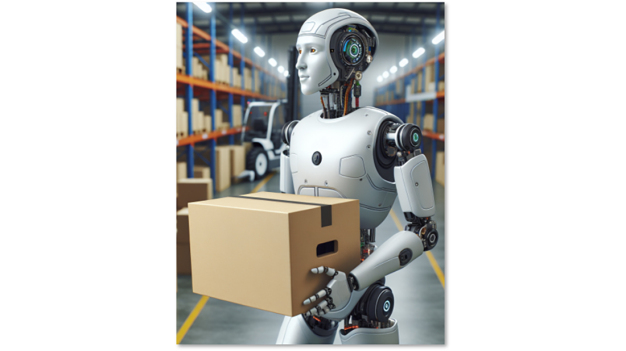
Handling tasks are seen as suitable applications for humanoids. © AI-generated image with Dall-E 3
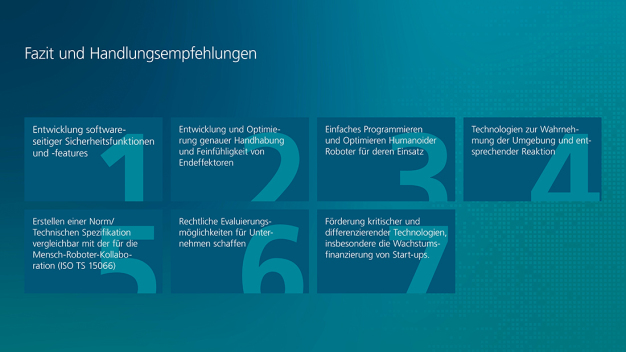
The author team derives these seven recommendations from their investigations.
The potential of humanoid robots is often praised, but concrete applications are still rare. A study published by Fraunhofer IPA within the framework of the AI Advancement Center analyzes the current state and derives recommendations for action for meaningful industrial use based on research, interviews, and surveys.
News about humanoid robots with typically two arms and optionally two legs or a mobile platform are currently flooding the media. New models or capabilities and sometimes massive investments in the technology are regularly reported. However, real pilot deployments of humanoids are still scarce. Therefore, the question arises as to what actual added value this technology can bring to companies and what is needed to bring it into practical use.
Possibilities and limitations of humanoid robots
Based on over 100 feedbacks from industry professionals, a new study by the Fraunhofer Institute for Production Technology and Automation IPA provides answers. The most frequently mentioned possible and sensible application scenarios for humanoids include material transport, machine loading, and grasping complex objects. Compared to previous solutions, humanoids should particularly stand out through their flexibility in performing various tasks. Werner Kraus, head of the Automation and Robotics research department and co-editor of the study, explains: "Exactly the combination of possible relocations and flexible gripping technology is, in my opinion, 'game-changing.' Because with this, tasks in existing plants, the brownfield, can also be automated with minimal integration effort."
However, the respondents of the study currently see the technical possibilities of humanoids as still somewhat reserved. Technologically, humanoids are likely to initially perform tasks where accuracy, system stability, or process speed are less relevant robot capabilities, according to the survey results. For example, transporting boxes was frequently seen as a possible task. However, 60 percent of those surveyed doubt whether humanoids need to have two legs for the desired tasks. They find a tracked platform or even a stationary application with a two-arm robot more appropriate.
Safety and economic efficiency as central criteria
The biggest challenge in practical deployment is functional safety, which is still largely unresolved and places special demands on the robot's design, for example regarding its stability. "Therefore, I do not currently see a mixed operation with humans as a likely scenario for initial deployments," says Kraus.
Excessive expectations and uncertainty about economic viability are additional hurdles that companies currently see. About half of all respondents would be willing to pay up to 100,000 euros for a humanoid. Simon Schmidt, business unit manager at Fraunhofer IPA and co-author of the study, summarizes: "In my opinion, successful deployment of humanoids will require not only technically feasible use cases but especially also business cases that are economically interesting."
A clear trend is emerging regarding the timeline for when humanoids could approximately enter practical use. Only 6 percent of respondents see them in industrial applications within the next two years. With 74 percent, a large majority considers a possible deployment in 3 to 10 years to be realistic.
Four work steps enable recommendations for action
The author team around Simon Schmidt, Joshua Beck, Lasse Hölge, Alexandra Huber, and Ramez Awad developed the study in four stages. First, the team gained a scientific and technical overview of humanoids through research. This was followed by expert interviews with system integrators and potential end-users regarding the state of the art, application possibilities, and future challenges. Based on these qualitative data, quantitative data were collected through a survey, supported by the German Mechanical Engineering Industry Association (VDMA) to gather as many responses as possible. In the final step, the team analyzed the data and derived recommendations for action.
AI Advancement Center brings AI and Cognitive Robotics into application
The study was funded by the Ministry of Economics, Labour, and Tourism of Baden-Württemberg and is a result of the AI Advancement Center "Learning Systems and Cognitive Robotics." The AI Advancement Center is operated jointly by Fraunhofer IPA and the Fraunhofer Institute for Work Organization and Industrial Engineering IAO, aiming to bring applications related to artificial intelligence (AI) and robotics into business practice. One focus of work is the series of studies "Learning Systems," which includes the humanoid study and is currently being expanded with further publications on AI and cognitive robotics.
All studies are available free of charge on the website.
Humanoid robots at the "European Robotics Forum" in Stuttgart
More than 1,000 guests from Europe's research, industry, and politics, over 60 sponsors, and an extensive program on robotics and artificial intelligence (AI): From March 25 to 27, 2025, the prestigious "European Robotics Forum" (ERF) organized by the "euRobotics" association will take place at the Liederhalle in Stuttgart. The Fraunhofer Institutes IPA and IAO, the University of Stuttgart, Cyber Valley, and other institutions are partners. The topic of humanoids will also be a focus in two workshops (participation requires a day ticket at www.erf2025.eu/register):
- Thursday, March 27, 11:10 a.m.: Workshop #18 Applications for Humanoid Robots in Europe (moderated by a humanoid)
- Thursday, March 27, 2:00 p.m.: Workshop #17 The New Frontiers of Advanced Humanoid and Legged Robots

Fraunhofer-Institut für Produktionstechnik und Automatisierung IPA
Nobelstraße 12
70569 Stuttgart
Germany
Phone: +49 711 970 1667
email: joerg-dieter.walz@ipa.fraunhofer.de
Internet: http://www.ipa.fraunhofer.de