



- R+D & Community of Interest
- Translated with AI
Higher cleanliness with lower costs
New method developed for cleaning control devices
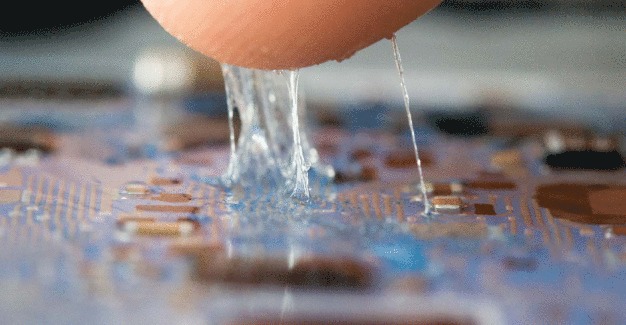
With the new cleaning process, silicone coatings can be reliably and cost-effectively removed from electrical control devices. (Source: Fraunhofer IPA)
To protect electronic control units in the automotive industry, manufacturers apply a silicone-based sealant. This must be removed during repair or refurbishment. However, existing cleaning methods are expensive and unreliable. In the "eCleanER" project, the Fraunhofer Process Innovation Research Group, together with small and medium-sized enterprises and the Chair of Environmentally Friendly Production Engineering at the University of Bayreuth, developed a method that achieves higher cleaning quality at lower costs. The project was successfully completed on May 31, 2015.
There has long been a need in the automotive industry for an innovative process to efficiently clean control units. "So far, the silicone-based sealant must be manually removed with solvents. This takes a long time and incurs high material costs," explains Simon Hohe, an employee of the Fraunhofer Process Innovation Research Group. Furthermore, the cleaning quality of the components varies, and the environment is burdened. The goal of the "eCleanER" cooperation project, funded by the BMWi-ZIM, was therefore to develop a method to reliably and cost-effectively remove the silicone coating from electronic control units.
Cleaning performance exceeded expectations
To achieve this goal, cleaning experts from the Fraunhofer IPA and the University of Bayreuth used an precisely defined intensive cleaner. The active ingredient dissolves the silicone-based sealants without leaving residues, without damaging the control units. Additionally, a dipping process mechanically supports the effect. "The cleaning performance exceeded our expectations. Moreover, the process costs less," explains Stefan Thäter, the project manager from the University of Bayreuth, about the advantages.
The process aims to become more environmentally friendly
In the next step, the project team is working to make the new cleaning process even more environmentally friendly. Using supercritical carbon dioxide, the experts aim to demonstrate that a cost-effective, environmentally friendly, and well-integrated cleaning solution into the refurbishment process is possible. "This further development is important to meet the increasing demands for environmental protection and resource conservation," Hohe states. Currently, the scientists are preparing the funding applications for the follow-up project.
The Fraunhofer Process Innovation Research Group
The Fraunhofer Process Innovation Research Group, based in Bayreuth, was founded in 2006. Led by Professor Dr.-Ing. Rolf Steinhilper, the 35-member team works on industrial and research projects in the field of regenerative production.

Fraunhofer-Institut für Produktionstechnik und Automatisierung IPA
Nobelstraße 12
70569 Stuttgart
Germany
Phone: +49 711 970 1667
email: joerg-dieter.walz@ipa.fraunhofer.de
Internet: http://www.ipa.fraunhofer.de