


- Filter
- Translated with AI
HEPA filter integrity tests at a new level
Syntegon and InfraSolution bring the first system for automated HEPA filter scans in barrier systems to market
Syntegon InfraSolution FFP Filterscan
Syntegon InfraSolution FFP Filterscan
Syntegon InfraSolution FFP Filterscan
Syntegon InfraSolution FFP Filterscan

The authors: Dr.-Ing. Dorfner and Dr. Kosian
In terms of sterilization, pharmaceutical production cannot make any compromises. The function of HEPA filters must also be regularly checked. This has already been automated in sterilization tunnels for some time. So why not extend the benefits of this solution to other areas? That was the idea behind InfraSolution and Syntegon – and they developed a robotics-based filter scan system for RABS and isolators. The advantages: significantly faster, reproducible results in real-time and increased process safety.
HEPA filters are important guarantees for sterile production conditions. In the pharmaceutical industry, they are used for the preparation or filtration of the room air in production areas. To ensure continuous functionality of the filters, pharmaceutical manufacturers are obliged as part of their quality management to regularly verify their performance through filter integrity tests. The goal is to detect leaks to prevent serious consequences, such as quality losses in the produced medication.
The standard procedure for filter integrity tests in sterilization tunnels and barrier systems has not changed significantly over the past decades: most pharmaceutical manufacturers rely on manual methods. During testing, an operator manually scans the entire interior using a measurement probe and inspects the HEPA filters installed inside. The quality of the filter can be determined from the ratio of the aerosol concentration before the filter element and the number of particles detected after the filter. A low particle count downstream of the filter indicates a good seal and leak-free operation.
Manual processes with potential for improvement
An example illustrates the challenges: to manually scan the entire length of a sterilization tunnel, the operator must examine one module after another. Both the speed of movement and the distance of the probe to the filter surface should remain constant. The DIN EN ISO standard 14644-3 specifies that, depending on the probe geometry, the measurement probe should not be moved faster than ten to twelve centimeters per second, with the meander-shaped measurement paths overlapping by at least ten percent of the probe width. The distance to the filter surface should remain constant at three centimeters or less.
Apart from the fact that these tight tolerances increase the risk of accidental damage to the filters during manual testing, the manual approach inevitably introduces minimal deviations in the probe's path. Considering that tunnel lengths of several meters are not uncommon, it quickly becomes clear how time-consuming and error-prone manual filter integrity tests can be. The documentation of test results is also manual: a connected particle counter records the particles that have entered for each tunnel section and prints the cumulative results on thermal paper every minute. These paper strips must then be individually labeled, annotated, and duplicated. There is no assignment of the detected particles to the position of the measurement probe; the technician must know and verify leaks in the filter medium.
Automation on the rise
This paper effort seems outdated, as it starkly contrasts with efficient production processes where robots have long automated key steps. The International Organization for Standardization (ISO) has also recognized this imbalance and recently updated DIN EN ISO 14644-3 to include automated filter integrity tests – which could give new momentum to the topic in the coming years. InfraSolution anticipated this development and already launched RobotScanFlex (RSF) in 2017 for automated filter integrity testing of ceiling filters in cleanrooms. Specific requirements led to the expansion of the product family and, in 2019, to the market launch of LinearTwinScan (LTS) for automated filter integrity testing in sterilization tunnels.
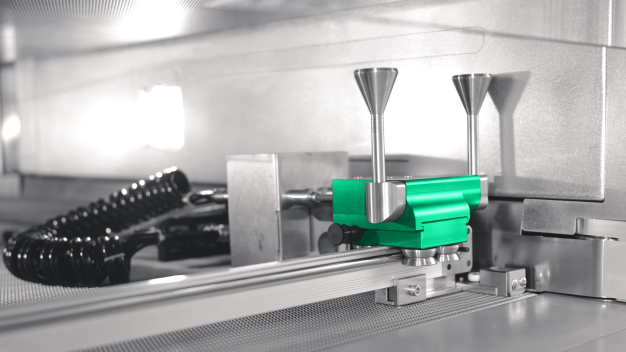
Installation takes a maximum of ten minutes and only a few manual steps. The operator connects the system to the connection nozzles of the tunnel section to be scanned to regulate the aerosol flow during testing, and places the linear rail at the appropriate length on the conveyor belt. Using two particle counters and two measurement probes, the particle count per tunnel section is automatically measured. The integrated evaluation software visualizes the results in real-time, including detected leaks, via a heatmap on the connected tablet PC. This allows the entire length of the sterilization tunnel to be automatically scanned section by section.
Application in barrier systems thanks to robotics
Choosing automated alternatives increases process safety and achieves more reliable measurements in significantly less time. In sterilization tunnels, for example, the evaluation time for integrity tests has been halved – with 100 percent filter measurement. Additionally, the LTS system provides reproducible results with high data integrity: after the filter tests, the evaluation software creates a digital test report as a PDF with an electronic signature, consolidating data from all tested filters into one document and complying with FDA and GMP requirements. This not only reduces the documentation effort for the operator but also facilitates data storage and quality assurance.
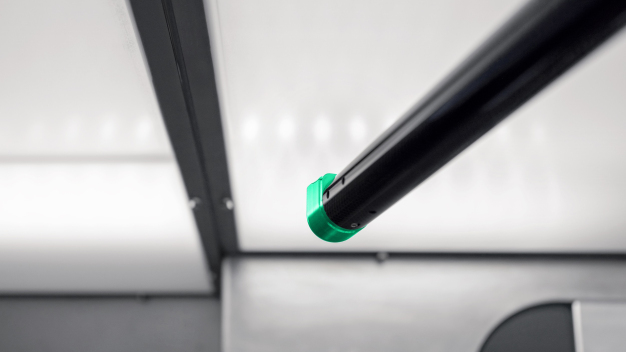
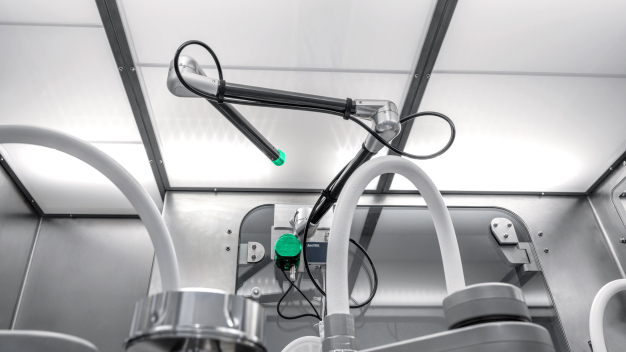
But HEPA filters are not only used in sterilization tunnels. Especially in barrier systems such as RABS, cRABS, or isolators, manual filter integrity testing is not only labor-intensive but often involves unintentional operator presence in critical safety areas. InfraSolution and Syntegon now address this with the further development of the LTS system. The core component of the new solution is a robot arm called “integrated RobotScanFlex” (iRSF), which automatically performs the integrity test of the filter. The particular advantage for companies already using the LTS system in their sterilization tunnels: the robot arm is also available separately, as the basic equipment – the tablet PC and the two control boxes – remains unchanged.
Focus on safety
Especially in barrier systems designed to minimize or eliminate contact between humans and products, reduced personnel effort is a key criterion: one operator is sufficient to hang the robot arm onto the isolator or RABS being tested. The filter scan then runs fully automatically. A kinematic simulation tool determines the ideal mounting positions for the robot based on the barrier system's dimensions and simulates the complete movement sequence of the robot arm in advance.
This allows potentially overlooked areas during manual filter integrity testing to be covered; blind spots are a thing of the past. The distance to the filters and the movement speed of the robot arm remain constant. If the system detects a leak, the affected filter position is re-scanned to perform the necessary retesting with a stationary probe and to save the results. This increases process safety and ensures secure, reproducible results in real-time. As with sterilization tunnels, documentation is significantly simplified in barrier systems, leading to substantial time savings.
First application: Versynta FFP
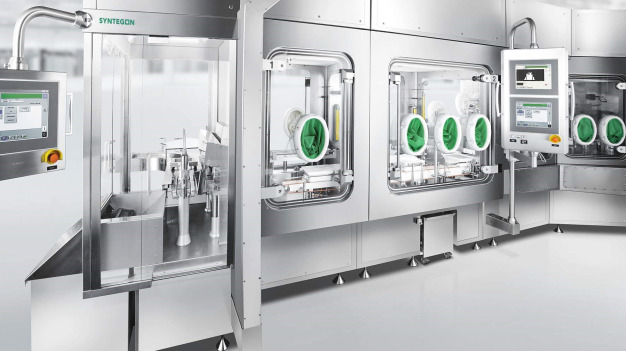
The world's first pilot project was the Versynta Flexible Filling Platform (FFP) by Syntegon. The new, modular small-batch solution is a customizable machine with an integrated isolator for filling aseptic and highly potent liquid drugs. It processes various containers such as vials, syringes, and cartridges with a throughput of up to 3,600 containers per hour, with 100 percent in-process control. For the RSF pilot, the simple geometry of the system, its forward-looking overall concept, and the ever-increasing demands on production and process quality were decisive factors.
The filter scan system was specifically adapted to the requirements of the closed isolator of the Versynta FFP. The collaboration of two experts with extensive experience in barrier systems and process technology (Syntegon) as well as technical equipment, software applications, and robotics (InfraSolution) resulted in a solution that sets new standards in HEPA filter integrity testing. The system is continuously developed and will be available for use in all isolators, RABS, and cRABS in the future.
Authors
Dr. Thomas Kosian
Senior Expert Barrier Systems
Syntegon Technology
Thomas.Kosian@syntegon.com
Dr.-Ing. Christian Dorfner
Head of R&D
InfraSolution AG
c.dorfner@infrasolution.ag

Syntegon Technology GmbH
Blaufelder Straße 45
74654 Crailsheim
Germany
Phone: +49 7951 4020
email: packaging-ph@syntegon.com
Internet: http://www.syntegon.com