




- Science
- Translated with AI
Fail-safe strain sensors without power consumption
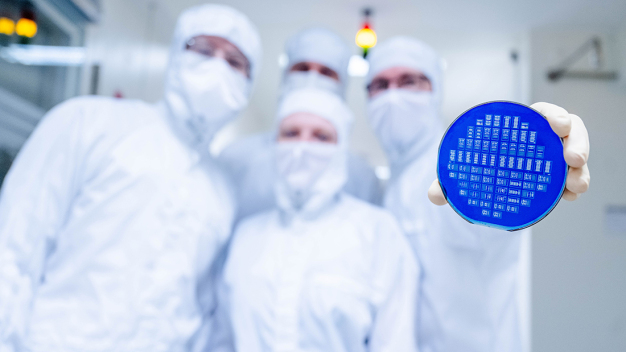
The mechIC team has developed strain sensors that consume no power. Production takes place in a cleanroom. © RUB, Marquard
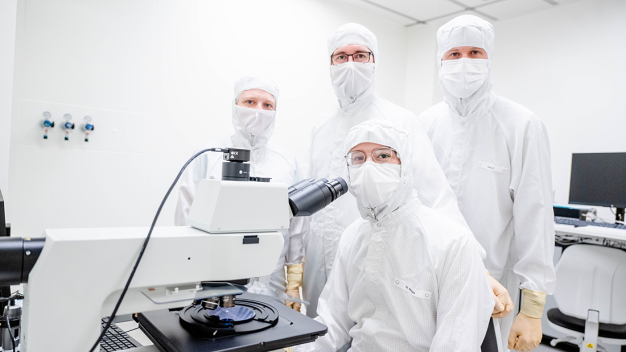

Because the structures of the sensors are tiny, every speck of dust would cause interference. Therefore, production takes place in a cleanroom. The team wears protective clothing to prevent contamination with hair and skin flakes. © Andreas Soika

Using methods from microchip production, the mechIC team manufactures sensors on silicon wafers. © RUB, Marquard
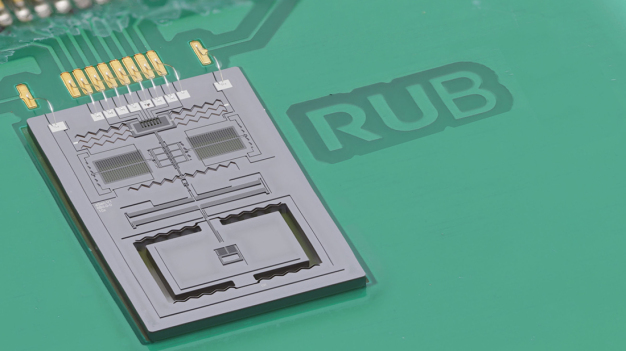
A detailed recording of the mechIC sensor, which operates purely mechanically. © Harald Austenfeld

The mechIC team from left to right: Philip Schmitt, Steffen Wittemeier, Lisa Schmitt, and Henning Mays. © RUB, Marquard
For their founding idea, a team from Bochum receives an EXIST funding of 1.34 million euros. Their technology could arrive just in time to solve an emerging global problem.
To monitor the safety of bridges, cranes, pipelines, wind turbines, and much more, strain sensors are needed. Researchers from Bochum and Paderborn have developed a fundamentally new technology for this purpose. Unlike conventional systems, it consumes no power and is almost insensitive to temperature. To bring the sensors to market readiness, Dr. Philip Schmitt, Dr. Lisa Schmitt, and Henning Mays from the Chair of Microsystems Technology at Ruhr University Bochum are preparing the founding of the startup “mechIC” — scheduled for 2025 — in collaboration with Steffen Wittemeier, formerly at Paderborn University. The Federal Ministry for Economic Affairs and Climate Action supports them with 1.37 million euros as part of the EXIST Research Transfer program.
The EXIST project is based at the Bochum Chair of Microsystems Technology, led by Prof. Dr. Martin Hoffmann. The funding started on April 1, 2024. The team is also supported by the WORLDFACTORY startup center at Ruhr University Bochum and the Materials Incubator.
“Forecasts indicate that by 2040, more electricity will be needed to monitor components than can be produced worldwide,” emphasizes Lisa Schmitt, highlighting the importance of the new sensors. “To ensure comprehensive monitoring, a change in trend is necessary.”
System functions purely mechanically
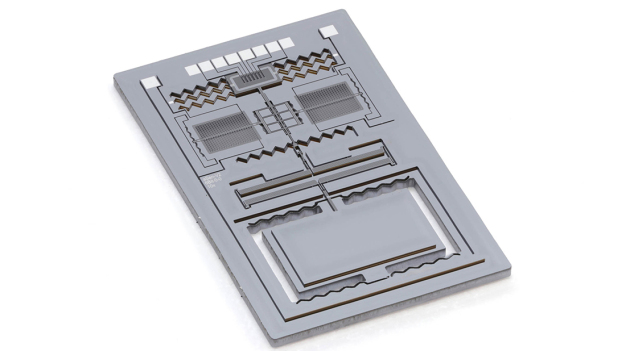
Unlike conventional strain sensors that operate electrically, the system from mechIC — short for mechanical Integrated Circuits — works mechanically. The core of the sensors is a silicon chip capable of perceiving strains in the nanometer range. When the component being monitored stretches, a gear-tooth-based structure within the chip shifts against a frame. The greater the strain, the further down the movable element latches into the frame. “This way, we can mechanically store the measured strain amplitudes,” explains Philip Schmitt.
The team developed the operating principle in the project “Research for New Microelectronics: Unconventional Passive Radio Sensors for Energy-Autonomous Shock and Vibration Monitoring,” abbreviated as UpFuse, funded by the Federal Ministry of Education and Research at Ruhr University Bochum and Paderborn University.
Data readable via smartphone
The mechIC sensor allows continuous real-time monitoring of components. The sensors can be configured to trigger an alarm when a threshold is exceeded or to be read out when needed. For this purpose, a micromechanical analog-digital converter translates the mechanical strain into an electrical signal. The energy for measurement and data processing is provided by the strain itself and does not need to be supplied externally. Therefore, the system requires no battery. The data can be read out simply via a smartphone app, designed to allow users to easily adapt it to their specific needs.
The sensors are approximately five by five millimeters in size and can be used for various applications. They are produced using established methods from the semiconductor industry. The founding team plans to move into series production in 2026.
Ruhr-Universität Bochum
44801 Bochum
Germany