

- Hygiene & Cleaning
- Translated with AI
Effective CO2 snow-jet cleaning process for small quantities of high purity parts
New CO2 snow-jet booths in cleanroom compatible design
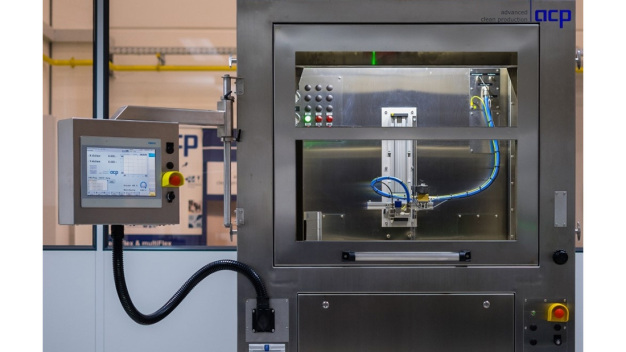
The workpiece to be cleaned is placed in the process chamber of the standalone system, which is made entirely of stainless steel, for automated cleaning on the part holder of an x/y-axis system, rotary table, or a combination of both. (Image source: acp systems AG)
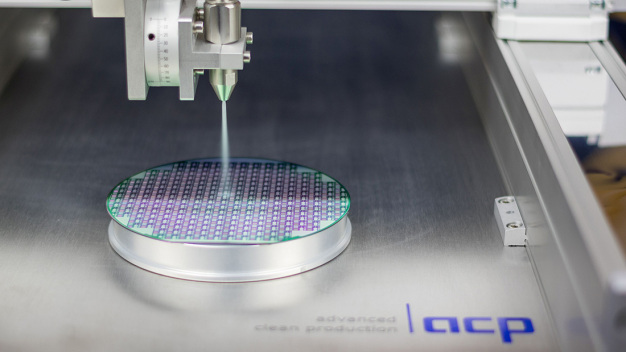
For reproducible cleaning results, all process parameters such as jet intensity and duration are kept constant in a program-specific manner. Additionally, the system is equipped as standard with a sensor system for process monitoring through continuous measurement of the snow jet density. (Image source: acp systems AG)
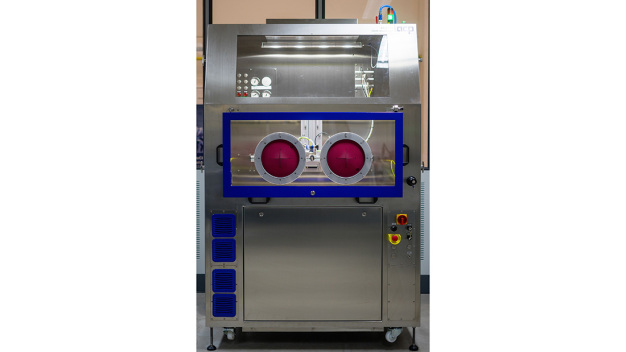
The compact, cleanroom-compatible JetStation-HP has been developed for cleaning tasks where parts in small quantities must meet the highest cleanliness standards. In the manual cleaning cabin, loading and unloading are carried out via a front flap with hand access. (Image source: acp systems AG)
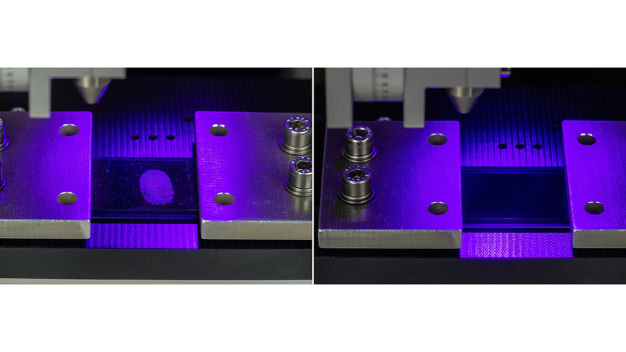
The before-after image, made under UV light, shows that particulates and contaminations on components made of all technical materials are removed in a process reliable manner. (Image courtesy: acp systems AG)
Whether in medical engineering, the semiconductor industry, in laboratory and development environments or in other areas - parts produced in small quantities often have to meet the highest cleanliness requirements. For such cases, acp systems has developed two new CO2 snow-jet booths suitable for cleanroom use. These enable highpurity workpieces to be cleaned in a manual or semi-automated process with the quattroClean technology.
Components for high-purity applications, for example in medical engineering, laser technology, semiconductor supply industry, precision optics and metrology could hardly be more varied. And yet they share common features such as low production volumes, high workpiece diversity and, above all,extremely high demands on surface cleanliness. This involves the removal of particulate and filmic contamination and, depending on the industry, possibly biological and ionic contaminants as well as organic and inorganic residues. Research and development departments are also confronted with these requirements. Conventional parts cleaning solutions are usually designed for much larger quantities and in some cases - such as with wetchemical cleaning - may reach their limits as far as process capability is concerned.
Compact CO2 snow-jet booths suitable for cleanroom use
With the new manual and automated JetStation-HP booths, acp systems AG supplies compact cleaning solutions for these use cases with quattroClean technology. The closed, sound-proofed stand-alone units are made entirely of stainless steel. They are only equipped with components and materials used in cleanroom applications. When designing the process chamber, attention was paid to ensuring that detached contaminants and carbon dioxide are removed quickly and effectively by the integrated extraction system and that no dirt pockets can form. This prevents the cleaned parts from becoming recontaminated.
For both booth models, a system for monitoring the CO2 concentration in the working area comes as standard. If the set limit value is exceeded, the carbon dioxide supply is automatically switched off and an error message is displayed.
The manual JetStation-HP is loaded and unloaded via the front flap with hand access and is suitable for both seated and standing workstations. The cleaning process, in which the part is guided to the nozzle by the operator, can be started conveniently via a foot pedal.
If higher requirements in terms of process reliability and/or part geometry must be met, the automated JetStation-HP is used. With this model, the part to be cleaned is advanced through a door which can be automated and placed in a receiver mounted on an x/y-axis system, rotary table, or combination of both, in the process chamber. The part-specific cleaning program stored in the system control unit is started at the push of a button. The process then runs fully automatically, with all parameters such as movements of the receiver, speed, force and duration of the jet, distance between nozzle and workpiece kept constant as specified in the parts program. In addition, the automated JetStation-HP model has a sensor system for monitoring the cleaning process, which continuously measures the density of the snow jet.
Plug & play concept for rapid deployment
The plug & play concept makes the JetStation-HP cleaning booths quick and easy to put into operation. All the technology for the snow-jet process and media preparation is integrated in the system housing, meaning that only the carbon dioxide and compressed air supply need to be connected up.
The quattroClean technology - four effects for clean surfaces
The cleaning medium used in the QuattroClean process developed by acp systems is liquid carbon dioxide, a by-product of industrial processes and thus climate-neutral. It is guided through a wear-free two-component ring nozzle and expands on exiting to form fine CO2 snow. This core jet is then bundled by a separate jacketed jet of compressed air and accelerated to supersonic speed. When the easily focused jet of snow and compressed air impacts on the surface to be cleaned, a combination of thermal, mechanical, sublimation and solvent effects occur. The interaction of these four mechanisms of action removes particulate and filmic contamination in a reliable and reproducible process. During the cleaning step, the crystalline carbon dioxide is completely transformed from a solid to a gas, meaning that parts are instantly dry.
The cleaning process is so gentle on materials that it can even be used to clean delicate and finely structured surfaces. The dry quattroClean technology is suitable for parts made from practically any technical material and combination of materials.

acp systems AG
Berblingerstraße 8
71254 Ditzingen
Germany
Phone: +49 7156 480140
email: info@acp-systems.com
Internet: http://acp-systems.com