



- Science
- Translated with AI
Economic State Secretary Dr. Patrick Rapp visits the Hahn-Schickard Institute for Microfabrication Technology in Stuttgart
In addition to research topics, the challenges of applied research and collaboration with industry were the main focus of the visit.
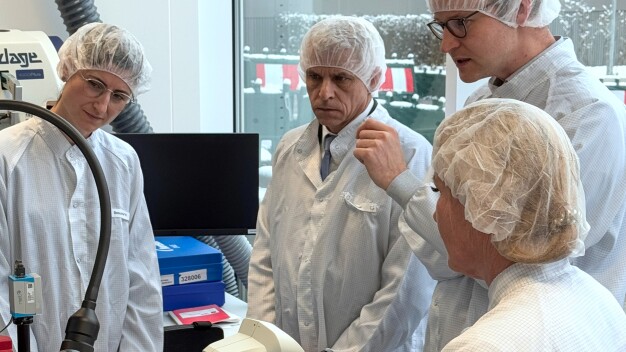
Cleanroom Production Line (Claudia Feith, Hahn-Schickard)
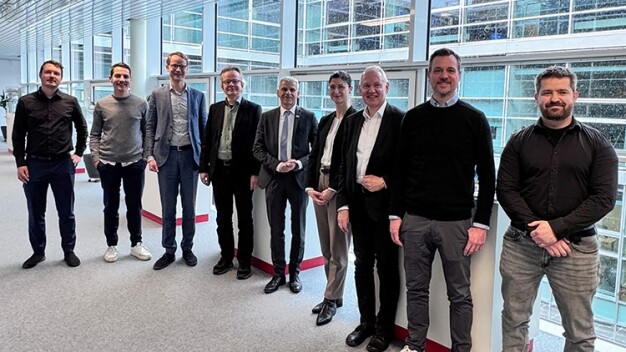
(v. l. n. r.: Dr. Simon Thiele, CTO, Printoptix GmbH; Stefan Wagner, Group Leader Precision Toolmaking + Plastics Technology, Hahn-Schickard; Dr. Karl-Peter Fritz, Institute Director Hahn-Schickard; Dr. Wolfgang Eberhardt, Head of Technology Department, Hahn-Schickard; Dr. Patrick Rapp, State Secretary, Ministry of Economics, Labour and Tourism Baden-Württemberg; Jennifer Mazat, Department 33 Automotive and Manufacturing Industry, Logistics, Ministry of Economics, Labour and Tourism Baden-Württemberg; Prof. Dr. André Zimmermann, Institute Director Hahn-Schickard and IFM of the University of Stuttgart; Dr. Tobias Grözinger, PCB-based AIT, Packaging (CR/APT3), Robert Bosch GmbH; Simon Petillon, Research Associate Laser Technology, Hahn-Schickard)
The institute directors Prof. Dr. André Zimmermann and Dr. Karl-Peter Fritz welcome State Secretary Dr. Patrick Rapp from the Ministry of Economic Affairs, Labour and Tourism Baden-Württemberg. Dr. Rapp met with scientific staff and industry partners of the institute for an exchange on current challenges in the German research landscape.
"Innovative developments in microsystem technology are a key driver for the competitiveness of our companies in important future markets. The Hahn-Schickard Institute for Microassembly Technology impressed me greatly with its close integration from research and application to the development of market-ready products," said State Secretary Dr. Patrick Rapp after his visit to Hahn-Schickard in Stuttgart.
Role of Hahn-Schickard Stuttgart in the Baden-Württemberg Innovation System
Hahn-Schickard sees itself as the leading non-university research institution for microsystem technology in Baden-Württemberg. In Stuttgart, the focus is on assembly and interconnection technology (AIT) for high-performance microsystems, which in this comprehensive form is addressed by only a few research institutions in Europe. The institute is oriented towards future markets such as medical technology (sensors for patients), aerospace (commercialization of space travel), industrial sensing, and high-frequency systems.
Assembly and interconnection technology (AIT) is the key to miniaturization and functional integration in microelectronics. Through AIT, the dimensions, weight, system performance, reliability, lifespan, and product costs of smart systems are significantly influenced. Hand-in-hand with the ongoing miniaturization in semiconductor technology, AIT makes an important contribution to the increasing functional integration of microsystems. Modern systems combine the integration capabilities of semiconductor technology and AIT.
Scientific Focuses Using Production and Medical Technology as Examples
Using production technology and medical technology as examples, the scientists explained the current state of research and presented the plant technology available at the institute for industry.
Advances in the Scalability of Highly Complex Optical Structures
Minimally invasive and personalized approaches in medicine to treat diseases elevate medicine to a new level. Medical technology offers exciting innovations and opens up new therapeutic options for numerous indications.
Micro-optics play a crucial role in modern sensing and photonics. Especially in medical technology, they enable innovative applications from minimally invasive diagnostics to highly complex optical systems. While two-photon lithography has revolutionized the manufacturing of complex micro-optical designs, Dr. Rapp also discussed various possibilities for scaling this technology on-site.
The Printoptix GmbH, a startup from Stuttgart, is a pioneer in the production of high-precision two-photon lithography optics in large quantities. The close collaboration between science and industry enables structures and designs that would not be feasible with conventional manufacturing methods. This paves the way for cost-effective, scalable production of micro-optics and connects prototype development with industrial manufacturing.
Hahn-Schickard is also working on developing scalable series production of injection-molded micro-lenses and micro-lens arrays for industrial and medical applications. Highly precise structuring methods such as two-photon lithography play a central role and form the basis for innovative, forward-looking optical technologies.
Production Technologies Using Power Electronics and RF Packages as Examples
Modern production technologies are of great importance for industry. They are the engine of intelligent manufacturing and thus a key factor for the competitiveness of industrial production. Dr. Rapp gained insights into the precision toolmaking available at the institute as well as the fabrication of chip packages in a cleanroom.
Power Electronics
Power electronics is a cross-sectional technology found in almost all applications involving electrical energy. Therefore, its role in societal megatrends such as energy efficiency, renewable energy utilization, smart grids, robotics, and electromobility is of great significance.
Power electronics is used for controlling and converting electrical energy. It supplies electrical and electromechanical components with the appropriate power exactly when needed. Efficient solutions also ensure that devices and systems can be operated with minimal losses. An example is the electric vehicle drive in an AC motor. Here, the DC from the battery must be converted into suitable AC. Hahn-Schickard researches new circuit carriers for power electronics for this purpose. The main advantages include low thermal resistance, enabling high power and integration densities, miniaturization, and long lifespan. Additional benefits include reduced production and material costs through innovative integration solutions.
High-Frequency Technology Packages
High-frequency (HF) technology is a key technology for numerous industries and plays a particularly important role in Baden-Württemberg in the development of e-mobility and autonomous driving, as well as in growth sectors such as aerospace and medical technology. Standardized packaging technologies are increasingly reaching their limits with rising frequencies in high-frequency and radar technology, necessitating new approaches. Innovative 3D packaging solutions based on three-dimensionally structured circuit carriers enable the construction of integrated, directional antennas for ever-smaller and more powerful systems.
Transfer of Research Results into Industry – The Entire Process Chain from a Single Source
Under the motto "Visions to Products," Hahn-Schickard has been a symbol of successful technology transfer from research results to companies for many years. In the foundry, we offer a broad range of compatible individual processes for assembly and interconnection technology from a single source. These can be individually combined for packaging and system integration of sensors. The portfolio covers the entire process chain from design, substrate manufacturing (injection molding or additive manufacturing), surface structuring, metallization, to 3D assembly and packaging.
In conclusion, institute director Dr. Karl-Peter Fritz emphasized: "The motto 'Visions to Products' is both an incentive and a commitment for us. Only when creative ideas have resulted in high-quality and reliable products for the local industry do we consider our research goals achieved."
Hahn-Schickard-Gesellschaft für angewandte Forschung e.V.
78052 Villingen-Schwenningen
Germany



