

- R+D & Community of Interest
- Translated with AI
Dipl.-Biol. Markus Keller, Dr.-Ing. Udo Gommel
CSM – Cleanroom-compatible materials
Particulate and VOC emissions, chemical and biological stability, and cleanability
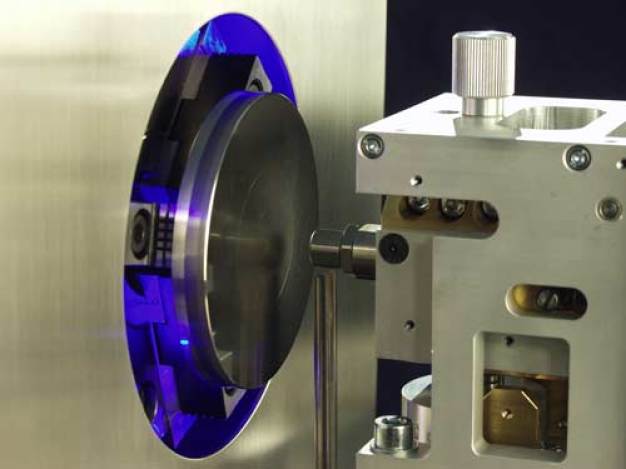
Fig. 1: Cleanroom-compatible tribological test rig at Fraunhofer IPA for determining particle emission classes of material surfaces. The test rig is installed in a cleanroom of ISO Class 1 to prevent cross-contamination.
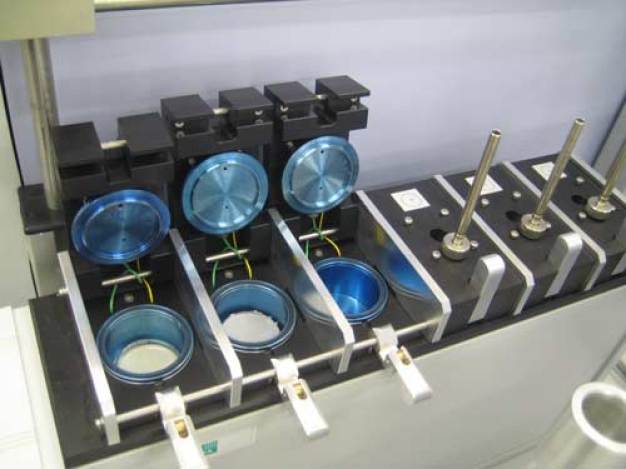
Fig. 2: Micro-emission chamber at Fraunhofer IPA for determining VOC emission classes of material surfaces.
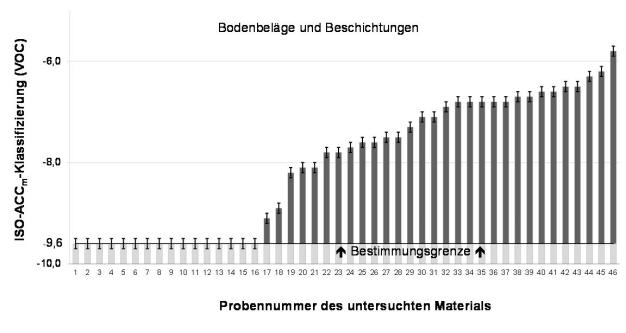
Fig. 3: Classifications of the outgassing behavior of volatile organic compounds (VOC) of some tested floor coverings and coatings.
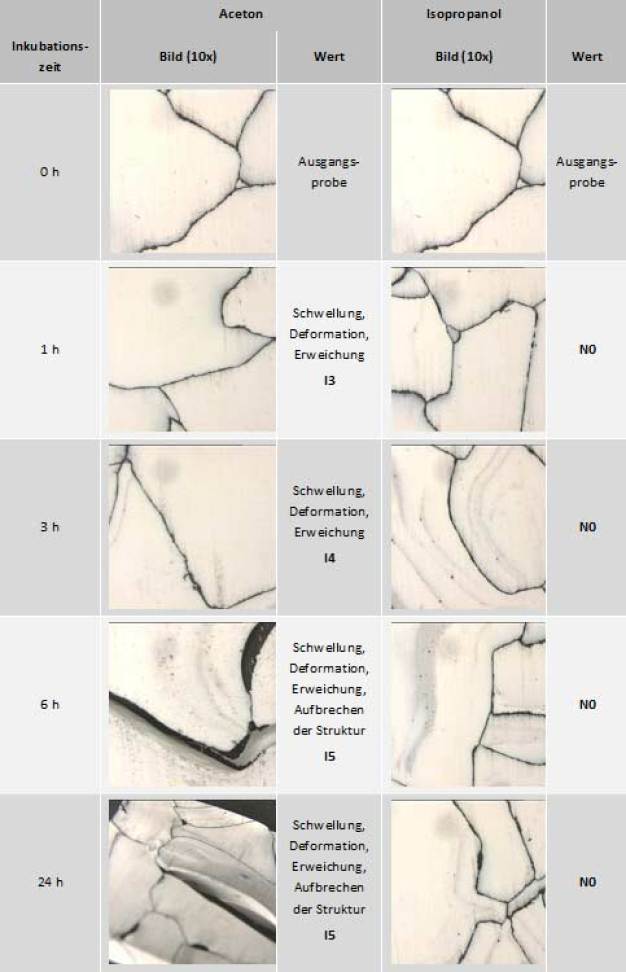
Fig. 4: Evaluation of the chemical resistance of a material sample according to ISO 2812-1 and ISO 4628-1 to -5. Example excerpt of two tested chemicals.
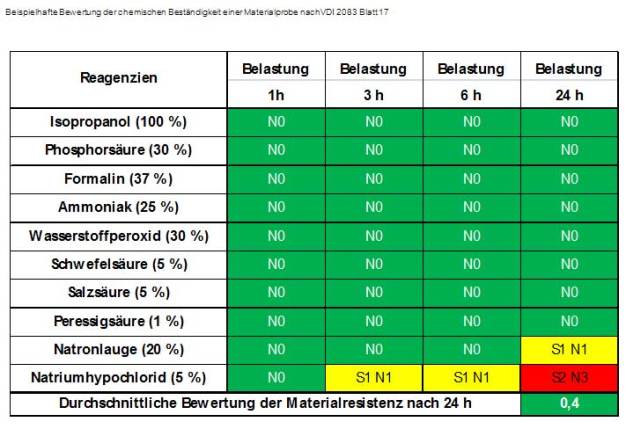
Fig. 5: Example assessment of the chemical resistance of a material sample according to VDI 2083 Sheet 17.
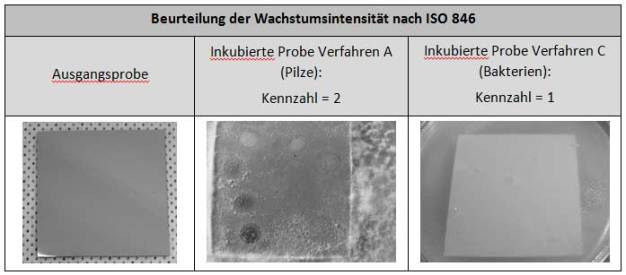
Fig. 6: Testing of the Sikafloor 390 floor covering according to ISO 846 Procedures A and C. Left: initial sample, middle and right: after 4 weeks of incubation.
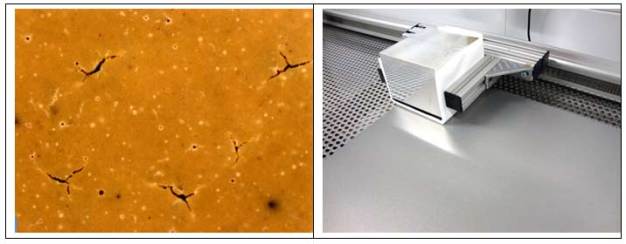
Fig. 7: Left: Cracks in a material surface under 50x magnification. Right: Linear scratch simulator.
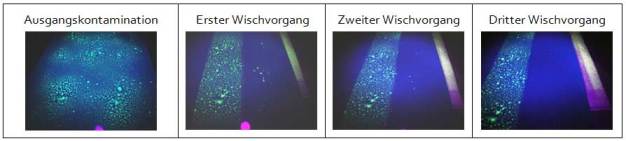
Fig. 8: Test contamination on a floor coating dried over two hours, three consecutive cleanings.
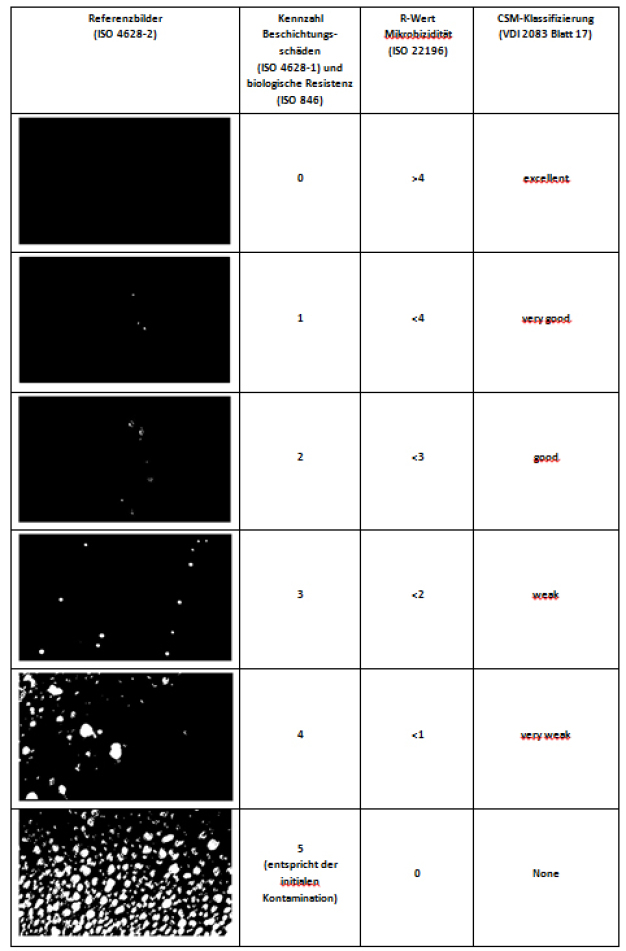
Fig. 9: Classifications of chemical and biological stability, antimicrobial properties, and cleanability based on the riboflavin test.
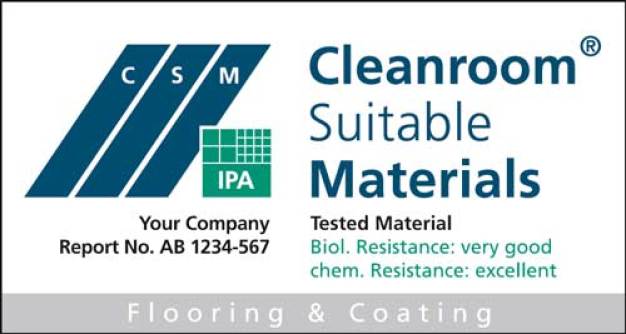
Fig. 10: Example CSM test seal.
1. Introduction
Many materials and building materials can contaminate a pure production environment due to their properties and are thus a significant factor in achieving and maintaining the required purity.
Emissions from a joint of a handling unit can release microscopic particles that may contaminate the surrounding production environment. Many of these microscopic particles remain airborne as aerosols for a long time and can sediment on critical contamination surfaces far from the actual emission source. A sedimented particle with a diameter of 500 nm can render a wafer in semiconductor production completely unusable for subsequent processes.
Airborne chemical contaminants can adsorb onto surfaces and cause lasting damage. For example, plasticizers condensing on wafers alter their wettability for subsequent etching steps. Nitrogen-containing compounds (airborne amines and ammonia) can attack even trace amounts of photoresists, leading to faulty exposure steps. Airborne organic compounds (VOCs) condense on lens systems, causing imaging errors during exposure steps.
If process water collects in a ground joint sealed with a substandard sealing material, the few mold spores present can establish themselves well due to favorable local growth conditions (moisture, temperature, nutrients), thus becoming a significant source of infection. Corrosion of a material caused by aggressive cleaning agents not only damages its material properties but can also become a dangerous source of particle emissions.
Chemical influences can also cause a material to crack. Mechanical impacts afterward can lead to crack formation, which can pose a hazard even at the microscopic level, as microorganisms possibly residing in the cracks can evade effective cleaning and sterilization.
Floor and wall systems must ensure adequate cleanability with common cleaning methods and agents. Additionally, slip resistance required by professional associations must not be overlooked for accident prevention.
The BioStoffV (Biological Substances Ordinance) mandates, for example, in Appendix 2, that all protective levels require water-impermeable and easy-to-clean surfaces. Furthermore, the BioStoffV recommends from level 2 onward sufficient resistance to acids, alkalis, disinfectants, and solvents. For reactive systems (epoxy floors, among others), low outgassing behavior of organic contaminants must be ensured to comply with personnel and, in critical processes, product protection. Tribological stress on a material (e.g., rolling bearings, walking load on a floor system, etc.) must not generate critical airborne particle contamination due to this stress.
Suitable materials must therefore be resistant to the cleaning and disinfecting agents used in contamination-critical manufacturing environments. Under specified tribological loads, material pairings must not lead to undesirable high particle emissions. In many production areas, only low outgassing materials are permitted. In hygienic manufacturing environments, the materials used must not be colonized or metabolized by microorganisms. The surface texture must be designed to ensure flawless cleanability.
Thus, for a comparative material selection depending on the application, the outgassing behavior and particle emission under tribological load, the chemical and microbiological properties, and cleanability must be determined and classified through standardized tests for various materials. The Fraunhofer IPA developed standardized testing methods within the framework of the Industry Consortium CSM – cleanroom suitable materials, which are explained below.
2. CSM Material Tests for Comparable Material Classifications
2.1 Particle Emission
If a material is mechanically stressed due to friction with another material, material abrasion usually occurs in the form of particles. This can happen through sliding friction, such as in ball bearings, or through adhesion friction, which can occur when walking with footwear over a floor system. To make comparative statements about different materials regarding their particle release under tribological stress, the Fraunhofer IPA uses a specially developed test stand called Material-Inspec for particle emission testing within the CSM industry consortium. This is operated in a reference cleanroom of class ISO 1 to eliminate measurement errors caused by foreign particles from the ambient air. For classification, depending on the investigated material group, either sliding or rolling friction is considered. The counter body in rolling friction tests is a standardized polyamide-6 roller to simulate the rolling of transport rollers. In sliding friction tests, a standardized stainless steel sphere is pressed against the material under test. The contact pressure and the angular velocity are kept constant. During the test, the particles generated are transported vertically downward by laminar displacement airflow at v = 0.45 m/s from the ceiling of the cleanroom through the perforated floor directly into the air particle measurement probe installed downstream. The air exiting the filter ceiling is enriched with positive and negative ions via bipolar corona ionizers, which neutralize the charge generated by tribological friction on the material pairs. As a result, the particles do not adhere to the surfaces due to electrostatic effects but are directly conveyed to the particle counter with the turbulence-free airflow.
The installed scattered light particle counter detects all particles with a diameter > 0.2 µm and classifies the number of particles according to predefined size channels. The measurement lasts at least one hour to account for single events. After accumulation and coordinate transformation of the data, a material-specific assessment regarding particle abrasion under tribological stress is obtained. This procedure is detailed and standardized in the current guideline VDI 2083 Part 17, published in June 2013. The determined material characteristic ISOm class allows a direct comparison between different materials regarding their potential contribution to particulate contamination in cleanroom environments (see Fig. 1).
2.2 Outgassing
The outgassing behavior of cleanroom-compatible materials plays an increasingly important role alongside particle generation during mechanical stress. When using suitable materials, legal limits for workplace exposure (MAK values) must be observed. Conversely, outgassing of critical compounds and compound classes can lead to unwanted effects in contamination-critical production processes. Outgassing components of materials (plasticizers, solvents, other volatile constituents) significantly contribute to airborne molecular contamination (airborne contamination by chemicals, ACC). Organic airborne contaminants (volatile organic compounds, VOCs) are particularly important. These airborne molecular contaminants have been identified as one of the main causes of the so-called "Sick Building Syndrome."
The described method allows for a comparison of different materials regarding their emissions of volatile organic compounds, enabling the creation of a ranking list for selection and classification. The amount of emitted organic compounds depends on their surface area, outgassing duration, age, and testing temperature. The material-specific surface emission rate (SERa) is related to these parameters and is given as mass per area and time at room temperature. Standardized testing is performed using measurements in a microchamber. Outgassing is determined by collecting and concentrating volatile compounds on an adsorber, followed by analysis via thermal desorption and coupled gas chromatography with mass spectrometry (TD-GC/MS).
Samples are selected to be representative regarding geometry and surface finish, corresponding to the intended application of the material. For multilayer applications, the layer structure matches the planned use. As VOC-free carrier materials, borosilicate glass dishes are used. The preconditioning of samples occurs over 30 days under controlled climatic conditions (room temperature 22 ± 1°C, relative humidity 45%). Cross-contamination during storage is prevented by using a mini-environment with VOC filtration. The VOC-reduced ambient quality should be at least one class better than the expected VOC level of the test sample.
After deposition, the material samples are conditioned in a microtest chamber at atmospheric pressure and a standardized temperature of 22°C ± 1°C for one hour. The volatile organic compounds outgassed from the sample are swept onto a sorption tube with a carrier gas and adsorbed there. The analysis of the sorption tubes is performed via thermal desorption and coupled gas chromatography with mass spectrometry, following VDA 278. The obtained values are used to determine the material-specific surface emission rate SERa, which can be standardized into a simple material characteristic ISO-ACCm class x (VOC). This procedure is also standardized in the new guideline VDI 2083 Part 17 (see Fig. 2).
Figure 3 shows an excerpt of the range of achieved ISO-ACCm classes (VOC) for some tested floor coverings and coatings.
2.3 Chemical Resistance
Various internationally recognized standards exist for testing chemical resistance. For material testing, immersion tests according to DIN EN ISO 2812-1 or the modified spot test according to VDI 2083 Part 18 have proven effective. Since the chemical spectrum of the final cleaning or disinfecting agents cannot be known in advance, a representative spectrum of possible chemical groups at maximum expected concentrations must be tested. This approach provides a fundamental statement about the chemical resistance of the material but cannot give a definitive statement about a specific cleaner or disinfectant. This approach was also developed within the CSM industry consortium and standardized in VDI 2083 Parts 17 and 18. In the CSM procedure, chemical resistance is tested against the following ten representative reagents, depending on the later maximum expected concentration in cleaning and disinfecting media:
Chemicals for sterilization gases:
• Formalin (37%)
• Hydrogen peroxide (30%)
• Peracetic acid (15%)
Alcohols for cleaning and disinfection:
• Isopropanol (100%)
Bases as components in alkaline cleaners:
• Sodium hydroxide (5%)
• Ammonia (25%)
Acids as components in acidic cleaners:
• Sulfuric acid (5%)
• Hydrochloric acid (5%)
• Phosphoric acid (30%)
Chlorine-containing cleaners:
• Sodium hypochlorite (5%)
The entire material sample is placed into a vessel filled with the respective chemical, which is then hermetically sealed. If a coating applied to a carrier material is to be tested, all surfaces and edges of the carrier must be sealed with the respective coating. In the modified spot test according to VDI 2083-18, the test substance is placed into a glass vessel. The sealing of the glass vessel and the test surface are applied, clamped into a device, and hermetically sealed. The test setup is then rotated 180°, so that the test substance can contact the sample surface.
The test objects are exposed to the respective reagents at room temperature for periods of one, three, six, and 24 hours, then checked for visible changes. The evaluation of the test results is performed visually at tenfold magnification regarding the following criteria: change in gloss, discoloration or yellowing, sources, blistering, extent of damage, size of damages, and intensity of changes.
According to ISO 4628-1 to -5, clear numerical ratings are assigned for evaluation. The poorer rating of each chemical after 24 hours is used for comparative assessment. The average of all ten ratings provides the classification and comparable evaluation value in the CSM procedure (see Fig. 4 and Fig. 5).
2.4 Biological Resistance
To investigate the biological resistance, i.e., the inertness of the used materials against bacteria and mold fungi, the international standard ISO 846 has proven effective. This test assesses whether the test material remains inert under the specified test conditions regarding mold fungi (Procedure A) and bacteria (Procedure C), or whether the materials can be metabolized by microorganisms. The test setups are incubated at 24°C and 95% relative humidity and evaluated visually after four weeks. A rating number based on a "worst-case scenario" of both procedures A and C is assigned (see Fig. 6).
2.5 Microbicidal Properties
A possible microbicidal property of a material can be divided into bactericidal efficacy (effect against bacteria) and fungicidal efficacy (effect against fungi).
The determination of bactericidal efficacy is performed according to ISO 22196. The bactericidal surface and the corresponding non-bactericidal surface are inoculated with Staphylococcus aureus and Escherichia coli. After 24 hours of incubation, colony-forming units (CFU) are determined for both treated and untreated samples using the contact method. The reduction factor R = log (CFU untreated / CFU treated) is calculated. In the contact method, a solid incubation medium (casein-soya peptone agar) with an area of about 50 cm² is pressed with a defined pressure onto a flat surface for a specified time (five seconds with enough pressure to contact the entire surface with the medium but without forming air bubbles; a weight of 1 kg has proven effective). Incubation proceeds similarly to other cultivation detection methods.
The presence of fungistatic or fungicidal efficacy can be tested according to ISO 846 Procedure B. Depending on the development of a inhibition zone after placing a material sample on a pre-inoculated Petri dish, the fungistatic or fungicidal property can be assessed.
2.6 Cleanability - Riboflavin Test
Adequate cleanability is generally necessary from a hygienic perspective to ensure a hygienically safe process and long-lasting products. The extent to which a material can be cleaned by wiping is checked using the standardized Riboflavin Test of the German Mechanical and Plant Engineering Association (VDMA).
The goal of this test is to qualitatively demonstrate how much a fluorescing test contamination can be reduced through a representative cleaning procedure. A fluorescing test contamination is created, which is used to contaminate the test specimen. The advantage of the fluorescing test contamination is the very low detection limit and excellent spatially resolved image documentation. The test contamination is dried for two hours. Then, the surface is cleaned with a linear wipe simulator in three wiping steps (first: loosening the contamination; second: removing the test contamination; third: removing possible smudges). After cleaning, any remaining contamination is detected via fluorescence excitation with detailed image documentation. Three repetitions are performed for statistical reliability. The evaluation follows ISO 4628-2 "Assessment of coating damages," where the fluorescing residues are assessed by quantity and size and assigned an ISO 4628-1 rating. This evaluation considers areas that cannot be cleaned due to surface defects (cracks, holes, etc.) and surface texture (roughness, microstructure, etc.). Subsequently, a classification according to VDI 2083 Part 17 is performed (see Fig. 7).
Figure 8 shows an example of the image documentation of a cleanability test of a material surface.
2.7 CSM Classification
The procedure for CSM classification regarding particle emission of material pairs is detailed and standardized in the VDI 2083 Part 17 guideline. The determined material characteristic is given as ISOm class. For CSM classification of the outgassing behavior, the determined material-specific surface emission rate SERa is converted into the corresponding ISO-ACCm class x (VOC) by simple logarithm of the SERa value. The classification of chemical and biological resistance, microbicidal activity, and cleanability based on the Riboflavin Test is performed according to the scheme shown in Fig. 9.
3. Summary
Considering different purity aspects in contamination-sensitive production environments requires extensive expertise in selecting suitable materials. Valid methods for testing and evaluating the purity suitability of materials enable objective material comparisons. The procedure has been standardized in VDI 2083 Part 17. The ongoing international standardization based on this VDI guideline is ISO. Through numerous material tests, a comprehensive knowledge pool regarding the purity suitability of materials for contamination-sensitive production environments has been established. Publicly accessible databases of cleanroom- and hygiene-compatible materials and equipment from Fraunhofer IPA have been created at www.tested-device.com and www.ipa-csm.com. The materials and results available to the public can be accessed at any time. This targeted material selection for contamination-sensitive production environments is thus already possible during the design phase of the production environment. (see Fig. 10)
4. Further Literature
- Keller, Markus (2010): Emissions of cleanroom-compatible materials. Cleanroom Technology (No. 3), pp. 14–17.
- Keller, Markus (2011): Follow-up CSM Meeting 2011. Cleanroom Technology 13 (No. 2), p. 10.
- Keller, Markus (2012): The emerging contamination type. Molecular contamination in cleanrooms. Cleanroom Technology 14 (No. 3), pp. 24–26
- Keller, Markus; Gommel, Udo (2012): Research on cleanroom floor systems. TechnoPharm 2 (No. 1), pp. 30–41.
- Keller, Markus; Gommel, Udo; Verl, Alexander (2012): Test Procedure to Determine Material Specific VOC Emission Rates and Prediction Model of VOC levels in Controlled Production Environments. Chemical Engineering Transactions 30, pp. 301–306.
- Keller, Markus; Gommel, Udo (2013): Research on hygienic flooring systems - Particle and VOC emissions, chemical and biological resistance, and cleanability. In: EHEDG European Hygienic Engineering & Design Group (Ed.): EHEDG Yearbook 2013/2014. Frankfurt: VDMA Verlag GmbH, pp. 30–41.

Fraunhofer-Institut für Produktionstechnik und Automatisierung IPA
Nobelstraße 12
70569 Stuttgart
Germany
Phone: +49 711 970 1667
email: joerg-dieter.walz@ipa.fraunhofer.de
Internet: http://www.ipa.fraunhofer.de