




- Translated with AI
Crucial Mutations
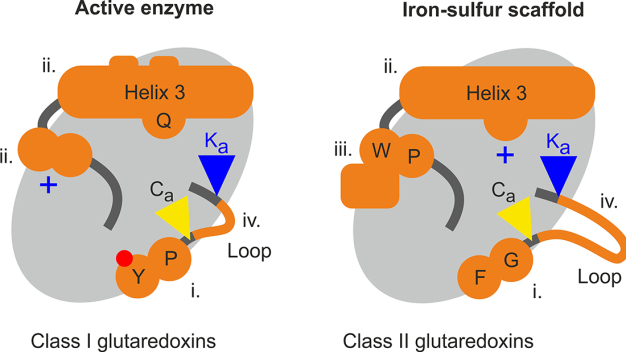
Schematic representation of the four structurally defining differences between enzymatically active and inactive glutaredoxins.
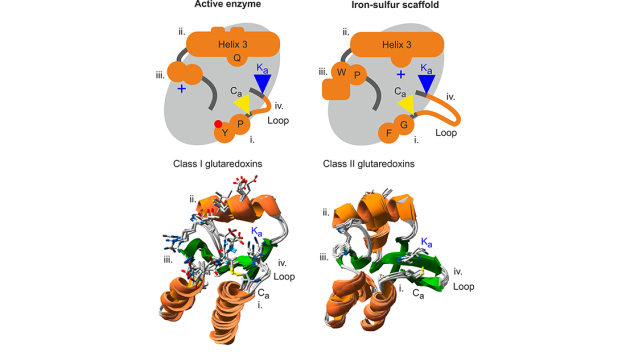
Comparison of the four structural differences that determine function between enzymatically active and inactive glutaredoxins.
German researchers were able to identify the precise structural differences that determine whether a protein becomes an active enzyme or a scaffold for iron ions. This insight, reported in the scientific journal Nature Communications, provides a deeper understanding of fundamental cellular processes such as DNA synthesis and iron metabolism.
Four mutations in a group of proteins called glutaredoxins determine how these proteins function in various organisms, from bacteria, yeast, and plants to humans, report researchers in the journal Nature Communications.
"These proteins are of central importance for vital metabolic pathways," explained Professor Marcel Deponte, a biochemist leading research at the Technical University of Kaiserslautern. "The findings regarding these proteins expand our fundamental understanding of how life works."
There are two main classes of glutaredoxin proteins. Class I glutaredoxins are enzymes that catalyze important redox reactions, such as the synthesis of the building blocks of DNA. Class II glutaredoxins are not active catalysts but serve as carriers and sensors for iron-sulfur clusters, which play a crucial role in iron metabolism.
While biochemists have known about these two classes for over 20 years, it has so far been unclear which structural differences are responsible for their different functions. Marcel Deponte teamed up with researchers from Saarland University and Heinrich Heine University Düsseldorf to study the proteins in test tubes, in yeast cells, and through computer-assisted modeling.
NMR structures of the proteins revealed four regions containing differences or mutations between the amino acid sequences of class I and class II. Marcel Deponte and his team wanted to precisely determine how much each mutation contributes to transforming the protein into a catalytically active class I glutaredoxin or an inactive class II glutaredoxin.
To measure this, they used a combination of editing and tracking techniques. In the first step, the proteins were produced and purified to analyze their activity in a test tube assay. Normally, an active enzyme of class I would catalyze or support a redox reaction, i.e., a chemical reaction involving electron transfer between molecules.
The team systematically replaced sections in the inactive class II protein with corresponding sections from active class I proteins, and vice versa. The most noticeable physical difference between the two classes is an extended loop in the inactive class II proteins. After removing this long loop and replacing it with the shorter loop from a class I protein, they observed a slight increase in catalytic activity. In combination with other mutations, the activity of the class II protein increased progressively. The researchers concluded that the long loop acts like an on/off switch in the inactive class II, and that all four mutations from class I glutaredoxins are necessary to fully convert the inactive protein into an active one. Ultimately, they succeeded in transforming inactive proteins, which normally recognize or transfer iron-sulfur clusters, into active enzymes that catalyze redox reactions, and vice versa.
"Mutations in all four regions work together to transform the protein either into an active redox catalyst or an iron-binding protein," explained Marcel Deponte.
The biochemistry team from Saarland, led by Professor Bruce Morgan, then developed an assay to test the relevance of the mutations in living yeast cells, confirming the same pattern of results — all four mutations are necessary for the complete transition between the two classes. For these analyses, the researchers used a green fluorescent probe that changes its fluorescence upon detecting redox reactions. The altered light emitted by the fluorescent probe indicated the extent to which a mutation enabled the protein to catalyze redox reactions within the cells.
Meanwhile, the group led by Professor Holger Gohlke from Düsseldorf conducted molecular dynamics simulations using supercomputers, which also supported and complemented the findings.
Collectively, the three studies "provide a truly convincing picture of how these proteins work," said Marcel Deponte. "This result was made possible by a priority program of the German Research Foundation that promotes this type of collaboration," he added, explaining further.
The next steps could involve investigating the effects of these mutations on human cells or applying a similar investigative process to other proteins. Thanks to advances in genetic sequencing technology, thousands of proteins have been decoded, but scientists have only just begun to understand what these proteins do or how they function.
Original publication:
M. Deponte et al., "Quantitative assessment of the determinant structural differences between redox-active and inactive glutaredoxins," Nature Communications, DOI: 10.1038/s41467-020-15441-3 (04/2020)
Technische Universität Kaiserslautern
67663 Kaiserslautern
Germany



