- Hygiene & Cleaning
- Translated with AI

Timo Speck
Covid19 – Cleanroom Tips
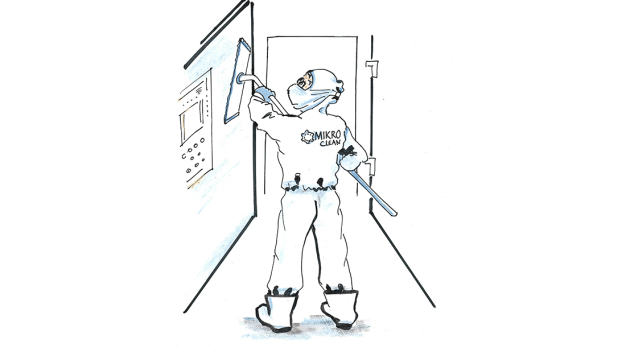
Corona affects nearly all areas of private and economic life. Therefore, even systems previously considered secure raise the question of how the risk of possible Covid-19 transmission can be further reduced. Through daily work in cleanroom cleaning, specialized cleaning companies like Mikroclean GmbH from Grafenberg possess extensive experience, which they are happy to share with cleanroom operators in the form of targeted, easy-to-implement cleanroom tips for the Covid-19 pandemic.
Tip #1 - "Clean" in the Lock
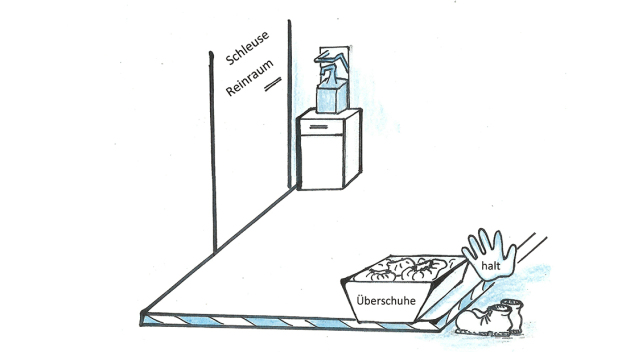
In relation to cleanrooms, personnel lockouts are particularly critical points. Because here, contact occurs between the potentially virus-contaminated environment and the secure, germ-free cleanroom. However, a simple measure offers the possibility to further reduce potential microbial load at the "dirty" end of the cleanroom lock and make the passage of the personnel working there even safer: the hygiene zone.
A clearly delineated area in front of the actual personnel lock — the hygiene zone — is entered by staff in such a way that the possible virus entry towards the lock is minimized to the absolute necessary minimum. To do this, all unnecessary clothing items, such as jackets, street shoes, and headgear, are removed before entering this zone and replaced with sterile protective clothing. Then, hands are disinfected at available disinfectant dispensers, and a hairnet along with a face mask are worn. Since the necessary means, such as floor markings, disinfectant with dispenser, and storage options for unnecessary clothing, can be set up with minimal effort and are already often available in cleanroom operations, such a hygiene zone can usually be implemented quickly and without significant costs.
Furthermore, the effectiveness of the hygiene zone can be increased through organizational measures. Reducing the throughput frequency via the hygiene zone and lockout minimizes microbial contamination of these critical areas to the absolute minimum. The same goal is pursued by adjusting the routes to keep other "passersby" without direct relation to the cleanroom away from the area from the outset. Lastly, designating wash areas helps to reinforce discipline regarding cleaning and handwashing among all personnel.
Tip #2 - Interval Cleaning
Adjustments to the interval cleaning of a cleanroom are also easy to implement and can help further reduce infection risk.
Not all areas of a cleanroom are cleaned with the same frequency. Less used surfaces, such as floors, walls, and ceilings, are cleaned less often than immediate work areas. Currently, it makes sense to shorten the intervals for these surfaces as well, to eliminate them as potential reservoirs of germs and prevent possible contamination by Covid-19 and other pathogens. Appropriate cleaning intervals for the particularly sensitive lockouts could be, for example, daily treatment. Additionally, a weekly sporicidal treatment is advisable. For floors, weekly cleaning is recommended, and for walls and ceilings, at least a monthly cycle.
Complementarily, the effectiveness of interval cleaning can be further intensified through a regular change of disinfectants. Rotating disinfectants prevents the development of resistance and maintains the efficacy of cleanroom cleaning.
Tip #3 - The Clothing Concept
Protective clothing is an absolute necessity when working in a cleanroom. Therefore, it also presents an unavoidable risk of introducing germs into the cleanroom. However, the risk of contamination can be significantly reduced through protective clothing.
Depending on the sensitivity of a cleanroom, employees already perform regular changes of protective clothing. Currently, more frequent changes help to reliably eliminate possible microbial loads. Previously weekly clothing changes should be switched to a daily routine. An already daily clothing change can be performed after each exit from the cleanroom. As a guideline for change intervals, it is advisable to consult the next higher GMP level applicable to your cleanroom. For example, guidance based on GMP-C standards for cleanrooms may be helpful for clothing change protocols according to GMB-B guidelines.
However, not all protective clothing can be changed regularly. The same applies to the facilities necessary for proper clothing changes. Regular disinfection is recommended here. Shoe disinfection should occur daily, while the sit-over bench should be cleaned immediately after each use. If disinfectant stations are provided in the changing area, their use can be mandated for all employees.
Tip #4 - Increased Protective Measures
Not only at the transition from outdoor areas to the actual cleanroom but also within the cleanroom itself, the risk potential can be significantly reduced with simple means.
Depending on the sensitivity of the cleanroom and the work performed there, employees already change their masks on a predetermined schedule. Perhaps a strict change schedule was not previously necessary. To counteract possible covert contamination of masks and thus of your cleanroom, existing change intervals should be halved. For example, a two-hour change routine could be changed to a mask change after each hour. If there is currently no regulation for mask changes, a policy should be established to change masks after one to a maximum of two hours.
The workplaces, equipment, and other functional areas within the cleanroom are subject to strict cleaning and disinfection plans. This is generally not the case for "auxiliary surfaces." However, these surfaces can also become breeding grounds for germs. The current recommendation is to disinfect all surfaces not directly involved in the work process regularly. This includes door handles, drawers, cabinet doors, telephones, keyboards, and other control elements, as well as desks, storage areas, and other sporadically frequented areas. These surfaces should initially be included in routine cleaning. If personnel working in the cleanroom are made aware of this and equipped with suitable disinfectants, an effective surface disinfection immediately after use can be established as a supportive measure.
Tip #5 – Protection Zones and Reserves
Both spatially and personnel-wise, the protection of a cleanroom can be further increased, and its functionality can be maintained as much as possible even in the current challenging situation.
With the lockout and a preceding hygiene zone (see Tip #1), the basic requirements for a germ-free cleanroom are met. In the current situation, additional measures can further enhance the level of protection. The microbial load should also be reduced in the areas immediately surrounding the cleanroom. Such a protection zone can be easily achieved by relocating work areas as far as possible away from the immediate vicinity of the cleanroom. Furthermore, access to the protection zone should be limited to absolutely necessary personnel. Finally, separation measures such as sneeze guards, hanging screens, and other similar facilities can help further advance the separation of the protection zone from other work and passage areas.
Despite best efforts, it may happen that employees working in the cleanroom become infected with Covid-19 elsewhere and are temporarily unavailable. To prevent disruption of work processes, an operational reserve can often be created with simple procedures for absent colleagues. For this, personnel from other areas familiar with the procedures in the cleanroom should be strictly separated from the cleanroom environment. Ideally, home office solutions are used to effectively protect these individuals and to serve as temporary replacements in case of absence of personnel in the cleanroom.
MEWA Cleanroom GmbH
72661 Grafenberg
Germany