




- Air
- Translated with AI
Corona measures: It's the dose of CO₂ that matters
Infection risk via aerosols – field test in the lecture halls of TU Berlin – practical recommendations for specialists and building management

Make the vortices glow: Using tracer particles, a light projection, and high-speed cameras, airflow and particle dispersion are measured indoors at the Hermann Rietschel Institute.
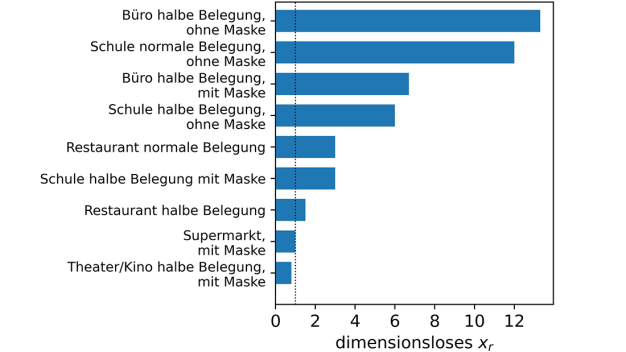
Fig. 1: Comparison of the risk factor xr from the simplified risk model for various everyday situations. The durations of stay vary here – a full work or school day is assumed, while a visit to the cinema or restaurant is correspondingly shorter. The reference value is xr = 1 for a half-hour stay in a supermarket with a mask. The value of xr is independent of the respective virus variant.
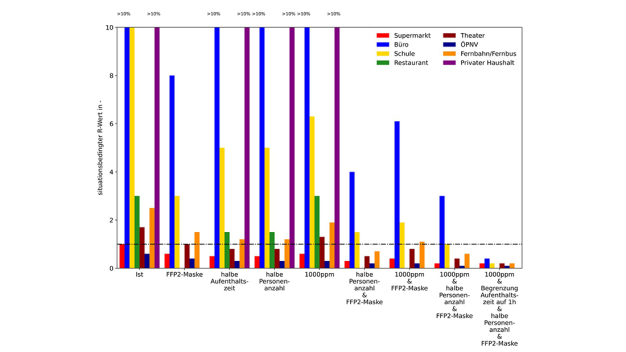
Fig. 2: How many additional people can an infected person infect on average in a specific situation? This is indicated by the "situation-dependent R-value." Here, it is shown for various situations and possible measures. The infected person is assumed to have a high virus factor, which corresponds to high infectivity, for example. The term "1000 ppm" refers to the CO2 level and means that the room, in this case, is sufficiently ventilated according to the requirements for good air hygiene.
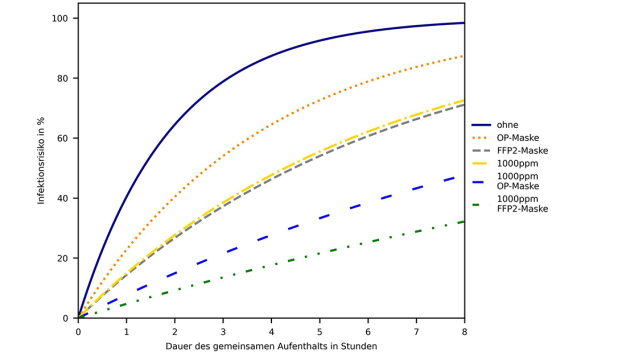
Fig. 3: Predicted infection risk for an employee in a large office with ten healthy individuals and one infectious person, plotted over a full workday. The curves correspond to the different measures (combinations) listed on the right. The term "1000 ppm" refers to the CO2 level and indicates that, in this case, the room is sufficiently ventilated according to the requirements for good air quality.
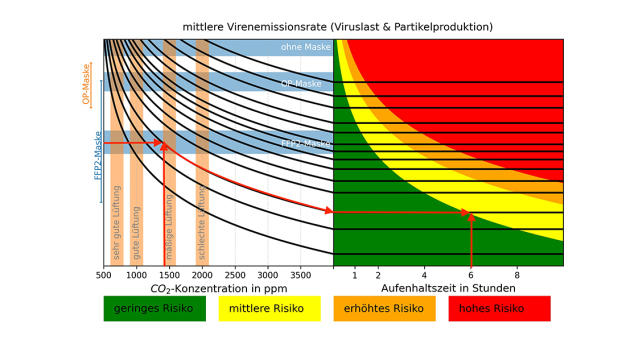
Fig. 4: Diagram for determining the infection risk when an infected person is present and statistically averaged infectivity. In the example (red arrows), for moderate ventilation and an average effectiveness of worn FFP2 masks during a six-hour stay, the point is located at the borderline between a low and a medium risk of more than one additional person becoming infected. This applies regardless of a specific number of people and for all typical room sizes.
Researchers from the Hermann Rietschel Institute of the Technical University (TU) Berlin and other scientists have developed a simplified risk model to provide practical and evidence-based recommendations for building and event management during the COVID-19 pandemic. It is based on a validated infection dose model, analysis of 25 documented outbreak events, and new mathematical calculations.
For the first time, the importance of carbon dioxide (CO2) concentration as an indicator of infection safety in indoor spaces is also demonstrated mathematically. The researchers propose to extend this value with the duration of stay of individuals to create a "CO2 dose." To test this improved indicator in building management, a field test is currently underway in lecture halls at TU Berlin. CO2 sensors transmit their data to cloud-based software.
The vaccinations and hygiene concepts for indoor spaces have made it possible for us to go to the cinema and participate in events despite high incidence rates. However, important questions remain open: What viral loads actually lead to outbreaks in practice? How can the effects of various hygiene measures be quantified in a simple mathematical model? And what general insights can be derived from this, regardless of the specific properties of the virus?
COVID-19 outbreaks from around the world
All infection events where one person infects more than one other person are considered outbreaks. "Well-documented outbreaks are like gold for us," says Prof. Dr.-Ing. Martin Kriegel, head of the Hermann Rietschel Institute and lead author of the study. "They are rare and at the same time extremely valuable." The cases studied come from all over the world, such as Korea, China, Hawaii, Israel, or France. There is also an outbreak at a German meat company, as well as several particularly well-documented outbreaks in a Hamburg school and during choir rehearsals in Berlin. Through the detection of viral DNA in the infected individuals, it was possible to precisely determine who infected whom. Co-authors of Kriegel's study include, among others, a virologist, a hygienist, and an epidemiologist.
Good crime scene work is important
Analysis and comparison of the 25 outbreaks allowed for general conclusions. They also provided clues as to which data are truly important for documenting an outbreak to quickly get a good picture of the infection dynamics. These include, for example, a reliable number of all infected individuals during the outbreak, the exact number of people present, as well as information about who was where and for how long, and what infected and infectious persons exactly did. Additional information about the ventilation situation is also relevant. "It's really like crime scene investigation. The faster these data can be collected after an outbreak, the better the involved persons remember the circumstances," Kriegel explains. But even with rudimentary information, outbreaks can still be reconstructed quite well using experience and processed through statistical analyses.
New model with mathematical simplifications
To provide concrete quantitative recommendations for preventing an outbreak, such as the maximum number of people in a room or the necessary fresh air flow, the researchers relied on basic equations of infection dynamics developed in the 1950s and 1970s. Building on this, they established a simplified mathematical infection model that includes parameters relevant to an outbreak. These relate to the properties of the virus and the space considered, but also to activities of the people in the room, for example. "We have made simplifications that enable practically applicable statements on infection prevention," explains Kriegel. A key result is the direct connection between the CO2 content in indoor air and the infection risk. One of the simplifications is, for example, assuming that the number of at-risk persons in the room is greater than the number of infectious persons—which is usually the case. This allows the elimination of the cumbersome exponential function in the model.
Risk comparison for everyday scenarios
One result of these calculations is a risk comparison of certain everyday situations, which applies to all types of viruses that primarily spread via aerosols (see Fig. 1). Staying in offices and schools ranks high in risk, while theater and cinema visits are associated with only a low risk. The often-discussed restaurant visits pose only a moderate risk for an outbreak with more than one infected person. "Nevertheless, the risk of infection there is relatively high because everyone speaks, and no one wears masks at their seat," Kriegel explains. The duration of stay makes the difference here—because no one stays as long in a restaurant as a normal workday in the office.
The factor of time is often overlooked
The importance of the time factor in risk assessments is also demonstrated by an overview of the effectiveness of various non-medical prevention measures and their combinations (see Fig. 2). Since the overall risk reduction calculation involves multiplying the contributions of individual protective components, for example, halving the duration of stay can double the protective effect of ventilation and mask-wearing. "While we intuitively know from chemical accidents or radioactive radiation that you shouldn't stay too long in a hazardous area, this is often forgotten with infection risks," says Martin Kriegel.
Field test in the lecture halls of TU Berlin
For this reason, measuring CO2 concentration in a room alone is only conditionally suitable for assessing infection risk. Although CO2 levels are a good indicator of when ventilation should be performed, there is no "safe CO2 threshold" beyond which no infections would occur. Because an infectious person in the room continuously emits virus-laden aerosols, and exposed individuals constantly breathe them in. "We therefore propose a CO2 dose for risk assessment, which additionally includes the duration of exposure to this concentration," Kriegel explains. Currently, experiments are underway in lecture halls at TU Berlin. CO2 sensors transmit their data to cloud-based software, which calculates the CO2 dose. Based on this, a smartphone app could access this data and create a personal risk profile for each student depending on their duration of stay and CO2 concentration. In collaboration with Prof. Dr.-Ing. David Bermbach's Mobile Cloud Computing department at TU Berlin, a web application has already been developed from the study, which can calculate the number of people likely to become infected based on the CO2 dose.
Recommendations for building management
The mathematical risk model developed in the study allows other researchers to conduct further investigations. It is also suitable for hygiene experts, ventilation engineers, and building or event management professionals who develop hygiene concepts. "The 'air exchange rate' often used in discussions about HVAC systems and mobile air purifiers is not effective," explains Kriegel. Instead, the researchers suggest using the "volume flow" related to the number of people and their duration of stay. While the air exchange rate indicates how often the entire room air volume is replaced within a certain period, this volume flow indicates how much uncontaminated fresh air is supplied per person and time of stay. "This way, we already have a direct connection between the sizing and operation of ventilation systems, the CO2 dose, and the predicted infection risk, which is not possible with the air exchange rate alone."
Through their work, the researchers aim to contribute to indoor air hygiene independently of a specific pathogen type. The focus is on measurement, emphasizes Kriegel. "Only those who measure can improve purposefully. Air is a foodstuff and should be monitored just like our drinking water." Because while we drink about 1.5 kilograms of water daily, we breathe in ten times more air—about 15 kilograms per day.
Technische Universität Berlin
10587 Berlin
Germany