



- Translated with AI
Jim Polarine, Marc Rogers
Control of mold spore infestation and removal of residues in cleanrooms
![Fig. 1 Appearance of residues on typical surfaces in cleanrooms (from a distance of 4 feet [1.2 m]); 3 applications with 0.5 ml/test strip. Top row: Phenol with low pH at 1:256; middle row: Phenol with high pH at 1:128; bottom row: ready-to-use sporicide (a mixture of peracetic acid and hydrogen peroxide). The test strips of vinyl in the bottom row and of epoxy in the middle row are shown enlarged (distance of 1 foot [0.3 m]).](/uploads/images/_scale/abb1_de_web_626x653.jpg "Fig. 1 Appearance of residues on typical surfaces in cleanrooms (from a distance of 4 feet [1.2 m]); 3 applications with 0.5 ml/test strip. Top row: Phenol with low pH at 1:256; middle row: Phenol with high pH at 1:128; bottom row: ready-to-use sporicide (a mixture of peracetic acid and hydrogen peroxide). The test strips of vinyl in the bottom row and of epoxy in the middle row are shown enlarged (distance of 1 foot [0.3 m]).")
Fig. 1 Appearance of residues on typical surfaces in cleanrooms (from a distance of 4 feet [1.2 m]); 3 applications with 0.5 ml/test strip. Top row: Phenol with low pH at 1:256; middle row: Phenol with high pH at 1:128; bottom row: ready-to-use sporicide (a mixture of peracetic acid and hydrogen peroxide). The test strips of vinyl in the bottom row and of epoxy in the middle row are shown enlarged (distance of 1 foot [0.3 m]).
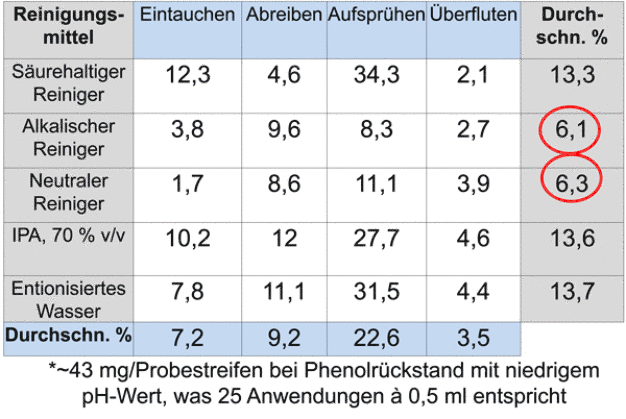
Table 1. Percentage of residues* on stainless steel test strips after the use of cleaners with four removal techniques
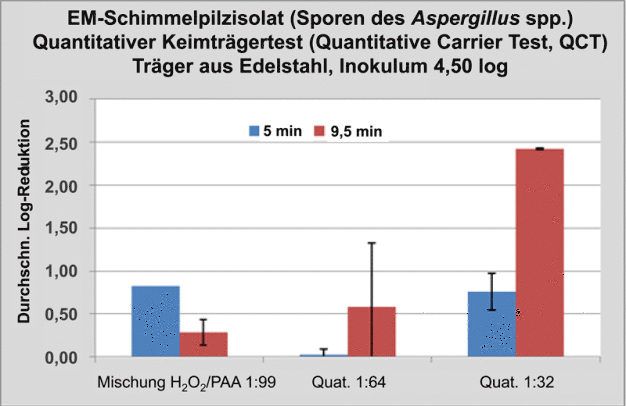
QCT results for mold spores
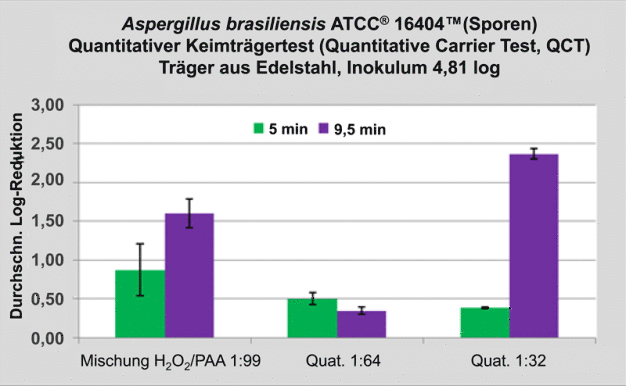
QCT results for mold spores
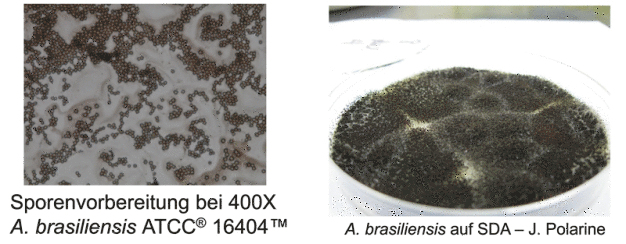
QCT results for mold spores
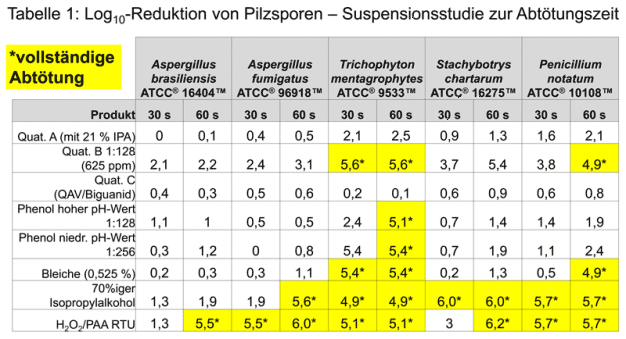
Table1b_EN_web
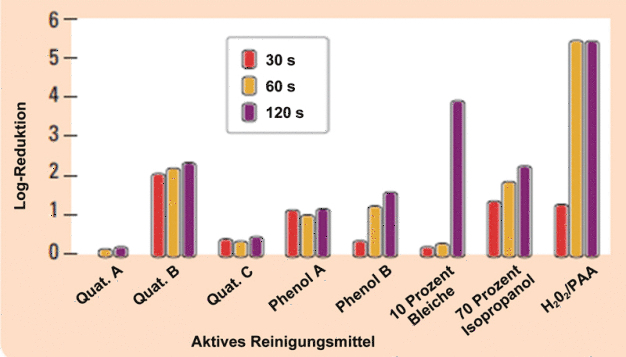
Table1c_EN_web
Residues
Disinfectants and sporicides are essential for controlling microbial contamination in the pharmaceutical, biotechnological, and medical device industries. However, repeated use over time can lead to deposits on disinfected surfaces. These residues may be problematic in terms of appearance, safety, and product integrity. Residues are most noticeable on stainless steel at a quantity of approximately 4 mg/cm2 (and visible to the naked eye). On other surfaces commonly found in cleanrooms, they may be more difficult to detect (Fig. 1).
Inactivation of fungal spores
Fungal isolates commonly found in cleanrooms:
Aspergillus spp.
Cladosporium spp.
Penicillium spp.
Chaetomium spp.
Paecilomyces spp.
Mucor spp.
Trycophyton spp.
Stachybotrys spp.
Alternaria spp.
Fusarium spp.
Rhizopus spp.
Curvularia spp.
Which products are suitable for fungi?
Formulations with quaternary ammonium: 70% isopropyl alcohol v/v
Formulations with phenol: 70% ethanol v/v
Sporicides: mixtures of H2O2/peracetic acid, H2O2 alone, sodium hypochlorite
Conclusions
In general, a sporicide is recommended for controlling fungal isolates on most surfaces in cleanrooms. In certain cases (e.g., a desired two-log reduction), quaternary cleaners (Quat.) or 70% isopropyl alcohol (IPA) may also be used. The results can be strain- and surface-specific, so an in-vitro surface test (swab test) is recommended.
A complete cleaning and disinfection program requires the removal of all residues. Therefore, it should be performed as needed after visual and tactile inspection. Further information can be found at:
http://www.ivtnetwork.com/article/jim-polarine-and-marc-rogers-rinsing-strategy
Acknowledgments
We would like to thank Carol Bartnett for the data on fungal spore inactivation and Brook Meadows for the data on residues and the photos (Fig. 1, Table 1).
STERIS Deutschland GmbH
50933 Köln
Germany