

- Translated with AI
Clear commitment to development and production in the Northern Black Forest
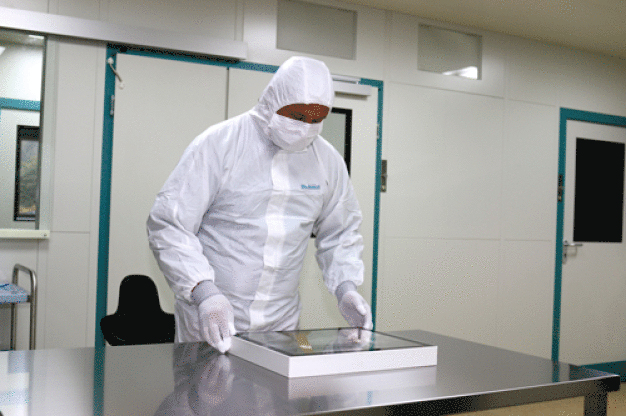
After the acquisition of the former Aldi building and grounds in Calmbach in January 2013, Richard Wöhr GmbH opened its own touchscreen manufacturing facility there in November 2014 after a lengthy approval and conversion phase.
With this, the shareholders and employees of the medium-sized family business send another clear commitment to development and production in the Northern Black Forest. More than that: With the new business field "Touch4B – Touch for Business," they aim to counter the strong Asian market at least in the area of custom touchscreens.
For this purpose, an additional 1,400 square meters of production space including a cleanroom for touchscreen bonding is available in the Beermiss industrial park. The decisive factor for the purchase was the proximity to the headquarters in Höfen's Gräfenau, where around 85 employees already work in the areas of enclosure construction and input systems, mechanics, as well as surface and system technology.
The new Werk 2 is equipped with several machines for scribing/cutting, grinding, milling, cleaning, and polishing glass plates. "Much of what we need is not yet on the market or must be converted from existing equipment," says Managing Director Stefan Wöhr regarding the difficulties causing further delays. Currently, the final preliminary tests are underway at the Höfen plant for the start of prototype manufacturing in the "Front Glass and Optical Bonding" area. The entire process chain will then be approved by the responsible authorities in Bad Wildbad, and the further building permit will be granted. Additionally, a 60-square-meter cleanroom has been built, in which the touchscreen panels, equipped with electronics (transparent conductive layers), will be bonded to the individually printed glass fronts in a particle-free environment. According to Stefan Wöhr, the surface and technical upgrades will also lead to an expansion of expertise and development possibilities.
"In the membrane keypad sector, we have long been experiencing stagnating, partly shrinking order volumes," Wöhr explains, attributing this development to the rapid success story of smartphones in the consumer sector and the high value of glass. "However, we want to continue growing sustainably, which is only possible through the exploration of new technologies and markets. Our core competence has always been the combination of various input systems and technologies at the interface between humans and machines. We want to build on that," Wöhr looks confidently into the future.
"In the future, we will offer touchscreen solutions, even in smaller quantities, which are flexible in size, design, and function. They will be used both as standalone variants and integrated into machines, meeting requirements in demanding, harsh production environments or in medical settings. Through the interplay of the Höfen and Calmbach plants, we are capable of manufacturing customized complete solutions from mechanics, surface technology, and design to electronics."
The company's innovation efforts, which originated in 1967 from an industrial painting business, are also supported by federal funds from the Central Innovation Program for Small and Medium-Sized Enterprises (ZIM) and from the Rural Development Program (ELR) of the state to support small and medium-sized enterprises in maintaining the decentralized economic structure. The necessary research and development for this has so far been carried out at the Höfen plant due to delays in the approval process.
ZIM is a nationwide, technology- and industry-open funding program for medium-sized companies and associated research institutions close to industry. It aims to sustainably support the innovation capacity and competitiveness of companies, including crafts and independent professionals, thereby contributing to their growth and the creation and safeguarding of jobs.
With its research project to develop a new manufacturing process for touch sensors, Richard Wöhr GmbH meets the requirements for funding as a standalone project. The company has hired additional personnel for its internal implementation by mid-2015. The goal is to develop and produce custom solutions with dual- or multitouch functions outside of standard components.
The touchscreens produced in large quantities by Asian manufacturers predominantly use conductive films and cover glasses made via screen printing, usually with one or two colors. Wöhr intends to replace these with variants produced through screen and digital printing using functional glass. Customer-specific control concepts with additional services in mechanics, electronics, and design are to be realized.
Wöhr has already demonstrated its competence in this area in recent years through numerous projects with renowned clients, especially in medical technology, thanks to its high manufacturing depth and breadth, explains Stefan Wöhr. For software development, the managing director also envisions collaboration with external research institutions.
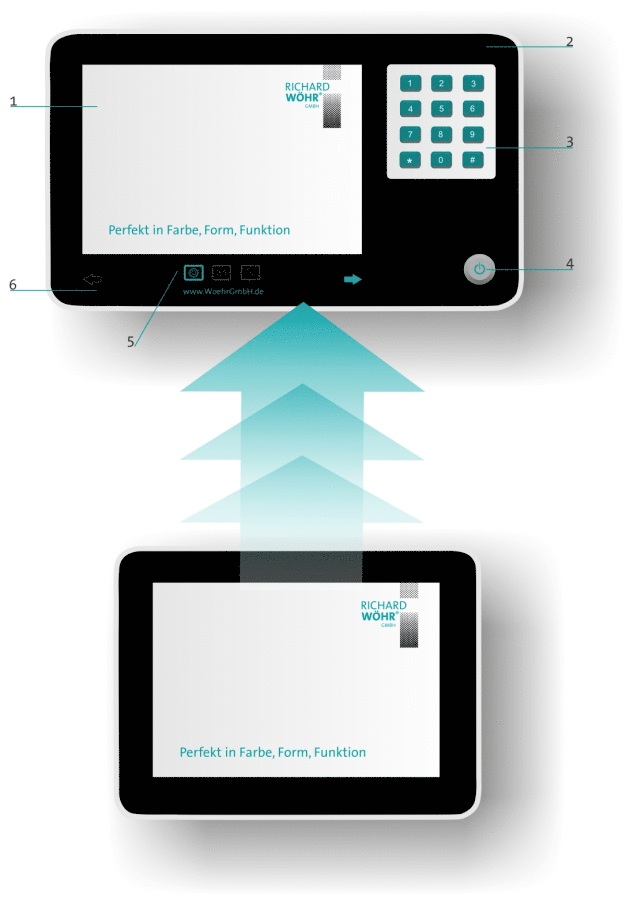
Added value for the customer compared to a standard touch device:
1. Customer-specific touch technology (currently in development at Wöhr)
2. Customer-printed glass (to be cut, processed, and printed at Wöhr in the future)
3. Capacitive touch panel or membrane keypad
4. Breakthrough for electromechanical switch or capacitive single switch
5. Printing or illumination
6. Backlit input or display
Richard Wöhr GmbH
75339 Höfen/Enz
Germany