



- Science
- Translated with AI
Cir.Log® – innovative AI-based camera system for the preparation of medical devices
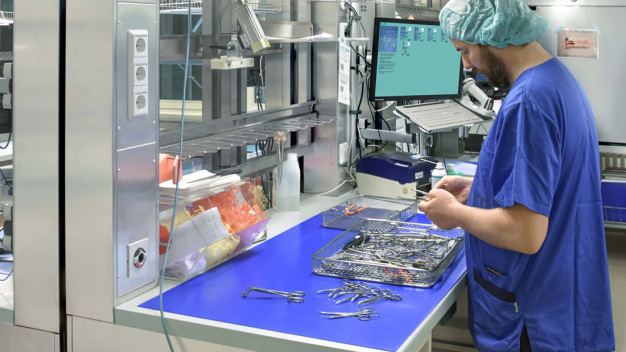
Fraunhofer scientist Clemens Briese during the testing of Cir.Log® in the AEMP of the Benjamin Franklin Campus of Charité Berlin. © Fraunhofer IPK
A research team at Fraunhofer IPK is developing an AI-based camera system that can recognize and track markerless surgical instruments. The technology aims to optimize sterilization logistics in hospitals and clinics. The research transfer is now being funded with over 1 million euros by the Federal Ministry for Economic Affairs and Climate Action (BMWK).
The shortage of skilled workers in healthcare affects not only medical personnel but also many service staff who ensure the smooth operation of hospitals and clinics. The highest demand is in the so-called reprocessing units for medical devices, or AEMP. Here, for each operation, the required instruments are manually cleaned, sorted, packed, and sterilized in advance. At Charité alone, around 14 million surgical sets are reprocessed annually under the strictest hygiene and quality standards. Most AEMPs follow a zero-error policy because problems here have direct impacts on patient care. Staff at the packing stations must therefore ensure that all instruments needed for an operation are fully contained in the so-called operating room sieve. This is no easy task with up to 160 scalpels, scissors, clamps, and other instruments that must be packed as efficiently as possible into such a sieve.
A camera system based on the latest AI technologies is intended to support staff in the future: It is called Cir.Log® and is currently being developed by researchers at Fraunhofer IPK. The camera is supposed to recognize and track surgical instruments using machine learning algorithms, and do so markerless, solely based on their appearance. It should reliably locate different surgical sets and verify which instruments have actually been packed into a sieve, which are still missing, and also identify instruments that do not belong to the sieve. Cir.Log® will essentially work like a barcode scanner, only without a barcode. Expensive and time-consuming application of barcodes, DataMatrix codes, or RFID chips, as is currently common for tracking surgical instruments, will become unnecessary. Due to its compact design, the camera system can be space-savingly used at standard packing tables and can be easily installed or retrofitted in any AEMP.
"We are convinced that our solution offers great added value for hospitals and clinics because it not only saves time and costs but also improves process security," says Jan Lehr, research associate at Fraunhofer IPK. Cir.Log® facilitates the onboarding of new staff and enables significantly faster packing times right from the start, especially for untrained or new personnel. "We estimate that experienced staff can work 30 percent more effectively with Cir.Log®. The onboarding time for new personnel is reduced by 65%," Lehr explains. The camera system also provides a digital documentation of each packing process, contributing to quality assurance in AEMPs. Last but not least, it also increases safety for patients: Due to the controlled and documented packing process of the surgical sieves, missing or incorrect instruments— which would otherwise be noticed only during surgery—are avoided. This allows surgeries to be carried out as planned and surgical schedules to be maintained.
Prototypes of Cir.Log® are already in use, among others, at Charité Campus Benjamin Franklin in Berlin. The goal of the research team at Fraunhofer IPK is to further develop the camera system to market maturity and then distribute it through an institute spin-off. Currently, they are working on a business plan and preparing for company formation within the framework of the Federal Ministry for Economic Affairs and Climate Action (BMWK)’s EXIST research transfer program. The BMWK is funding the project with around 1 million euros.
Das Fraunhofer-Institut für Produktionsanlagen und Konstruktionstechnik IPK
10587 Berlin
Germany



