



- Science
- Translated with AI
CIPHOR – Recommendation for the funding of a new research building for Integrated Quantum Photonics
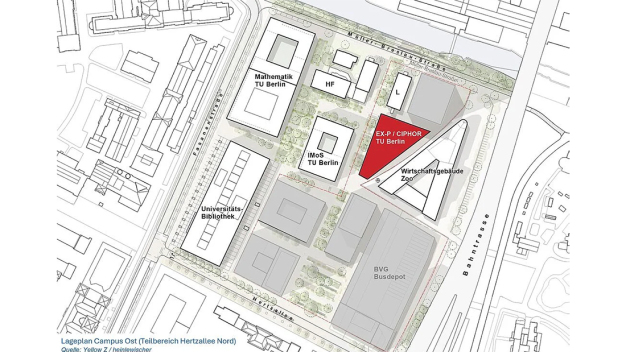
Site plan for the Center for Integrated Photonics Research (CIPHOR)
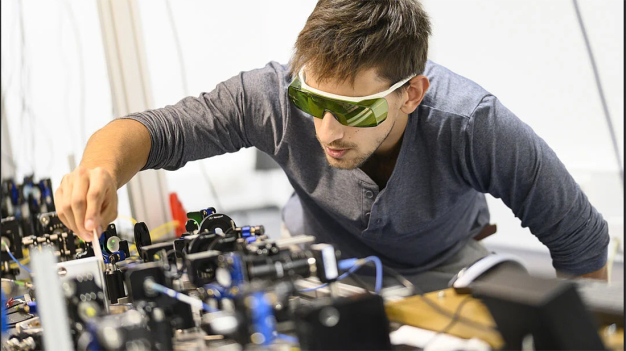
PhD student in the quantum optics laboratory
The TU Berlin has participated very successfully in the competitive procedure for the realization of new research buildings in joint funding between the federal government and the states for the funding phase 2025. Under the term "CIPHOR," the project for Integrated Quantum Photonics was rated as "very good to outstanding" by the Research Buildings Committee and was recommended for funding by the Science Council on April 19, 2024, to the Joint Science Conference (GWK). The goal is to establish the research building as part of the replacement new construction of Nanophysics on the Charlottenburg campus. The funding amount of approximately 63 million euros will be split equally between the state of Berlin and the federal government for the research building.
State-of-the-art Photonics: one of the most important key technologies of the 21st century
The focus of the research building is cutting-edge photonics. It is one of the most important key technologies of the 21st century and forms the basis for a wide range of applications in information and communication technologies (ICT), quantum technologies, sensor technology, and medicine. The photonics industry is one of the main growth drivers in Germany, with an annual turnover of over 50 billion euros and more than 190,000 employees, with the Berlin-Brandenburg region being one of the most important centers for optical technologies. A key driver of innovation is the miniaturization of optical components and systems, as well as the integration of various nanophotonic components and materials onto a compact and highly functional chip.
This is precisely where the planned Center for Integrated Photonics Research (CIPHOR) at TU Berlin will begin and advance integrated quantum photonics in the new research building. "With CIPHOR, quantum photonics research at TU Berlin will gain a groundbreaking foundation that will shape the development of physics in the coming decades," explains Prof. Dr. Michael Kneissl, spokesperson for CIPHOR.
State-of-the-art technological and experimental infrastructure
To address the challenges described, highly advanced technological and experimental infrastructure is necessary, which does not yet exist nationally or internationally. The laboratory concept of the research building includes three highly specialized central laboratory areas ("Core Laboratories") with experimental equipment at the highest level, which will be used collaboratively and allow resource pooling.
The participating institutes of TU Berlin
The participating scientists represent the institutes of Solid State Physics (IFKP), Optics and Atomic Physics (IOAP), and Theoretical Physics (ITP), as well as the extended circle including Electrical Engineering and Computer Science at TU Berlin. All areas can draw on the highest scientific expertise, for example, from several Collaborative Research Centers funded by the German Research Foundation.
2,000 square meters of usable space on the TU Campus OST
The CIPHOR research building, with its three central laboratory areas and approximately 2,000 square meters of usable space (floors 1-6), is to be part of a new building for TU Berlin's experimental physics. For this, the measure must be included in Berlin's investment planning. The site for the experimental physics building is a construction site on TU Campus OST at Müller-Breslau Street. The construction cost share for the three laboratory areas and 400 square meters of office space in the new research building amounts to approximately 54 million euros. Including costs for large equipment amounting to 6.7 million euros and initial setup costs of about 2 million euros, total costs amount to approximately 63 million euros.
"We are very pleased with the funding commitment. It is urgently needed not only from a construction perspective. In the modern laboratory building, our researchers will develop new applications for secure data transmission, photonic quantum computing, quantum sensing, and medicine. We can build on the strengths of the location and our scientific expertise here. I thank everyone who invested time, ideas, and enthusiasm. It is an investment in our future," says Prof. Dr. Geraldine Rauch, President of TU Berlin.
"I am extremely pleased with this success: it is the second initiative from Faculty II - Mathematics and Natural Sciences that has secured this funding for a research building. CIPHOR thrives on interdisciplinary and cross-institute cooperation and will serve as a model for modern laboratory use. I would like to expressly thank Department V - Universities in the Berlin Senate Department for Science, Health, and Care, and Department IV - Buildings and Service Management of TU Berlin's administration for their constructive collaboration," says Dean of Faculty II Mathematics and Natural Sciences, Prof. Dr. Etienne Emmrich.
Unique selling point of the approach
A goal and a unique selling point of the approach is the development of compact, integrated quantum photonic circuits (Quantum Photonic Integrated Circuits, Q-PIC), which combine novel and diverse functionalities on a semiconductor chip. Quantum photonic experiments, which currently occupy many square meters of optical table space or entire laboratories, are to be integrated onto a tiny semiconductor chip the size of a pinhead, enabling new applications in secure data transmission, photonic quantum computing, quantum sensing, and medicine. The knowledge and know-how generated in CIPHOR are intended not only for pure research but also to facilitate technology transfer through spin-offs and collaborations with industry partners.
Strength of the Berlin-Brandenburg region
Especially in the field of optical technologies, the Berlin-Brandenburg region is particularly strong with numerous SMEs. In the broader context of the new federal states, cooperation opportunities also arise with major chip manufacturers such as Intel, Infineon, and Bosch, which also offer interesting career options for highly qualified CIPHOR specialists.
TU Berlin
10623 Berlin
Germany