


- Science
- Translated with AI
Chat with machine data
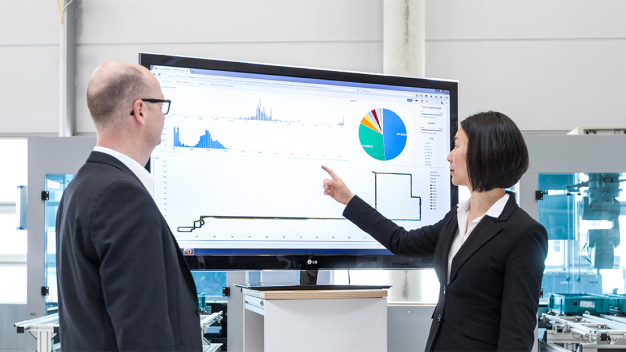
Through a generative artificial intelligence, production and machine data are to become more easily accessible. © University of Stuttgart IFF/Fraunhofer IPA, Photo: Rainer Bez
Thanks to AI, machine data becomes accessible to everyone: A research team at the Fraunhofer IPA is working on a generative artificial intelligence system that allows employees to query production and machine data via chat. It visualizes complex data and thus simplifies analysis in everyday work.
In a factory, large amounts of production and machine data are generated daily. However, in many cases, this data remains unused. The effort required to evaluate the data is especially challenging for small and medium-sized enterprises. Because specialized personnel must gather data from many different sources, painstakingly prepare it manually, and finally illustrate it with charts and diagrams.
“Access to and analysis of production and machine data must become easier,” says Matthias Schneider from the research team IT Architectures for Production at the Fraunhofer Institute for Production Technology and Automation IPA. This is precisely where the research project “Visualization of Production Data as a Generative Interactive Extension” (ViPGeniE) comes in. In collaboration with the three Baden-Württemberg companies ads-tec Industrial IT GmbH, Data Coffee GmbH, and Ulrich GmbH & Co. KG, Fraunhofer IPA aims to make production and machine data more accessible through a generative artificial intelligence system.
Analyzing data without expert knowledge
Just as many people today communicate privately with a generative artificial intelligence, employees in the future should be able to query specific data—such as certain machine states or temperature trends—via chat. In response, they will receive not only text but also the appropriate diagrams, which the AI generates specifically for their human conversation partner.
Building on this, employees can ask further questions to the AI. A kind of dialogue between human and machine emerges, during which correlations or causes of errors become understandable. This is made possible by the interplay of several technologies: production and sensor data are continuously collected and described in a so-called Digital Twin, a virtual replica of the production. This provides the necessary contextual information for the artificial intelligence to interpret the data correctly.
“The barrier to using production and machine data is thus significantly lowered,” says Schneider, “because no specialized knowledge is needed to access and evaluate the data.” Additionally, waiting times are eliminated for tasks such as adjusting existing static visualizations or creating new ones. Even if a company has its own data analysis specialists, they are usually not immediately available and can only respond to inquiries with delays. Small and medium-sized enterprises across all industries would particularly benefit from ViPGeniE, as they often cannot afford to employ data analysts.”
Initial results expected from 2027
The researchers around Schneider at Fraunhofer IPA are taking on several key tasks in the ViPGeniE project: They are developing the system architecture, a flexible environment where different language models can be used equally, and Digital Twins that structure the data and make analysis by the generative AI possible in the first place.
A first demonstrator, showing how complex production and machine data from various sources can be visualized understandably within seconds using generative AI, is expected to be presented by the project partners in the second quarter of 2027.

Fraunhofer-Institut für Produktionstechnik und Automatisierung IPA
Nobelstraße 12
70569 Stuttgart
Germany
Phone: +49 711 970 1667
email: joerg-dieter.walz@ipa.fraunhofer.de
Internet: http://www.ipa.fraunhofer.de