




- R+D & Community of Interest
- Translated with AI
Benchmark makes forecast tools comparable
Power consumption
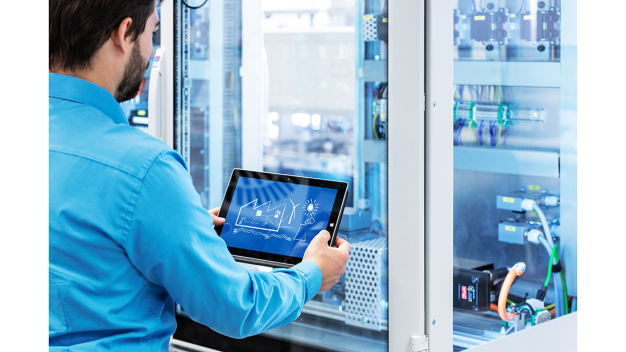
Researchers from Fraunhofer IPA have developed a benchmark tool. It makes various methods for determining future power consumption comparable. (Source: Fraunhofer IPA / Photo: Rainer Bez)
The agony of choice: Companies that want to benefit from low or negative electricity prices need reliable forecasts of future electricity consumption. Because the market for forecast tools is confusing, researchers from the Fraunhofer IPA have developed a benchmark that compares market-available solutions.
When the sun isn't shining and the wind isn't blowing, solar parks and wind turbines don't produce electricity. Such a dark period is relatively rare, but the more electricity comes from renewable energy sources, the more the electricity supply is subject to seasonal and weather-related fluctuations – and with them, the price on the Leipzig electricity exchange rises or falls. In 2019, it even dipped into negative territory for 200 hours. Companies that want to profit from such price dips must be able to estimate as accurately as possible how much electricity they will consume in the near future and ramp up their production whenever the electricity price is low or negative.
However, there is such a multitude of forecast tools available for predicting electricity consumption that even experienced energy managers can hardly keep track of them all. From simple methods assuming that consumption on weekdays in summer remains roughly the same, to self-learning algorithms that query electricity consumption quarterly over a longer period and draw conclusions for the future.
Benchmark tool simulates load forecasts
The question of which forecast tool is right for a particular company can only be answered with considerable effort. "In addition to the market offerings, the company's own energy data must also be carefully checked," advises Thilo Walser from the Department of Industrial Energy Systems at the Fraunhofer Institute for Production Technology and Automation IPA. He and his colleagues have developed a benchmark tool that compares available forecast tools on the market with the specific circumstances of a company and thus determines the most suitable method.
For this, the researchers need access to data from a company's energy management software. "High availability and quality of data are prerequisites for successful forecasting," explains Can Kaymakci, a research associate at Fraunhofer IPA. Based on the data, the benchmark tool simulates load forecasts using all relevant methods. The result of this benchmark analysis is a list that ranks the evaluated forecast tools according to their suitability.
Researchers aim to develop their own forecast tool
"The benchmark not only provides an independent evaluation of forecast tools," says Walser, "but also makes statements about the requirements that the forecasting method places on a company's IT system and how quickly the model computes its predictions." In an additional consultation, the researchers also give tips on which data should be collected in the future to achieve more precise load forecasts.
But the researchers themselves also gain new insights from their benchmark tool. During its development, they gathered enough knowledge to develop their own forecasting method. "This is intended to improve the forecast for inadequately predictable electricity consumption," says Christian Dierolf from Fraunhofer IPA. This is especially interesting for industrial companies with highly variable load curves daily. "Improved forecasts would open up profit potential from fluctuations in electricity prices," Dierolf adds.

Fraunhofer-Institut für Produktionstechnik und Automatisierung IPA
Nobelstraße 12
70569 Stuttgart
Germany
Phone: +49 711 970 1667
email: joerg-dieter.walz@ipa.fraunhofer.de
Internet: http://www.ipa.fraunhofer.de