

- Science
- Translated with AI
Bavarian Funding: Fraunhofer Institute in Würzburg advances innovative drug research with cell-based testing systems
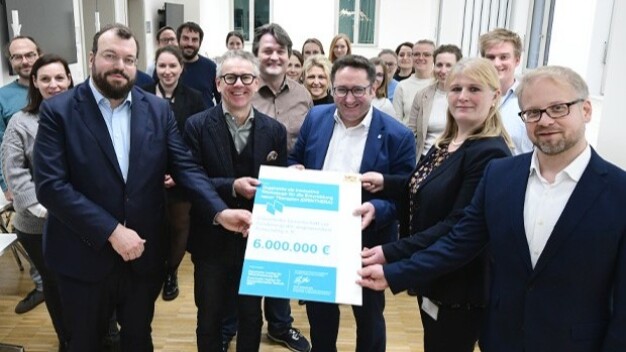
**"ORINTHERA"** will advance the development of highly functional tissue models for the pharmaceutical industry with Bavarian funding. State Secretary Tobias Gotthardt (center) during the handover of the funding decision of 6 million euros to Prof. Dr. Heiko Zimmermann, Institute Director of Fraunhofer IBMT, Dr. Thomas Hofmann, Deputy Institute Director of Fraunhofer ISC, Dr. Julia Neubauer, Managing Director of the Fraunhofer Center for Stem Cell Process Technology, Prof. Dr. Florian Groeber-Becker, Head of the Fraunhofer Translational Center for Regenerative Therapies (foreground from left to right). © Fraunhofer ISC
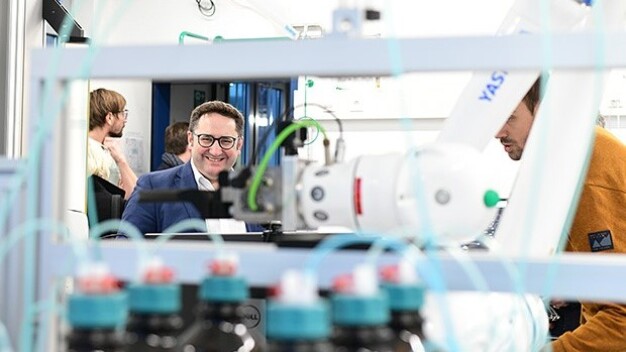
Digitized Material Development and Intelligent High-Tech Manufacturing - State Secretary Tobias Gotthardt in the "Materials Acceleration Platform" laboratory of the Fraunhofer ISC. © Fraunhofer ISC
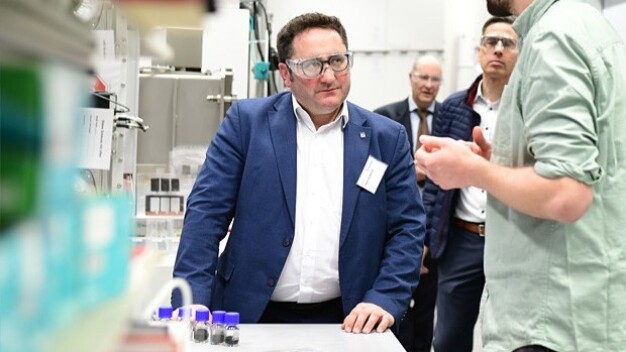
Rethinking batteries – sustainable materials, battery passport, design for recycling and reuse of functional materials – State Secretary Gotthardt visits the battery manufacturing facility of Fraunhofer ISC. © Fraunhofer ISC
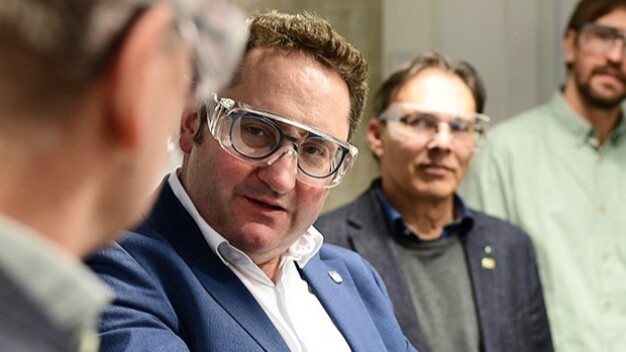
Communicating materials for safe handling of hydrogen – or what clever particles make possible – State Secretary Gotthardt is being informed about the advances in particle technology. © Fraunhofer ISC
On Friday, December 13, 2024, State Secretary Tobias Gotthardt from the Bavarian Ministry of Economic Affairs visited the Würzburg Fraunhofer Institute for Silicate Research ISC and the Fraunhofer Project Center for Stem Cell Process Technology. The appointment had been scheduled for some time. It was recently complemented with good news: the ceremonial handover of a funding notice amounting to 6 million euros, with which the Bavarian Ministry of Economic Affairs supports the expansion of research on cell-based advanced test systems for the exploration of new active substances and medicines in Würzburg. Leading the current project "ORINTHERA" are the two Fraunhofer Institutes for Biomedical Engineering IBMT and for Silicate Research ISC in Würzburg, with the joint Stem Cell Process Technology (SPT) project center and the Fraunhofer Translational Center for Regenerative Therapies (TLZ) of Fraunhofer ISC.
Clinical and pharmaceutical research continuously work on new and better therapies for diseases. But before a new drug or therapy can be classified as safe and effective, often hundreds of tests and trials are necessary – a time-consuming and costly process.
New impulses for pharmaceutical research
The new research project "ORINTHERA" will set the course over the next five years for automated and standardized production of complex cell-based test systems. State Secretary Tobias Gotthardt: "Through this project, we accelerate the development of highly functional tissue models from human cells and make them safer. This allows new therapies, medicines, or vaccines to be made available more quickly and reliably for people. In this way, we strengthen Bavaria as a highly innovative location."
"The core of the project is organ-like cell cultures, which are produced in vitro – that is, in test tubes – from human stem cells on special artificial tissue structures, e.g., heart muscle cells that actually contract spontaneously," explains Dr. Julia Neubauer, Managing Director of the SPT project center. The tissue structures create a three-dimensional environment that can be colonized by stem cells or so-called human induced pluripotent stem cells (hiPS cells, which are reprogrammed from almost any mature cell). "The resulting three-dimensional cell cultures can have complex organ-like properties and are therefore called organoids," adds Prof. Dr. Florian Groeber-Becker from the Translational Center for Regenerative Therapies at Fraunhofer ISC.
Such organoids could become important test models for new drugs and the development of new therapies in the future, as they can be produced directly from human cells. They could provide more meaningful study results regarding efficacy or tolerability in humans than animal testing. To make this possible, it is essential that such organoids are produced according to precisely defined procedures. Furthermore, standardized testing protocols must be developed to obtain reliable and reproducible test results.
The "ORINTHERA" project aims to help develop such study protocols and standards, as well as the associated automated procedures and materials, to enable efficient production and use of organoids. For example, they should become more useful for the pharmaceutical industry and accelerate the development and provision of new, safer medicines.
Research for the energy transition
Further focal points during State Secretary Gotthardt’s visit to Würzburg included contributions from Fraunhofer ISC’s materials development for the energy transition, such as battery research and hydrogen technology, as well as digitalization and space technologies.
The Fraunhofer Research and Development Center for Electromobility Bavaria at Fraunhofer ISC is one of the leading battery research centers in Germany, advancing the development of new high-performance battery materials together with industry. Würzburg's battery experts also contribute their material and process knowledge to sustainable reuse and resource-efficient, so-called "direct" – meaning functional-preserving – recycling of batteries, as well as in training specialists for the battery industry.
The second pillar for a CO2-free energy supply is expected to be hydrogen technologies. In collaboration with Friedrich-Alexander University Erlangen-Nürnberg, Fraunhofer ISC is developing a new class of sensor particles that enable safe handling of hydrogen and are easy to deploy. Such "communicating materials" are becoming increasingly interesting in other application areas as well, e.g., in combination with digitalization and automation.
Material development – from "Bio" to "Space"
At Fraunhofer ISC, digitization and automation of material development processes in combination with machine learning are pursued intensively. Through so-called "materials acceleration," i.e., accelerated material development, a revolution in material discovery and optimization is expected in the scientific community. Digital models of materials with modeled properties enable the automated and robot-assisted development of improved sustainable materials. Synthesis processes are refined through machine learning until the desired combination of material properties is achieved. Digitization and automation also play an important role at ISC in NewSpace projects such as "NetPioneer" and "VLEO." Together with the Fraunhofer Institute for Short-Term Dynamics EMI, efforts are underway to develop cost-effective materials for harsh conditions and smart manufacturing technologies for the serial production of small satellites in NewSpace. These efforts are intended to culminate in a modular manufacturing facility.
"The institute thus achieves an extremely wide range of applications with its material developments – literally from the smallest body cell to space. Unique in Bavaria!" praised State Secretary Gotthardt the work of Fraunhofer ISC.
Fraunhofer-Institut für Silicatforschung ISC
97082 Würzburg
Germany