


- Translated with AI
44 L of hexane in one hour: Automatic module for rotary evaporators with the world's only residual discharge allows unattended continuous operation
Time mode prevents foam formation with demanding media such as plant extracts
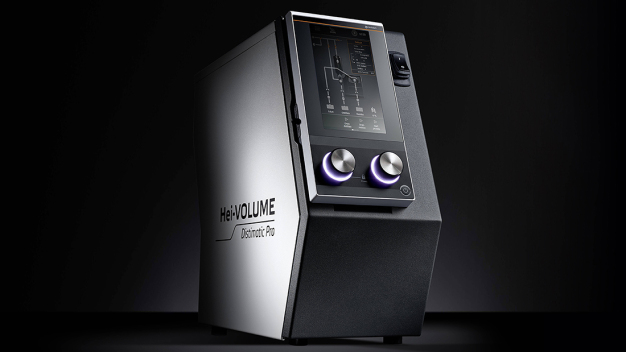
Through sensor-controlled automation, constant conditions for the evaporation processes are ensured, regardless of medium and volume. Thanks to the self-operating feed system, quantities of up to 1000 liters per day can be processed, since even the piston change is eliminated. (Source: Heidolph Instruments GmbH & Co. KG)
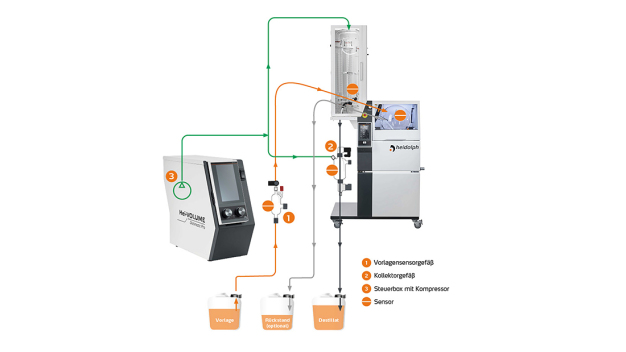
The operating principle of the Hei-VOLUME Distimatic Pro module is based on three automatically executed steps: First, the medium is filled from a pre-treatment container into the rotary piston. During the subsequent evaporation process, the resulting distillate is collected and drained into an attached container. Once a certain amount has evaporated, the process is gradually continued from the pre-treatment container. Optionally, the residue from the rotary piston can be automatically emptied. (Source: Heidolph Instruments GmbH & Co. KG)
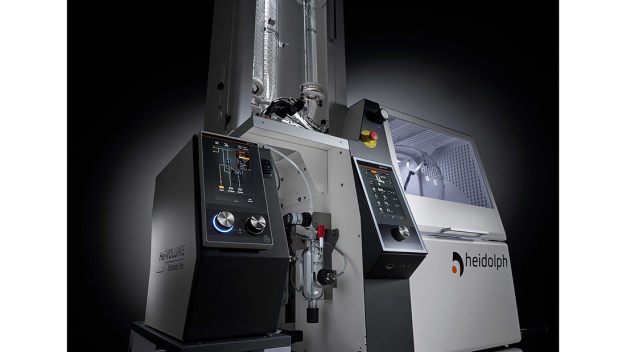
The Hei-VOLUME Distimatic Pro module can be combined with existing large-scale rotary evaporators of the Hei-VAP Industrial series and upgrades them to an automated complete system. (Source: Heidolph Instruments GmbH & Co. KG)
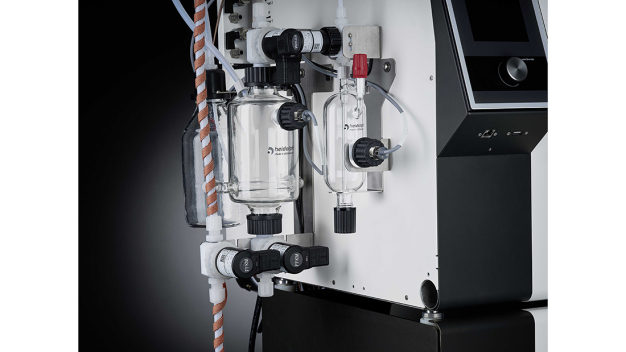
To prevent overflow and ensure the optimal cycle of vaporization, drainage, and refilling, various calibration-free sensors ensure the operation of all module components. (Source: Heidolph Instruments GmbH & Co. KG)
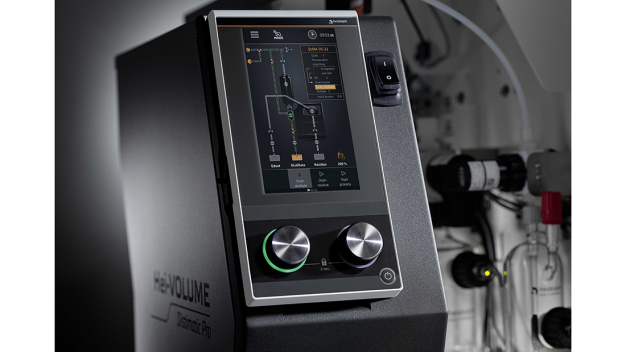
The operation of the Hei-VOLUME Distimatic Pro automatic module is carried out via the intuitive control panel with touchscreen. The graphical display, combined with a color scheme and illuminated push rotary knobs, always shows the current status and process step of the system. (Source: Heidolph Instruments GmbH & Co. KG)
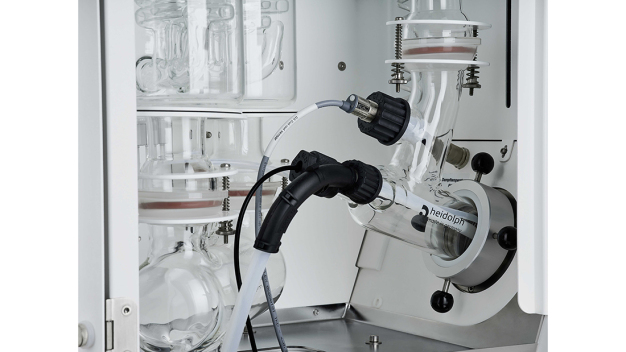
For safe continuous operation without supervision, the Hei-VOLUME Distimatic Pro automatic module is equipped with an emergency sensor on the evaporator. (Source: Heidolph Instruments GmbH & Co. KG)

"The high flexibility and smart sensor technology ensure that the system can make a decisive contribution to the automatic recycling of contaminated solvents and their reuse, making daily laboratory work not only more efficient but also more cost-effective and sustainable," summarizes Jürgen Heyder, Product Manager for Rotary Evaporators at Heidolph Instruments GmbH & Co. KG. (Source: Heidolph Instruments GmbH & Co. KG)
Many laboratories acquire solvents of technical purity for cost reasons. However, to achieve a purity suitable for synthesis, they must first be distilled—a process that takes a lot of time in everyday laboratory work. If this is done, for example, with manually operated rotary evaporators, regular adjustment of parameters and monitoring by personnel are necessary to ensure optimal system utilization. Additionally, plant extracts and synthesis steps often remain as viscous oils in the rotary flask after processing with the rotary evaporator. These must then be manually emptied before a new cycle can be started. The new Hei-VOLUME Distimatic Pro automatic module from Heidolph Instruments GmbH & Co. KG provides a solution. The autonomous system, consisting of a rotary evaporator and the Hei-VOLUME Distimatic Pro module, can operate unattended day and night. The module automatically refills the evaporator flask according to the selected operating mode. Various sensors in the collection vessel and in the rotary flask monitor the process flow and trigger tasks such as emptying the distillate or residues by overpressure. Thanks to automatic residue emptying, manual removal during the process cycle is eliminated. This allows processing much larger quantities than the volume of a single flask fill.
"Numerous laboratories as well as working groups at universities and institutes use solvents of technical purity because they are cheaper to purchase," reports Jürgen Heyder, Product Manager for Rotary Evaporators at Heidolph Instruments GmbH & Co. KG. "However, due to impurities, they must first be processed to make them suitable for synthesis." This can be very time-consuming, because when using semi-automatic or manual rotary evaporators, monitoring by personnel is necessary to change full flasks, refill medium, and prevent unexpected interruptions of the distillation cycle for demanding mixtures. Especially foaming media such as plant extracts can extend distillation times because they appear as viscous oils at the end of the process and hold solvent residues. Therefore, introducing such media into the rotary evaporator in small amounts is advantageous.
Therefore, Heidolph Instruments GmbH & Co. KG has expanded its proven rotary evaporation systems with the automatic Hei-VOLUME Distimatic Pro module. Through sensor-monitored automation, consistent conditions for evaporation processes are ensured, regardless of medium and volume. Thanks to self-feeding, even quantities up to 1,000 liters of hexane per day can be processed with an automated large rotary evaporator system, since flask changes are eliminated. "In this way, up to 44 liters of hexane, 14.6 liters of ethanol, or 4.6 liters of water can be evaporated in one hour," explains Heyder. "We are talking about a throughput that is three times higher compared to an 8-hour workday with a conventional large rotary evaporator. Eliminating setup times, such as filling the rotary flask, further increases system efficiency."
1,000 liters of hexane per day thanks to fully automatic monitoring
The operating principle of the Hei-VOLUME Distimatic Pro automatic module is based on three automatically executed steps: First, the medium is filled from a source container into the rotary flask. Typically, this is a 20-liter flask. During the subsequent evaporation process, the resulting distillate is collected and transferred to an attached container. Once a certain amount has evaporated, the system gradually refills from the source. "The automatic filling and refilling of the rotary flask occurs due to the system vacuum," explains Heyder. "Through the vacuum in the rotary evaporator, new medium enters as soon as the valve on the source container opens, either sensor- or time-controlled. When the source is empty, the system switches off." The automatic residue emptying also ensures that liquid or viscous residues, such as those that can occur when processing plant extracts, are transferred into an attached container. A fill level sensor continuously monitors the residue amount in the flask. When the rotary flask is filled with concentrate, overpressure emptying begins: the system is vented, and the residue is expelled by overpressure. This process is 61 percent faster than comparable systems that pump out residues.
All source and collection containers can be exchanged without interrupting the evaporation cycle. While residues are pressed directly into a chosen container, the distillate initially enters a collection vessel with distillate cooling, replacing the traditional collection flask. The cooling prevents unwanted co-boiling of volatile solvents. The sensor-controlled collection vessel emptying also works with overpressure. First, the collection vessel is separately vented, then emptied by overpressure. Afterwards, the vessel is evacuated before the valve to the rest of the system reopens and the distillate continues to be collected. The overpressure transfer is 83 percent faster than conventional pumping. Additionally, the device offers a so-called flushing mode to clean the system. It allows choosing whether only the media-carrying hoses and the rotary flask or the entire system should be cleaned with an appropriate solvent.
Maximum flexibility and control in operation
To prevent overflows and ensure the optimal cycle of evaporation, removal, and refilling, various calibration-free sensors ensure the operation of all module components. In addition to a fill level sensor in the rotary flask, the Hei-VOLUME Distimatic Pro automatic module has a fault sensor on the evaporator. "If the evaporator fills with medium due to a fault, the system automatically switches off. It is vented, and a safe operating condition is established," explains Heyder. There is also a sensor to monitor the source container. When it is empty, the sensor triggers the end of the process and switches off the system and peripherals. A sensor on the collection vessel monitors and controls its emptying as well.
The operation of the Hei-VOLUME Distimatic Pro automatic module is via the removable control panel with touchscreen. The graphical display, combined with a color scheme and push-turn knobs, always shows the current state and process step of the system. LED rings on the knobs also indicate this from a distance. Three operating modes can be selected: sensor-controlled, time-controlled, and manual mode. This allows each laboratory and working group to adapt the system to their specific requirements without extensive calibration or modifications. While the manual mode is suitable for small batch processing, the time mode can process very sticky and foaming media. For this, only the interval at which the valve to the flask opens is set, allowing only a few hundred milliliters into the flask to evaporate immediately. Foam formation is thus prevented. Furthermore, all process parameters can be recorded via datalogging on the panel for monitoring purposes. Parameters for recurring processes can also be saved and transferred to other systems via USB stick. To prevent manipulation during operation, the screen can optionally be PIN-protected. "The high flexibility and smart sensor technology ensure that the system can make a significant contribution to the automatic recycling of contaminated solvents and their reuse, making daily laboratory work not only more efficient but also more cost-effective and sustainable," summarizes Heyder.
Heidolph Instruments GmbH & Co.KG
93309 Kelheim
Germany