




- Science
10 Mio. für die Forschung in Jena – Minister Tiefensee besichtigt Spitzentechnologien für die Biophotonik
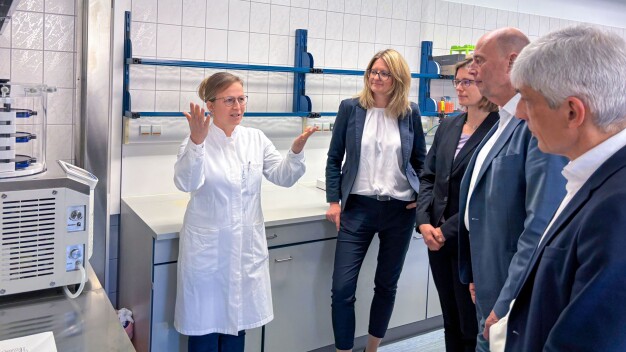
Forschende der Universität Jena und des Leibniz-Instituts für Photonische Technologien präsentieren Thüringens Wissenschaftsminister Wolfgang Tiefensee ihre Arbeiten an lichtbasierten Diagnoseverfahren für die Diagnostik von Infektionskrankheiten. (Bild: Leibniz-IPHT)

Thüringens Wissenschaftsminister Wolfgang Tiefensee, Dr. Karina Weber (Administrative Direktorin Leibniz-IPHT), Prof. Ute Neugebauer (Leibniz-IPHT und FSU Jena) sowie Dr. Thoralf Held, Kanzler der Friedrich-Schiller-Universität Jena (von links). (Bild: Leibniz-IPHT)
Über neue Technologien zur Weiterentwicklung biophotonischer und mikroskopischer Verfahren informierte sich Thüringens Wissenschaftsminister Wolfgang Tiefensee am 5. Dezember 2024 an der Friedrich-Schiller-Universität Jena und dem Leibniz-Institut für Photonische Technologien (Leibniz-IPHT). Das Land hatte die Anschaffung der hochmodernen Anlagen und Geräte im vergangenen Jahr mit 10,5 Millionen Euro aus Mitteln des Europäischen Fonds für regionale Entwicklung (EFRE) gefördert. Die neue Forschungsinfrastruktur wird von der Universität Jena mit dem Leibniz-IPHT genutzt. Damit sollen neue Forschungsschwerpunkte in Medizin, Pharmazie sowie Lebens- und Umweltwissenschaften erschlossen werden.
„Mit diesen Investitionen stärken wir Forschung und Entwicklung an der Schnittstelle von medizinischen und photonischen Technologien, die sich in den letzten Jahren zu einem echten Kompetenzschwerpunkt für Thüringen entwickelt hat“, erklärte Wissenschaftsminister Wolfgang Tiefensee bei der Übergabe. Die Förderung komme aber nicht nur der regionalen Wissenschaftslandschaft zugute, sondern schaffe auch die Basis für innovative neue Produkte und Verfahren und damit für eine höhere Wettbewerbsfähigkeit der Thüringer Biotechnologie- und Medizintechnikbranche.
Neue Geräte fördern interdisziplinäre Spitzenforschung
Unter den neu angeschafften Geräten sind ein kombiniertes Fluoreszenz- und Rasterkraftmikroskop (AFM), ein 3D-Nanodrucker sowie spektroskopische und mikroskopische Instrumente. Diese Infrastruktur unterstützt die Zusammenarbeit zwischen der Friedrich-Schiller-Universität Jena und dem Leibniz-IPHT und fördert interdisziplinäre Forschungsansätze. „Die EFRE-Förderung ermöglicht wichtige innovationspolitische Impulse für die Gesundheitsforschung und Digitalisierung, wie sie in der 'Roadmap für eine bessere Patientenversorgung' festgehalten sind. Gleichzeitig stärkt sie die universitären Profillinien LIGHT und LIFE und erhöht die nationale und internationale Sichtbarkeit Jenas als herausragenden Wissenschaftsstandort“, betonte Dr. Thoralf Held, Kanzler der Friedrich-Schiller-Universität Jena. „Diese moderne Infrastruktur ermöglicht es uns zudem, die erfolgreiche Zusammenarbeit zwischen Universität und außeruniversitären Forschungseinrichtungen in Thüringen weiterzuführen – insbesondere durch die gemeinsame Berufung von Professorinnen und Professoren, die wir seit Jahren erfolgreich umsetzen.“
Technologie für die Medizin der Zukunft
Ein Beispiel für die neu angeschafften Geräte ist ein Mikroskop, das Fluoreszenzmikroskopie mit Rasterkraftmikroskopie kombiniert. Es ermöglicht detaillierte Einblicke in biologische Prozesse – von der Analyse einzelner Zellen bis zur gezielten Manipulation von Nanopartikeln. Mit diesen Technologien können Forschende die Grundlagen von Infektionskrankheiten besser verstehen und neue Möglichkeiten für personalisierte Behandlungsstrategien entwickeln.
„Hochmoderne Technologien wie diese eröffnen neue Perspektiven für die biophotonische Forschung und deren Anwendung in der Medizin und den Lebenswissenschaften“, so Prof. Dr. Jürgen Popp, Lehrstuhlinhaber am Institut für Physikalische Chemie der Universität Jena und wissenschaftlicher Direktor des Leibniz-IPHT. „Sie ermöglichen es uns beispielsweise, die Dynamik biologischer Prozesse präzise zu erfassen und Innovationen in der Diagnostik und Therapie voranzutreiben. „Die erfolgreiche Umsetzung dieses gemeinsamen Projekts verdanken wir der engagierten Zusammenarbeit zwischen der Universität Jena, dem Leibniz-IPHT und dem Thüringer Wissenschaftsministerium.“
Wissenschaftliche Erkenntnisse und regionale Entwicklung
Die EFRE-Förderung ist Teil der Innovationsstrategie des Freistaats Thüringen und trägt zur Stärkung der regionalen Forschungsinfrastruktur sowie zur nationalen und internationalen Sichtbarkeit bei. Gleichzeitig fördert sie die Ausbildung talentierter Nachwuchsforschender und den Ausbau gesellschaftlich relevanter Forschung.
Leibniz-Institut für Photonische Technologien e. V.
07745 Jena
Germany